
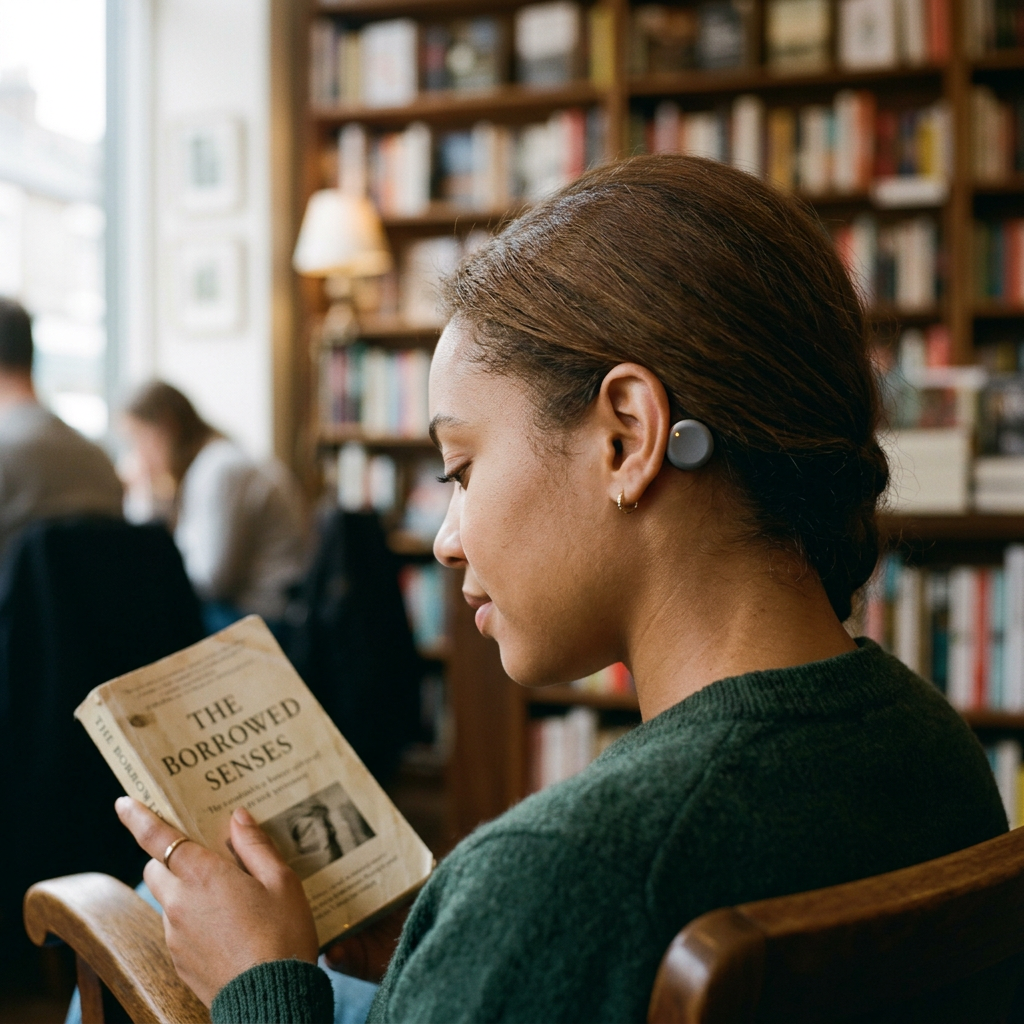
The disc behind my ear is smaller than a two-forint coin, and if I didn’t know it was there, I might never notice it at all. Cool against the skin, then warm once it’s switched on, and an hour later, when it comes off, it leaves a faint reddish circle I usually cover with foundation before heading to work at the bookshop.
My name is Nóra Fekete, I’m twenty-four, and for two years now I’ve been a “provider” for an app called Híd – Bridge – which is the official word for it, though in the early months I called myself a “conduit” instead, because it sounded less like I was selling off a piece of myself.
At the bookshop, where I spent most of my days, my boss, Marianna Sós, never found out what else I did in the evenings. I worked four days a week there, shelving returns in the back room, selling the latest bestsellers at the front counter to people who never once asked my name. The work was predictable, dull, but steady, and I liked it, because it never asked of me anything I didn’t want to give.
The idea behind Híd is simple, at least in the ad spots I first saw on the metro: someone pays to step out of their own body for an hour and feel, instead, as another person. Not mind-reading, not memories, just raw sensation – whatever the provider sees, hears, smells, tastes, touches, the renter lives too, in real time, through a palm-sized transmitter both of them wear behind the ear, above the temple. The company calls it a medical revolution: cancer patients getting their sense of taste back, the mobility-impaired feeling what it’s like to run, agoraphobics getting a sunlit square without ever opening their own front door.
Registration took one morning at the office near Blaha Lujza Square. Someone who looked like a nurse but wore street clothes took my blood pressure, drew a blood sample, and had me fill out a short questionnaire about sensory sensitivity. Afterward a technician fitted the disc for the first time, for a test cycle, and asked me to close my eyes and describe what I felt. Nothing dramatic – just a faint tingling at my temple, like holding a cold glass to your face for a minute. He said that was normal, and that the first few times it could feel strange to know someone was “there,” even if I couldn’t feel it directly.
I signed a stack of papers that morning – faster than I should have, because the waiting-room chair was uncomfortable and my impatience outweighed my caution. Among them was a short video narrated by a cheerful voice explaining that Híd “builds human connection where the body’s limits have been a wall,” and that every provider “freely, at their own pace” chose which categories to work in. A graph at the end, decorated with little stars, showed how much I could earn monthly at “average engagement,” and the number was high enough that I stopped paying attention to fine print the video never mentioned at all. Barta László wasn’t my coordinator yet then – just a voice in a training clip explaining that my first month would bring only “regeneration” and “mobility” jobs, while the system “learned my sensory profile.”
My first job was for Irén Vencel. She was sixty-seven, and three years of chemotherapy had left her unable to taste anything she ate – she said so herself, in the introductory video Híd sent new providers so we’d understand who we were working for, that everything tasted like a damp paper napkin, whatever she put in her mouth. The app matched us because my profile mentioned that I loved lángos, and because the market stall-holder on Fény Street knew my coordinator, Barta, who always sat in his coffee-stained shirt at the Híd office near Blaha Lujza Square, explaining everything as though he were selling an insurance policy.
I put on the disc, went to the market, ordered a lángos loaded with sour cream and cheese the way I always did, and sat down at a scuffed metal table at the edge of the market, where you could see the curve of the tracks leading into Nyugati station. While I ate, my phone buzzed with a message: “Renter connected.” I didn’t feel anything different. No voice in my head, no sense of a second mind sitting beside my own thoughts – I just ate, the way I always did, and an hour later, when the time was up, a message arrived: “Renter says thank you. Rating: five stars. Comment: I haven’t cried from joy in three years. I did today.”
I printed that comment out and carried it in my wallet for a while, like proof that what I was doing wasn’t shameful, but something closer to caregiving than to service.
Three weeks later Irén Vencel rented again, this time for a whole Sunday afternoon, and Barta suggested I not stop at lángos but try other things too – a slice of dobos torte at Gerbeaud, a cup of mulled wine at the Christmas market, anything rich and layered. I made the rounds of three pastry shops that afternoon, waiting a full minute after every bite before starting the next, because it felt like that slowness mattered, like whoever was on the other end of the line didn’t want to rush through something they’d gone without for so long. The feedback that evening was longer than the first: “The caramel layer in the dobos torte was like a childhood memory I didn’t know I still had.”
I started it for the money, I won’t dress that up. I’d dropped out of university two years before, when my father’s heart surgery ate through everything we’d saved, and after that there was never quite enough, only just enough. My bookshop salary covered rent and the barest groceries. Zsuzsa and I knew each other from the dorms, two years before I quit while she went on in communications, and when we ran into each other at a mutual friend’s birthday and she showed me what she made in a month with Híd – almost three times what I made at the shop – I didn’t think about it very hard.
The first weeks the jobs were simple and good. A man named Csaba, whom I never saw but pieced together from his comments, had lived in a wheelchair since an accident, and twice a month rented my senses to run with, along the paths of Margaret Island. I ran, and he – somewhere in an apartment I never saw – felt the fatigue building in my thighs, the cold air in my nose, the crunch of gravel under my soles. After the first time he wrote a long, flustered, grateful message saying he hadn’t run in eleven years, and now, even in a borrowed body, he had.
After a few months Csaba started writing longer messages – not just thanks, but small accounts of what his life had been before the accident: how he’d run competitively in university, how he and a girlfriend had planned to run the Budapest half marathon together before an inattentive truck put him in a wheelchair. I never expected him to tell me these things, but I was glad he did, because it made the whole arrangement feel less like a one-way transaction and more like lending a friend your own legs for an afternoon.
There was another renter, an older woman who booked a walking package every week, always at the same time, four in the afternoon, when the sun hit the City Park just right, and who never left a comment, only ever gave exactly five stars and a small heart emoji. Barta said she was agoraphobic, hadn’t left her flat in four years, and this was her only way of “going out” at all. Once, only once, she left a longer note – a street musician had been playing an old Hungarian song by the lake, and she wrote that it had been her wedding song, and that she hadn’t heard it live since her husband, who used to play it for her every anniversary, died two years earlier. From that day on, whenever I saw a street musician in the City Park, I always paused for a minute, wondering if she might be renting right then.
My third recurring renter was a young man I knew almost nothing about, except that he lived with a rare muscular condition and wanted to feel rain. He always booked when the weather app forecast it, which meant I sometimes got a Híd notification at five in the morning: job available, outdoor, low intensity, and had to go stand in the rain without an umbrella, face turned up to the sky, until my skin had felt enough. The first time I felt ridiculous, standing on the pavement outside my building at half past five in my pyjama coat while a neighbor walking his dog gave me a strange look. But the feedback said he hadn’t been out in rain in ten years, and that now, even through borrowed skin, he’d felt a drop run down his neck. After the second time I stopped feeling ridiculous, only cold, and after the third I bought a waterproof coat I kept just for those mornings, because I figured if I was going to keep doing this, I might as well not get pneumonia out of it.
These jobs were easy, because I knew what I was giving, and I felt I knew who I was giving it to. The contract – which I admit I only half read, the way no one reads the whole of a long legal document when they need the money – had a clause saying renters booked by category, and that a provider didn’t necessarily need to know which specific renter connected on a given occasion, only the category: “regeneration,” “mobility,” “sensory enrichment.” I assumed this was just privacy, protecting renter anonymity. I didn’t think through what it also meant: that I would never know who, exactly, was inside me.
The shift came slowly, not in one moment, more the way you notice a room’s temperature has changed without being able to say when it started.
The first odd thing was a category name: “urban walk – evening, intensity: low.” I asked Barta what “intensity” meant for an ordinary walk, and he said it was just an internal metric measuring how “experiential” an activity was for the renter – a museum stroll rated low, a mountain run rated high. It sounded logical. I accepted the evening walk because it paid well, nearly double a daytime one, and because I liked Erzsébet Boulevard at night, the lit shop windows, the light of the trams on the asphalt.
During those evening walks I started noticing something hard to put into words. Not a voice, not a presence the way ghosts work in films – more a faint, barely perceptible weight on my attention, as if someone were standing behind me in a room, and though I never turned around, my skin knew they were there. One evening, when I stopped in front of a shop window to look at a dress I couldn’t afford, that weight stretched, lingered, as though the renter had asked me to stay longer, to keep looking, though no one had said anything to me, no one could have – the app didn’t allow two-way live communication.
I asked another provider about it, a man in his sixties named Vilmos, whom I met in the Híd waiting room during my biannual medical review – also part of the contract, checking every six months that the disc wasn’t damaging the skin or the nervous system. Vilmos had been doing this ten years, since the first, bulkier, head-mounted version, back when the company wasn’t yet Híd but some short-lived startup that folded and got bought by a bigger investor. He said the resolution used to be worse, that you mostly felt colors and pressure, not tastes, and that the current system had gotten “too good” for people not to want to abuse it. He was a retired railway worker, had lost his wife nine years ago, and said Híd was the only reason he got up in the morning anymore, because at least someone needed what his body could still do. Yes, he said, he knew that weight I was describing, and it was better not to think about it too much, because the more attention you paid it, the more you felt it.
“Evening walks are the best-paying category outside the medical segment,” he said, and there was something in his voice I couldn’t place yet, a kind of tired resignation. “Because a lot of people request them. Mostly men. They say on the booking form they want ‘urban atmosphere,’ but if you look at which routes they prefer, it’s always the darker ones, the emptier ones.”
Sitting with us in the waiting room was a girl a few years younger than me, Bogi, who’d been listening and cut in to say she thought we were overthinking the whole thing. She preferred “sensory enrichment,” worked for foodie renters who wanted to experience expensive restaurant meals through her, and said her only complaint was that she’d gained weight, having to eat a full tasting menu three times a week for strangers’ entertainment. We laughed, and for a moment the mood in the waiting room lifted, but when Bogi left at the sound of her name from reception, Vilmos watched her go and said she’d only been doing this two months, hadn’t yet run into a renter who made her afraid of her own job, and that he hoped she never would.
I didn’t ask anything more, because I was afraid of the answer, and because I had a walk like that scheduled myself that evening – a roughly forty-minute route between Rákóczi Road and Horváth Mihály Square, which until then I’d considered a neutral, even pleasant assignment – and I didn’t want fear bleeding into whatever the renter was about to feel before I’d even set out.
The night that brought the crisis was in November, a Wednesday, walking from Rákóczi Road toward Horváth Mihály Square along the route the app had laid out – there was a feature that pre-assigned a route you had to follow, “for the consistency of the renter’s experience,” as the contract put it. The category this time was “urban walk – evening, intensity: medium,” and the pay was almost triple the usual, which I put down, at the time, to the renter having bought some kind of premium package.
The square was quiet, only a few lamps lit, one of them flickering where it was burning out, and the air was cold, cold enough that I could hear my own breath in my ears, which the disc was probably carrying through just as clearly as my footsteps. Two young men sat on a bench with beer cans but said nothing to me, and a woman walking a dog said hello as I passed. Nothing signaled that anything was about to happen. I was checking the time on my phone, wondering whether I’d make it to the square in the twelve minutes left on the job, when a man stepped out of a doorway and started after me. I didn’t scream. I quickened my pace, and so did he, and when I turned to face him – my instinct telling me it was better to see him than to run blind – he grabbed the strap of my bag. I shouted, wrenched at the bag, and somehow – I still don’t know exactly how – managed to kick his leg hard enough that he let go, and I ran, my heart in my throat, all the way to the door of the nearest open restaurant, where I stopped, shaking, and a waitress who looked at me brought a glass of water without my having to ask.
I wasn’t hurt. The bag was intact, so was my wallet, just a scraped knee from when I’d fallen for a second, and a long tear in my coat sleeve that I never mended, because every time I looked at it I remembered the whole evening and put on a different coat instead. But the disc had stayed on the entire time, and when I got home, took it off, and checked my phone with shaking hands, a message was waiting – not the usual automated “renter says thank you” format, but something more personal, longer: “Rarely do I get material this alive. Thank you for being so afraid. Five-star tip attached.”
The tip really was five times the usual amount.
I couldn’t sleep that night. Every time I closed my eyes I felt the man’s hand on my bag strap again, and my body reacted as if it had to live through those few seconds a second time, my heart racing, my palms sweating, until at some point I got up and switched on every light in the flat, because in the dark it was too easy to believe someone was still standing behind me, watching. My neighbor asked the next day if everything was alright, because she’d heard me pacing around two in the morning.
For days I couldn’t think about anything but that sentence. “Thank you for being so afraid.” Not “I’m sorry that happened,” not “I hope you’re okay” – thanks, the way you’d compliment a chef. I called Híd’s customer service, and a young woman who spoke like she was reading from a script told me the “intensity: medium” category could include “unexpected environmental factors,” that this was in the contract I’d signed, and that she was sorry I’d had a bad experience, but the company took no responsibility for “events” – she used the English word, “events,” as if it would sound too heavy in Hungarian – that the platform itself hadn’t generated.
I asked who the renter had been. She said she couldn’t share that, for privacy reasons. I asked whether this renter had booked similar “intensity: medium” walks on the same route with other providers before. A long silence on the line, then she said she wasn’t authorized to answer that either, but suggested I “flag” the renter if I didn’t want to be matched with them again – as if this were a dating app, and not someone who had lived through my own body being attacked.
I flagged him. I don’t know what that actually meant, because the system never confirmed the flagged renter could never connect to me again, only replied: “Your preferences have been noted.”
On another evening walk, in February, I nearly ran into Marianna, my boss from the shop, walking a dog on the Nagykörút. She saw me and was already raising her hand to wave, but I turned quickly toward a shop window as if looking at something, pretending not to notice. I don’t know if it worked, or if she simply didn’t want to intrude, but the whole way home I kept wondering what I’d have said if she’d stopped me and asked why I was walking alone, late at night, in some direction I hadn’t chosen, along a route that wasn’t mine to pick.
At my next biannual checkup, the dermatologist examining the skin around the disc noted mild inflammation behind my ear, and said it was more common in people wearing the device under “higher cortisol levels” – which she kindly translated herself as meaning people who took more stressful jobs. She prescribed a cream and suggested I try taking fewer “intense” jobs, as if that were as simple a decision as drinking less coffee. I thanked her for the advice, paid for the visit, and used the cream for months, but the inflammation never fully went away, just ebbed and flared, like some internal weather I didn’t control.
That’s when I started reading the contract again, start to finish, slowly, pencil in hand, underlining the sentences I’d skimmed past before. There was a clause on page fourteen I hadn’t even known existed, printed in smaller type than the rest, titled “Quality Assurance Consent” rather than anything that would have warned me it mattered. It said Híd could, “periodically, without prior notice, for quality assurance and safety purposes,” activate the disc “outside the hours designated in the contract,” and could use “anonymized samples” from this data “to improve the service.”
I didn’t think through what that meant in practice, until it happened to me.
In early December my father was taken back to hospital for a heart arrhythmia that might have been serious, might not; the doctors weren’t sure, and kept him for observation. I had a “regeneration” category job scheduled for that evening, low-risk, something as simple as cooking dinner, and the protocol required putting the disc on half an hour before the job began, so the system could “calibrate” the sensors before the renter connected. So I put the disc on before leaving for the hospital, calculating I’d be home in time for the job to start, and in the stairwell, before going in to see him, I sat down on the steps for a minute, because I couldn’t go any further without crying out something I’d been holding in all day. It didn’t take long, maybe two minutes, alone in the stairwell, and it never occurred to me that the “calibration window” the protocol mentioned could be anything other than an empty test signal nobody was watching.
Two days later a message arrived from the app, not in the usual job-notification format but under the “feedback” tab, where renters normally left their star ratings: “Thank you for the honest moment. 2,000 HUF credited to your account for quality assurance participation.”
I looked at the phone and didn’t know what to do with my fingers, because they were shaking, and not from the cold.
I called Híd’s customer service again, and this time I didn’t let the script steer the conversation. I asked how the disc could have activated on a Friday evening when I had no job scheduled. The woman – a different one, but equally well trained, equally patient – said the quality assurance protocol could include “randomized, brief activation windows” the system selected automatically to gather “real, non-staged data” on hardware stability, and that this was in the clause on page fourteen that I’d signed.
I asked whether a renter could connect during those windows.
A long silence. Then she said technically any active window could be “made available” to the quality assurance system, which could include a “limited number of premium-status renters” who had “consented to extended testing,” but that this was entirely anonymous, and there was no reason to believe anyone had specifically, deliberately connected to me at that moment.
I didn’t believe it. Not because I could prove otherwise, but because the credit amount – two thousand forints, exactly what a “regeneration” category, low-intensity job usually paid – fit too precisely with the idea that someone had actually “received” something during those two minutes I spent in the hospital stairwell.
A week later I went to the office in person, because the email reply had felt too smooth, too rehearsed, and I thought I might see something in Barta’s face a screen wouldn’t show. His shirt was coffee-stained as always, and when I sat down across from him, he looked at me kindly, interested at first, but the moment I started talking about the V774-K code, his expression shifted – defensive, half-closed, like a window someone was shutting from the inside.
“Nóra, I understand it was frightening,” he said, “but think about how many people we help. Mrs. Vencel got her sense of taste back. Csaba ran again after eleven years. This system needs renters who… want more intense experiences too, because they’re the ones paying the price that lets us fund discounted social packages for people who can’t afford full rate.”
“So you know what they’re looking for,” I said.
“We know which category they purchase,” he replied, and the emphasis on “category” was so delicate that I understood exactly what it meant: the company would never say out loud what these renters were actually after, because saying it would mean taking responsibility for it.
I didn’t tell Zsuzsa, the friend who’d gotten me into Híd, because she loved the work, because for her it really was just money, pleasant money earned without having to do anything she wouldn’t have done anyway – mostly “regeneration” and “mobility” jobs, running, gardening, sometimes a concert someone else “experienced” through her too. The one time I tried to bring the subject up, she just said not to think about it too much, “it’s just an app, Nóra, like any other,” and that if it bothered me this much, I should quit.
I didn’t tell my mother either, though for a different reason. She thinks I took on double shifts at the bookshop, and when she asked at a Sunday lunch where my new coat came from, I said I’d saved up for it out of my salary, and I saw the pride on her face, which hurt worse than suspicion would have. Once I almost told her everything, one evening when my father’s condition had taken a turn and we were both sitting in the hospital waiting room, but when I opened my mouth all that came out was “I’m tired, Mom,” and she took my hand and said she knew I was working hard, and that she was proud of me for standing by the family like this. I didn’t correct her.
A few days after the shock of the hospital stairwell, I called Kata, an old classmate who’d studied law, who might not be able to help but could at least understand the language the contract was written in. I told her about the calibration window, the hospital stairwell, the 2,000-forint credit. Kata was quiet for a long time, then said – and this was the frightening part – that there was in fact nothing legally actionable in what I’d described, because my consent was written into the contract, and it would be very hard for a private individual to prove “harm” from a use of data they’d formally agreed to.
“That doesn’t mean it’s right, though,” she added quickly, as if afraid the legal jargon might let the company off the hook even in my own head. “It just means the law hasn’t caught up to where the technology already is. Those are two different things.”
I asked what she’d do in my place. She was quiet for a long time before saying she didn’t know, because she’d never been in a position where she had to choose between rent and medicine, and that she felt ashamed giving advice so easily to someone facing a far harder decision than anything she’d ever faced on an exam. She suggested I write an email explicitly withdrawing my consent to the calibration and quality-assurance activations, because at least that would put my objection on paper. I wrote it. The reply was an automated confirmation, then, two weeks later, a human response saying the calibration window was “technically inseparable from the service’s basic functioning,” and that withdrawal was only possible by deleting the account entirely.
I didn’t delete my account. Looking back now, that’s the hardest sentence in this whole account to write, harder than any feedback I’ve ever read.
I couldn’t stop, though. My father’s hospital bills – because even with insurance, it didn’t cover everything, a costly medication he had to buy separately, a private room the doctor said would be better for him – demanded more money every month than the bookshop could cover. Híd’s money wasn’t a luxury anymore, it was a necessity, and the more I needed it, the less I could afford to choose among the jobs on offer.
I started tracking the patterns, keeping a separate notebook of rates and categories, like some accountant trying to put her own fears into a spreadsheet. A “regeneration” job paid an average of 4,500 forints an hour. A “mobility” job, 6,000. An “evening walk – low intensity,” 7,000; “medium,” 12,000; and when I was once offered a “high” category night walk in Józsefváros, the rate was 21,000 forints for a single hour – almost as much as I made in a full week at the shop. I also discovered that if I turned down one of these jobs, the system offered me fewer jobs overall the next day, as if punishing me for not being “flexible” enough – a word I found in Híd’s internal scoring guidelines, which Barta sent when I asked why I’d gotten fewer requests one month.
I tried limiting myself to the safe categories – “regeneration,” “mobility,” “sunlight” – but my income dropped by half, and my father’s medication didn’t get any cheaper to match.
I remember one afternoon at the pharmacy when the cashier said there wasn’t enough on my card for my father’s blood thinner, and I had to step aside and check my banking app while two people waited behind me. I put the box back, went to an ATM, transferred out what remained of a nearly empty savings account, and went back for the medicine. That evening I accepted an “intensity: medium” job I’d have turned down before – not because some conviction in me had changed, but because the calculator in my brain gave a different answer when a specific box of medicine outweighed an abstract fear.
That week in December, while he was held for observation, my father once asked where I’d gotten the money for the new, warmer coat I wore on the hospital’s unheated corridors. I said I’d picked up overtime at the shop, and he nodded, said he was proud of me for working this hard at my age, when – he’d heard – his friend’s daughter was still living off her parents. I held his hand, which felt thinner than I remembered it, and didn’t dare tell him the coat had been paid for by a job in which strangers rented out my skin, because I knew that a man who’d done physical labor his whole life, who held it as a matter of honor that you earned your bread with your own two hands, would never have understood why I let someone “sit inside me,” even for a few hours at a time.
In mid-January, Irén Vencel, my first renter, died. I didn’t hear it from her – we’d never spoken directly – only a formal, templated message from Híd informing me that “one of your previous renters has passed away, and the remaining balance of her rental account has been donated to charity.” I don’t know why it shook me as much as it did, since I’d never seen her face, only knew her from that first piece of feedback, the sentence about crying and the lángos. But all week I kept wondering what had become of the hour she’d spent with me, the taste she’d gotten back – whether moments like that stayed somewhere, or simply vanished, like a file nobody had saved.
February brought the second frightening incident, though not in the form of physical threat this time. I took an “evening walk – high intensity” job because my income was already critical, and this time the route wasn’t a street but a park – Népliget, which had a particularly bad reputation at night. Among the trees hardly a lamp was lit, the ground was muddy from February’s thaw, and every snapping branch, every distant dog bark sounded closer than it was. I walked, trying to move fast and purposeful, the way Vilmos had advised – “walk like you have somewhere to be, predators find that less interesting” – and nothing happened, no one came near, but the weight on my attention, that particular sense of presence, stayed there the whole time, tauter than ever before, as if the renter weren’t just watching but wanting something, and when I got home, took off the disc, and checked the message, all it said was: “Thank you. Next time too.”
“Next time too.” As if this were a series he’d subscribed to, and I was the next episode.
I didn’t sleep that night. I sat up in bed, staring at my phone, trying to work out whether “next time too” meant he knew when I’d take another job like this, or whether it was just an empty threat, a formula he wrote the same way to anyone he rented. I called Zsuzsa at three in the morning, woke her, and just told her I was scared, without being able to explain exactly what of, and she, half asleep, said to come over if I wanted, but by morning I was too exhausted to go anywhere, just lay in bed staring at the ceiling until it got light.
That’s when I decided to try to find out who this person was, or at least to try to keep from being matched with him again. Vilmos told me there was an unofficial forum providers used among themselves, a secret group on some messaging app Híd either didn’t know about or wouldn’t admit to knowing about, where providers shared renters’ identifying codes – because although you couldn’t learn their names, every renter had an internal code visible in the message headers, a string of letters and numbers you could cross-reference against other people’s experiences.
I joined the group – an outdated, sluggish messaging app nobody used for anything else anymore, precisely because Híd’s filters didn’t recognize its name – and searched for the code from the November and February messages: V774-K, the same both times. Seventeen other providers had already written about him, going back almost two years.
The first post I read was from a provider named Viola, who wrote that he’d requested “nighttime, more dangerous routes” from her too, and that she’d received two similarly personal thank-you messages – once when a dog barked at her and startled her, another time when an unfamiliar car pulled up slowly beside her and followed for several minutes before driving off. “I don’t know if he staged it or just got lucky,” Viola wrote, “but since then I’ve always felt like someone was waiting exactly for something bad to happen to me.”
A third commenter wrote that she’d once tried contacting a security researcher, hoping he could help work out how the same code kept returning to the same providers, but the researcher, after looking at Híd’s public documentation, only wrote back that the system “likely uses a learning algorithm for matching,” and that this alone didn’t prove anything malicious – only that the company knew exactly which renter would find what they were looking for in which provider.
Another post, from a young man named Dávid, said he’d quit working for Híd altogether, because this renter was “always there when something goes wrong,” and that he thought the system somehow knew in advance which routes would turn “live” and preferentially routed that code toward them. A third, unsigned post said only: “Don’t think that if you turn down the job, you’re rid of him. He just goes to someone else. Someone who maybe doesn’t read this group.”
I didn’t know how much to believe. Maybe it was just a desperate provider’s conspiracy theory, a pattern fear had drawn out of random data. But I couldn’t shake the thought that Híd’s system – which knew which routes had higher crime statistics, which knew when it got dark, which knew how many security cameras lined a given street – might price “intensity: medium” and “high” jobs at a premium precisely because it knew what these renters were paying for, and that it wasn’t in the company’s interest to ask why.
I wrote Barta a long email laying it all out: the November walk, the hospital stairwell, the February park, the V774-K code. Three days later he replied, briefly, formally, saying he had “forwarded the concerns raised to the appropriate department,” that “Híd is committed to provider safety,” and that if I no longer wanted “intensity: medium” or higher jobs, I could simply adjust my preferences in my profile.
I adjusted them. My income dropped again.
In early March I cut my shifts at the bookshop in half, realizing I couldn’t physically sustain both – the day job and the evening, “low-intensity” Híd work I’d restricted myself to – because both exhausted me, just differently: the shop took my body, Híd somehow took my attention, that capacity to be, for even one moment, only mine, only my own senses.
I started looking at people differently at the shop, too. A man buying a novel, indistinguishable from any other customer, suddenly gave me a look at the register that sent a chill down my back, and only afterward did I realize there was no reason for it, that he’d simply been impatiently waiting for his change. But the thought had entered my head once and refused to leave: that anyone standing near me in a queue might have rented an hour of me once before, heard my footsteps, felt my fear, and I would never know which one it had been.
Because that’s what I came to understand in those months: you can’t simply “switch off” the part of your brain that wants what you feel to be only yours, once you’ve known for two years that at any moment – even now, as I write this – someone else might be feeling exactly what you feel. Even without the disc, the sensation stayed, like a phantom ache, a weight at the edge of my attention, asking: are you sure you’re alone?
In April, Vilmos quit. He sent one last message before leaving the secret group too – he’d gotten an offer, a week earlier, for a category called “intimate moments,” then only being offered to a handful of selected providers, and when he asked his coordinator what exactly it meant, the man either didn’t know or wouldn’t say, only that “renters like it when someone doesn’t realize they’re being watched.” Vilmos deleted his account after that. He wrote he’d rather go a little hungry than keep not knowing who he was handing his body to each evening. I missed him in the waiting room, at the coffee machine before the biannual checkup, where we always bought the same bad coffee, and when I tried to reach him, his number was no longer in service.
Through all of this, I kept the sunny afternoon walks too, for the renter who never wrote anything but the heart emoji. One April afternoon, walking by the lake in the City Park, a family of ducks crossing right in front of me, I felt the attention behind my head grow warmer than usual, not taut, not demanding, more like someone sitting quietly beside you on a bench, simply watching what you watch. It was the only kind of presence I was never afraid of, and it sometimes made me think the fault wasn’t the technology itself, only that there was no way to sort who it fell into the hands of.
I never saw the V774-K code among my own messages again, but that didn’t put me at ease, because I knew it didn’t mean he’d disappeared, only that he’d moved on to another provider, and that somewhere, at this very moment, someone else might be afraid while he enjoyed it.
That same month I got feedback on an entirely ordinary “mobility” job – a morning bike ride on Margaret Island – in which the renter wrote: “Nice yellow coat, the one from your grandmother.” I’d never told anyone the coat had been my grandmother’s; she’d been dead eight years, and the coat was just an old, outdated thing I wore because it was warm and I couldn’t afford a new one. Maybe the renter had simply guessed, or heard it from another provider, or maybe the system had somehow accessed a part of my profile I’d never knowingly given it – but from that day on I read every piece of feedback twice, three times, searching for something they shouldn’t have known.
Late February brought another evening I wasn’t sure I’d been alone. I was on the phone with my ex, Áron, who’d broken up with me a year and a half before, and who sometimes, rarely, when he’d been drinking, called late at night to say how much he missed me. The disc was on that evening, because I’d finished a “mobility” job half an hour earlier and forgot to take it off, Áron’s call wiping everything else from my mind. I cried into the phone, said things I would never have said to anyone I knew was listening, and only the next morning, taking off the disc, did I see the display still read “active session: 41 minutes,” though I’d accepted no job that evening – and realized someone had listened to all of it.
In May, Barta messaged to say a new “premium” category had opened, one my profile made me “ideally suited” for: “intimate moments – compensation: elevated.” He didn’t describe what it meant, just sent a link to another consent form I had to sign before I could see the details.
I went back to the secret group and searched the phrase. Three posts, all recent, all vague. One provider wrote that according to the category description, the work consisted of “the renter connecting during ordinary moments of daily life when the provider doesn’t know they’re being watched,” which the company justified by saying “the most valuable sensory data is the unconscious, unperformed moment.” Another comment, Viola’s, asked whether this wasn’t exactly what Vilmos had described with the calibration windows, just now given a name and a price, legalized, wrapped in a word that sounded like a promise – “intimate” – when really it meant the company was admitting it had been watching unannounced moments all along, and was now just paying us to accept that knowledge.
Bogi’s name turned up in a fresh post in the group too – she’d gotten the offer as well, and signed, reasoning that “if they’re always watching somehow anyway, they might as well pay properly for it.” That sentence nagged at me for days, because there was a kind of logic in it I couldn’t simply declare wrong, even as it turned my stomach.
I called Zsuzsa that evening, planning at first just to mention the category lightly, to see if she’d gotten the offer too and gauge her interest from her voice. But the moment I explained what it meant – that the renter could connect during moments when I didn’t know I was being watched – Zsuzsa went quiet on the line, and when she spoke again, her voice was more careful than I’d ever heard it.
“I got that one too,” she said. “I didn’t sign it.”
It was the first time Zsuzsa had admitted something about this job unsettled her, and that frightened me more than anything, because she’d always been the one telling me not to think about it too much.
“Then why’d they send it to me?” I asked.
“I guess because you need the money more than I do,” she said, and there was no mockery in it, no reproach, just a plain, raw truth that made my stomach hurt worse.
I put the phone down and sat a long time at the kitchen table, the consent form still open and unsigned on the laptop screen, looking at the disc resting empty and switched off on the table like a small cold pebble. I tried to tally up how long until the next medicine bill, how long until rent, how many more shifts I could pick up at the shop without collapsing, and how much longer that part of me could bear asking, every night, whether I was really alone when I closed my eyes.
I sat back down and, under the kitchen light, read the consent form again, not to understand the legal language this time, just to put off the moment I had to decide. I thought of Irén Vencel, the caramel layer of the dobos torte she said was like a childhood memory she hadn’t known she still had. I thought of Csaba, running again after eleven years. I thought of the sunny afternoon woman’s heart emoji. And I thought of the V774-K code, the man’s hand on my bag strap, the hospital stairwell, Vilmos’s dead phone number.
I couldn’t separate the two sides cleanly enough to keep one and let go of the other. The system wasn’t built to let you pick and choose – the only question was how much I was willing to tolerate of what I couldn’t see, for the sake of what I could. I got up from the table, went into the bathroom, and stood a long time looking at myself in the mirror, as if the answer I couldn’t find in my head might be found on my face.
The next morning, before coffee, still half asleep, I signed anyway, a quick, trembling motion, before I could change my mind again. The disc sat behind my ear all day, cool, then warming, and that evening, bent over the sink with a plate in my hand, the same ordinary motion I’d made a thousand times before, I felt that weight settle at the edge of my attention again, meaning someone had connected, and I didn’t know how long they’d been there, or for how much longer, and for the first time since I’d started this work, I didn’t look up at my phone to find out who.
I set the plate in the rack, and my hand paused in the air for a moment, as if someone else were curious too about this gesture, this nothing, a clean plate in an evening kitchen. Maybe it was just a lonely person on the other end who had no other way of not being alone in a room. Maybe it was someone looking for exactly the kind of attention in me that makes the skin go cold underneath. I couldn’t tell the difference between the two, and that was the thing Híd had never promised me: that one day I would no longer be able to tell the people who wanted to heal through me apart from the ones who wanted something else, something that didn’t even have a name yet.
When I finally took the disc off, I looked in the mirror at the faint reddish circle behind my ear, the same one I check after every job, two years running now, and this time, for the first time, I couldn’t say whose touch had left it there.





Leave a Reply