
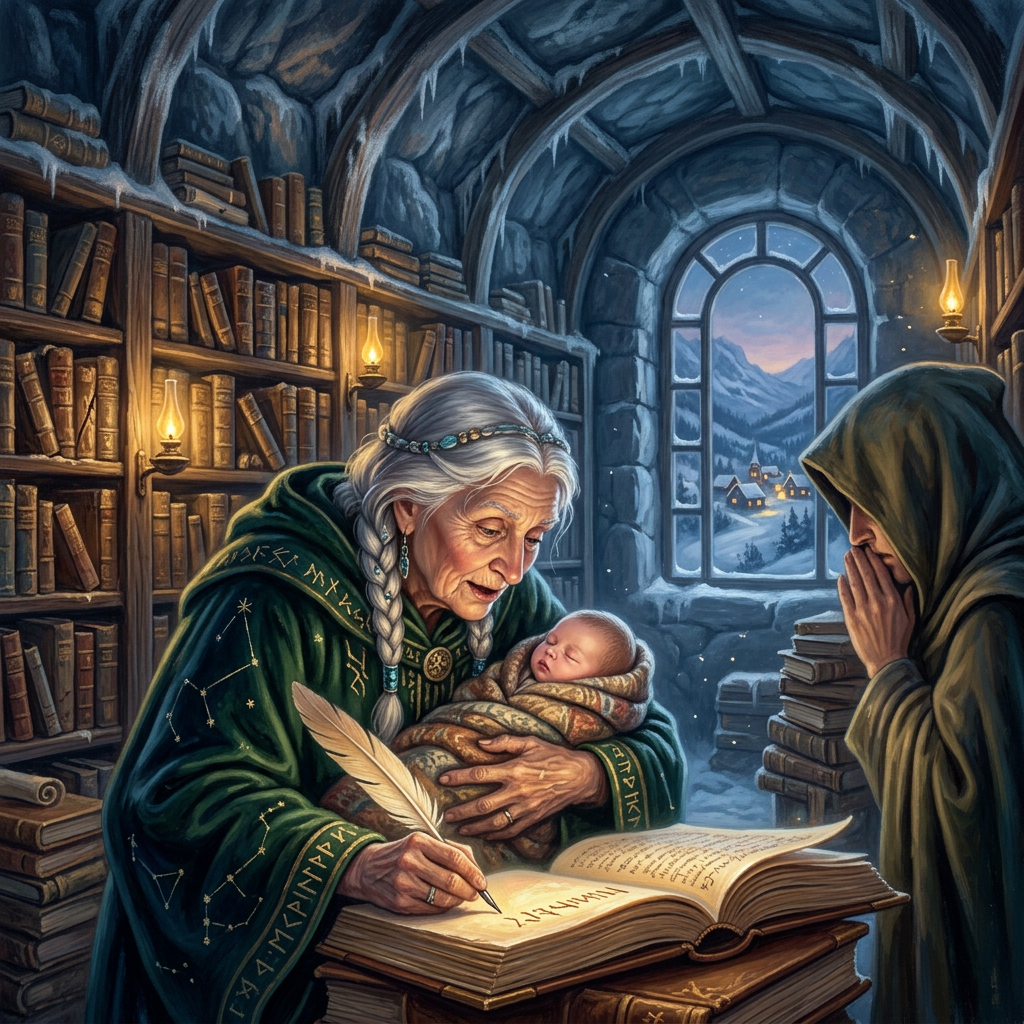
They say that in Frostvale every person carries two names. Everyone knows the first: it is the name called across the yard when a child tumbles out of a tree, the name used to summon a young man at the spinning circle, the name carved into the church beam’s tally of the dead. The second name is known, at any given time, to only one living soul: the Keeper of Names. That name is given in a whisper, a few days after birth, and from that moment on it is the person’s true name — the one in which their fate lives, the one that holds them together when everything else lets go.
They say that back when the village was not yet called Frostvale, but simply the Village Under the Hill, a woman went from house to house and chose which name belonged to which child. She did not consult paper, nor the moon, nor the stars alone — she studied the child itself: its crying, the motion of its hands, the way it drew its very first breath. She said every child already carries its name inside it, and all one has to do is listen closely enough to hear it, the way a person presses an ear to a tree trunk to hear which way the sap is running. She was the first Keeper, and after her came her daughter, and her daughter’s daughter, in an unbroken line, all the way down to Zsófia of the Still House, with whom this story truly begins.
Frostvale was not large in those days — a few dozen houses crouched along both banks of Raven’s Brook, ringed by grain fields and an old, dense forest whose edge the children never crossed after dark. The village grew slowly, and its names multiplied with it, until it became harder and harder to hold them all in a single head, but the line of the Still House always found a way to manage, because — as they used to say — “a village is only a village for as long as everyone knows who everyone else is, clear down to the bone.”
The family’s name, Still, had come from the office, not from blood. They say the first Keeper had once been called Anna Black, but she kept her secrets in such silence, never once letting slip a word of what she knew, that the village simply started calling her Still, and the name stuck to her descendants too, even to those who married into other family names. Husbands came and went with the marriages, but the Still line always endured, because the office could only pass down through a daughter — a daughter by blood, or a chosen daughter whom the Keeper herself selected and trained, if she bore no child of her own, or if that child could not carry the weight.
The rules of the office were simple, but strict, and no one dared break them, because everyone knew the story of what happened to those who did.
A true name could be spoken aloud only three times in a person’s life. First at the naming, when the Keeper whispered it into the infant’s ear at the Whispering Stone, that flat rock leaning out over the river, chosen by the very first Keeper because there, she said, the water’s rushing swallowed the sound before the wind could carry it elsewhere. Second, on the night of the wedding, when a person murmured it to their chosen partner, as proof that no one else would ever be trusted so deeply. And third, on the deathbed, when the Keeper — or, if she no longer lived, her successor — bent low over the dying and listened as the person spoke themselves for the last time, before giving their name back to the earth, so that it might, a generation or two later, once no one remembered whose it had been, be given to someone else.
For names never ran out. There was a pool of them — called the resting names — which returned ten, twenty, sometimes fifty years after a death, to new children, the way a field left fallow returns to clover. It fell to the Keeper to remember which name was “resting” and which might wake again.
They tell of a time, in the days of Zsófia’s grandmother, when a name rested forty-two years before waking in a girl the village knew as Young Rose. The grandmother, deep in the listening-silence, suddenly saw an old face rise before her — a woman dead four decades, whose name had fit no newborn since. “When a name comes back,” she told her apprentice afterward, “it can feel as though an old acquaintance has walked in wearing a different face. Don’t let it frighten you. The name doesn’t carry its former bearer’s fate — only its shape, the way a coat fits well enough on whoever next wears it.” Young Rose grew up and married into a distant village, never knowing her name had waited forty-two years inside an old woman’s memory.
But the most important rule was this: a Keeper must never carry everything alone. So that there would always be someone able to carry on in case of trouble, every child, when given its name, was also given a small fragment of it — not the name itself, just a sound, a syllable, a rhyme, which the person might later, by listening closely enough to themselves, use to find the direction home. This was called the echo-syllable. It was never enough on its own for someone to guess their own true name — but it was enough for a Keeper, should she ever need it, to know where to begin looking.
They also say that whoever lost their name — because the Keeper died before she could pass it on, because it was stolen in some wicked exchange of words, or because the Keeper herself forgot it in her old age — that person began, slowly, to drift. Not at once. At first it was only bad luck: a stumble where one never used to stumble, milk souring in the jug for no reason, dogs barking at someone they used to nuzzle. Then came the forgetting — not the forgetting of ordinary things, but something deeper: forgetting why they loved what they loved, forgetting their mother’s voice, forgetting, at the end, whether they had ever been glad of anything at all. The villagers said such a person “went nameless” — as though a house were being slowly emptied of its furniture, and then its walls, until nothing remained but a bare lot where something had once stood.
*
The greatest misfortune the village remembered had happened three generations before Zsófia, and is still called the Lost Year.
The Keeper then was Ilona of the Still House, strong, healthy, barely past forty, and no one thought she needed to hurry with naming her successor. She had a niece she had begun teaching, but slowly, unhurriedly, because — Ilona said — “names don’t run off anywhere, there’s time.” One summer evening, when Raven’s Brook rose in flood, Ilona crossed the old ford to reach a sick child, and the water swept her away. They found her three days later on a gravel bar downstream, and with her went everything she had carried in her head that had not yet passed to her niece.
Eleven people’s names were never fully recovered. Among them was an old man, Imre Carter, who had been the finest wheelwright in the village for sixty years, and whom every child had once known, because he carved them clacking sticks every autumn. Imre’s name was among the eleven lost, and from that day he moved through the village as though no one saw him — though they did see him; it was he who felt otherwise, more and more, until, terribly, his feeling became true: people began forgetting to greet him, forgetting which house was his, and once a child who had been a mere infant when Imre was his father’s closest friend looked at the old man in the marketplace and asked his mother, “Who is that?” From then on Imre spoke less and less, came out of his house more and more rarely, and when he died four years later, barely a handful of people stood around his grave — not because he had been unloved, but because it simply never occurred to anyone that they ought to go.
There was also a woman, Veronka Beetle, barely twenty, when she lost her name. One day, mid-hoeing, she set down her hoe at the end of the row, took off her headscarf, and hung it on a branch, as if she only meant to rest a while — and then she walked toward the forest, and never came back. The village searched for days, combed the length of Raven’s Brook, even checked the neighboring village’s market in case she had wandered that way, but they found only her headscarf, hanging where she had left it, unraveling in the wind. Afterward it was said that Veronka had gone into the forest because she was searching somewhere for her own name, like someone who has lost their key and keeps searching until they find some other door that will still let them in — and that perhaps, deep in the forest, where other laws rule among the trees, she had hoped to find what the village could no longer give back to her.
After Veronka’s disappearance, the village adopted another custom, still kept to this day: on the last night of every year, called the Night of Names, the villagers gather before the church, light a fire, and one by one speak their everyday names aloud, facing the flames, as if to say: here I am, do not forget me. It does not replace the true name, but the village holds that it reminds people of each other, and reminds the fire of them too, in case the fire keeps its own count of who still lives among the houses.
After the Lost Year, the village and the line of Keepers changed their customs. From then on every Keeper had to name at least one successor by the time she turned thirty, whether a daughter by blood or by choice. From then on they also instituted the seventh-year renewal: every seventh year, around Michaelmas, the Keeper and her apprentice walked out together to the Whispering Stone and went through the names of everyone facing greater danger that year — those going off to war, those expecting a sickly child, those setting out on a long journey — so that if anything happened, the knowledge would already live in two heads, not just one.
This was the order that Zsófia of the Still House inherited, and which she followed faithfully, right up until the day her own mind began to betray her.
*
Even before her own trouble began, Zsófia had learned a great deal about how hard it can sometimes be to hear a name. She had heard the story from her mother, Erzsébet of the Still House, and later told it to Panna, back when the girl was still a new apprentice.
In Erzsébet’s time, a child was born deaf, and many in the village thought such a child had no need of a true name at all, since it would never hear it spoken — what good was the secret then? Erzsébet refused this. “A name isn’t given to enter through the ear,” she told the child’s mother. “It’s given to enter a fate. The ear is only the door it usually comes through — if that door is elsewhere, then that door must be found.”
She sat beside the infant for three days without speaking, watching instead how it responded to light, to warm and cold water, how it stroked its hand along the swaddling’s edge. On the third evening, when the child’s hand brushed its mother’s face and rested there, as if trying to hear something through skin, Erzsébet found the name — and instead of whispering it, wrote it into the child’s palm with her fingertip, letter by letter, while the child watched with open eyes. It was the first time a Keeper had given a name by any means but the traditional one, and when she told her own mother, the woman found it strange at first, but came to see that the rule’s true heart was attention, not the ear — and attention could travel by many roads.
Zsófia always told this story whenever someone asked her how she knew which name fit which child. “I don’t find it,” she would say, “because I have some special gift for it. I find it because I learned to pay attention where others would only look. My mother taught me that, and she learned it from hers.” Panna took the lesson to heart, and years later, when her own turn came to teach, she passed the very same story on to Eszti.
*
Zsófia was seventy-eight years old when this story begins, and had held the office for fifty-three years. She had taken it from her mother, Erzsébet of the Still House, who died of a winter fever — but fortunately, or rather carefully, Erzsébet had already passed on everything Zsófia needed to know, years earlier, and the transfer had gone properly, by the rules, not the way it had gone with Ilona.
Zsófia had an apprentice: Panna, a seventeen-year-old girl, not chosen by blood but because, at the age of ten, when another child lost her kitten, Panna had spent an entire afternoon searching for it and refused to give up until it was found, even though the kitten was not even hers. Zsófia told the girl’s mother at the time, “There is room in this child’s heart for other people. That is what matters, not blood.” She had been teaching her for five years now, and Panna had slowly, gradually received the names of part of the village — the names of those whose lives carried no particular danger, whose affairs were in order, because Zsófia believed the harder, more complicated ones should wait until the girl’s hand was surer.
The ceremony of transfer was simple but solemn: Zsófia and Panna would walk out to the Whispering Stone, and if the person in question was also present — for certain names could only be passed on if the bearer themselves stood there, giving consent through their silence — Zsófia, standing on one side of the stone, would speak the name into Panna’s ear, while the river’s rush, as always, swallowed the word from every other ear. Afterward Panna would repeat it silently to herself three times, mouthing it without sound, so that her body would learn it too, not only her mind.
In the years this story concerns, the village’s life kept weaving itself around its names, as it always had. One winter a young man, Mátyás Balogh, went off to be a soldier, and before he left, Zsófia and Panna took him out to the Whispering Stone, so that, following the seventh-year renewal, his name would lodge in both their heads — for going to war is great danger, and if a man dies far from home, it is well that at least two people here still know who he truly was. On another occasion, before a young couple’s wedding, Zsófia reminded the groom of the rule: on the wedding night, once the guests had fallen asleep, he was to whisper his true name to his bride, and at no other time, and to no one else, ever. The groom, a blacksmith’s apprentice named Vince, trembled as he spoke of it, saying, “I feel as though I’m handing over my own skin.” Zsófia only nodded. “You are,” she said. “That’s the whole point.”
Not everyone accepted easily that such a young girl should be entrusted with their most guarded secrets. An old shepherd, Vendel Kelemen, told Zsófia flatly he did not trust Panna: “How can a girl who doesn’t even know herself yet guard a stranger’s fate?” Zsófia only said, “Then wait, Vendel, until you’re convinced yourself.” Vendel put off giving Panna his name for three years, always finding an excuse, but one winter, gravely ill and believing he was dying, he sent for Panna, not Zsófia, because by then he had seen how patiently, attentively she treated everyone. “You’ve changed my mind,” he told her, weakly but clearly, and gave her his name at last. He recovered, lived another ten years, and never regretted the trust he had placed in her.
There was another case that same year, which showed even more clearly what the third speaking was for. Erzsók Farmer, an elderly widow long ill, sent for Zsófia one autumn night, sensing her time was near. Zsófia brought Panna along too, believing the girl needed to see how it was done before the day she would have to do it alone.
They sat beside Erzsók’s bed, and the old woman, though her body could barely move, had eyes that were clear and watchful. “The time is close,” Zsófia said softly, taking her hand. “When you’re ready, speak yourself, and I will listen, so I may give your name back to the earth.”
Erzsók nodded and closed her eyes, and for long minutes the room held only the candle’s crackle. At last her lips moved, shaping a word so quietly that only Zsófia, leaning close, could hear it. When she finished, she exhaled a deep sigh, and something eased in her face, as though she had finally set down a burden carried her whole life.
“She is free now,” Zsófia told Panna as they stepped out into the cold night. “That is the whole point of the third speaking. It isn’t so that we learn the name — we are only witnesses. It is so that the person themselves, one last time, can say who they truly were, before they go. That is the one gift only we can truly give: the ear that listens all the way through.”
Panna did not yet understand the full weight of those words. Only months later, when Zsófia herself lay on her deathbed, did she come to see how right the old woman had been.
*
The trouble began in small ways, as trouble usually does.
The previous spring, not long before this story truly begins, a young cooper named Gáspár Kádár and his wife, Teréz, were expecting a son. The boy was born at the end of spring, on a rainy, windy night, when the thunder shook the houses so hard the roof tiles rattled like bells. Zsófia was already more tired than usual by then, for that winter had been hard on her — a feverish illness had laid her low for a week, and though she rose from it, something seemed to have stayed behind, a weariness that would not pass.
The naming took place, as custom demanded, a few days after the birth. Teréz carried the baby to the Whispering Stone and stood there while Zsófia took the infant into her arms and studied his face at length, listened to his crying, watched his little fist close and then open again. At such moments Zsófia always sank into a kind of stillness the village called the listening, in which — they said — the name rose to the surface like a fish coming up for air.
But that night Zsófia’s listening went on longer than usual. Teréz, later, once everything had taken on far greater weight, tried to recall every detail of that night: the rain drumming on the roof, a dog barking somewhere in the distance, and Zsófia humming softly all the while, an old tune Teréz did not recognize but found strangely beautiful. At last Zsófia whispered the name into the infant’s ear — Teréz could not hear it, since the river’s rush, as always, swallowed it — and then spoke the everyday name the village would come to know him by: “Call him Berci.”
She gave the echo-syllable too, as always, but this time Teréz found something odd about it: instead of a single sound or syllable, Zsófia hummed a short string of notes into the child’s ear, saying, “Keep this for him, Teréz, in case he ever asks for it.”
No one thought anything of it at the time. Berci grew into a sweet, healthy, cheerful little boy, quick to smile, beloved by the whole street, because he always went to sit with the old folk and talk, as though he knew they liked having someone listen to them.
*
But something in Zsófia had changed since that night, and it only became clear slowly.
At first they were small things. She forgot where she had hung her apron, though for fifty years she had always hung it on the same hook. Once she told Panna the same story twice in a single afternoon, word for word, with the exact same turns of phrase, as though hearing her own voice tell it for the first time. One day at the market she set off toward home but turned the wrong way, and only came to herself when she found she had reached the mill, where she never went.
Panna noticed, but did not want to believe what she was seeing. The village elders spoke of it quietly among themselves, the way people speak of aging: “Well, Zsófia’s getting old too,” they said, and gave it no more thought.
But one day, in early autumn, when Berci had just turned two and was learning to run while laughing at the same time, Zsófia sat alone in her house, trying to think through whose names she still needed to pass on to Panna that year — for the seventh-year renewal was coming soon, and she had to draw up the list of those whose fate stood in particular danger that season.
And then, when her thoughts reached Berci’s name, she found emptiness.
Not quite emptiness — more as though a word sat on the tip of her tongue, that feeling of knowing for certain that you know something, yet being unable to reach it. Zsófia tried to recall the night itself: the rain, the thunder, Teréz’s face, the weight of the infant in her arms. All of this she saw clearly. But when she turned her thoughts to the sound she had whispered into the child’s ear, she found only a smudge, like someone looking at a window fogged over by their own breath.
At first she told herself she was only tired. She lay down, slept a little, and when she woke, tried again. Nothing.
Only then did real fear take hold — not the fear of someone who has lost an object, but the fear of someone who realizes that their own hand no longer moves the way it used to, and that it will not come back on its own.
*
Zsófia told no one for a full week. She thought perhaps it was only a matter of time, that some night, in sleep, her own mind would set right what it had lost. But by the end of that week, when Berci stumbled one afternoon on his own two feet in front of the house, though he had always run nimbly before, and afterward would barely come outside for two days because “something was squeezing his throat,” as Teréz put it, Zsófia understood she could wait no longer.
She called Panna in, sat her down at the table, and told her plainly, as a Keeper should, even with her heart trembling inside her: “I have forgotten Berci’s name.”
At first Panna did not grasp how serious this was. “Well, you’ll find it again,” she said, “the same way you gave it.”
Zsófia shook her head. “A name cannot be invented, Panna. A name must be found, because it was already there in the child when he was born, and I only heard it. If I invent one now, it will be false, and a false name is worse than none at all, because the person believes they have it, while in truth they are losing themselves more and more under a stranger’s word.”
She showed Panna what she still had: the tune she had hummed that night — for she remembered that much, at least a fragment of the melody — the rain, the thunder, the echo-syllable she had given Teréz. “This is where we start,” Zsófia said. “Like tracking a trail. Names don’t come out of thin air. They come from somewhere: from a sound, a memory, something that was in me that evening. If we find where it came from, perhaps we’ll find the name itself.”
*
So began the search the village still speaks of today, though at the time only a few knew what was truly happening.
First they went to Teréz, and questioned her closely about everything she remembered of that night. Teréz listed it all: the rain, the dog barking, the tune Zsófia had hummed. She tried humming it herself, but could only recall a few notes, because she had not been paying attention the way she now wished she had — who could have guessed that this would one day become the most important thing she had heard that night?
Zsófia listened to the fragmentary tune and tried to place where she knew it from. “This isn’t a new melody,” she said at last. “I carried this from somewhere. Perhaps I heard it from my mother, or from hers — these are old songs the women of the Still House hum when they are thinking.”
Panna asked whether she remembered whose name this tune had once belonged to — for if this was the waking of a resting name, then once, long ago, it might have belonged to some other child.
It was a good thought, but a hard road to follow. Zsófia could keep no old records, for names could never be put to paper — this was the oldest rule of all, because a name written on paper could be stolen, could be read by the wrong mouth, could be lost in a single moment to a house fire, while a name kept in a head could only be taken if the whole head were taken with it. So everything Zsófia knew of the resting names lived only in her own memory, and now, just as that memory had begun to falter, this source too had grown uncertain.
Still, day after day, she and Panna sat together at the Whispering Stone, and Zsófia went, one by one, through the old names she knew: those that had once belonged to some long-dead soul at the village’s edge, and had since been “resting.” She spoke each one quietly in turn, testing whether it fit the tune, whether it fit Berci — his smile, his running, the way he talked with the old folk.
None of them truly fit. Zsófia grew more and more discouraged, and Panna could see that the search itself was wearing her down, as though every failed attempt knocked loose another small piece of her memory.
One rainy afternoon, when their patience was beginning to run thin, Panna tried a new idea: if words would not come, perhaps the body remembered what the mind could not. They went back to the Whispering Stone, and Teréz came with them, carrying a cradle-pillow wrapped in swaddling to stand exactly as she had stood that night. Zsófia stepped into the same place she had stood then, and Panna even tried to recreate the rain, slowly pouring a bucket of water into a gutter spout so the trickling would resemble that evening’s storm.
Zsófia closed her eyes and let her body remember: her arm bent the same way it had then, her weight leaning the same way onto her left hip. “I can feel the rhythm,” she said quietly. “The thunder struck four times before I began. Four, and then I started humming.” This alone did not bring back the word, but it brought back something of the mood, the beat in which the name had been born, and from that attempt on Zsófia remembered the tune’s rhythm far more surely — which later, when Teréz and Berci unknowingly carried it further, would prove the key. “The word doesn’t always come back first,” Zsófia told Panna that evening, tired but with a small flicker of hope. “Sometimes the body remembers first, and the word follows after, like a child who has fallen behind the procession but still knows which way to run to catch up with the others.”
*
Meanwhile, more and more small misfortunes befell Berci, and the village began to notice, though no one knew what to make of it.
The bees, which never troubled children otherwise, stung Berci three times in a row one day, while his sister stood beside him untouched. In the river, where the children liked to catch minnows with their bare hands, the fish always slipped from Berci’s grasp, however deftly he reached for them, while the others succeeded easily. One night he had a bad dream and told his mother he had dreamed of “a big, empty house,” in which “someone just keeps carrying the furniture out, and I don’t know whose house it is.”
Teréz told this to Zsófia, and Zsófia’s hand shook as she heard it. “This is the beginning,” she said. “This is exactly how it was in the Lost Year. First only bad luck, then the dreams, then—” She did not finish the sentence, and did not need to.
Gáspár, the father, learned the truth at last — until then Teréz and Zsófia had not wanted to frighten him, but it could no longer be hidden. At first he was furious. “How could you forget my son’s name?” he shouted, his voice breaking, for he knew this was not the kind of anger that could lead anywhere good. Zsófia did not argue with him. “You’re right to be angry,” she said quietly. “But anger brings nothing back. Help me instead: tell me everything you remember from that evening, however small it may seem.”
Gáspár thought, and then something occurred to him that he had never thought important before: that before Teréz set out for the Whispering Stone with the child, he, standing at the edge of the bed, had said to his wife, “Look at the sky — just like the forge fire.” For the clouds before the rain had been a reddish black, like embers in a smith’s furnace. Zsófia’s head snapped up at this. “The fire,” she said. “Yes — I remember now, I was thinking of fire that night, of the furnace, something of that kind. But why?”
The trail, however, could not be followed at once, and Panna, in her impatience, went to find Zsuzsánna Tóth, the oldest woman in the village, who had lived through the Lost Year as a child, and whose memory might still hold something of the old resting names that Zsófia had perhaps forgotten. Zsuzsánna, nearly ninety but still sharp of mind, sat by her hearth and heard Panna out, then was silent a long while before answering.
“Names bound to fire,” she said at last, “those used to come from the Smith line, because that’s where the village’s largest furnace always burned. But I don’t remember exactly which name it was — only that there was one that wasn’t passed on for decades, because the man who bore it did something terrible with it — a smith who used fire for the wrong purpose, and the village decided that name needed to rest until his deeds were forgotten.” This was an unsettling thought: what if Zsófia had found exactly such a name, one better left resting longer? But Zsófia, hearing this, shook her head. “Not every memory bound to fire is bad,” she said. “Fire gives life too, not only ruin. I don’t think that’s the line.” Still, the uncertainty halted the search for a time, since they did not want to go the wrong way, and for weeks they tried other names, running through everything Zsófia still remembered from the old resting list, but none of them fit.
Meanwhile, rumors began spreading. Some said Zsófia should have handed the office to Panna long ago, that her aging mind now only put children at risk. A sharp-tongued farmer named Ferenc Molnár declared at the tavern that “once a Keeper forgets a name, she’s no Keeper anymore, just an old woman who still believes herself one.” Panna wanted to snap back, but Zsófia waved her off. “Let them talk. Fear is always louder than hope, but you don’t have to answer every voice. We’re working, not arguing.”
But the strain showed itself in more than words alone. One evening, nearly a month into the search, Berci, growing ever more restless, slipped out of the house after sunset while Teréz was bathing his younger sibling. By the time they noticed he was missing from the room, dusk had deepened well into dark, and Teréz, crying out his name in terror — his everyday name, for what else could she have cried — ran out into the street. Neighbors joined the search with lanterns, and everyone arrived, unspoken, at the same frightened thought: Veronka, who had vanished just as suddenly once, and never returned.
They found Berci at last at the edge of the village, beneath the old pear tree at the forest’s border, sitting and stroking the bark in the dark. When asked why he had come there, he only said, “I didn’t know where to go. It was like my feet knew, but I didn’t.” Teréz swept him into her arms, weeping, but Zsófia, who had come to join the search too, leaning on her cane, slowly, simply stood for a moment, looking at the boy beneath the tree, and thought: there is no more time to hesitate. This sign had come too close to what they told of Veronka.
From that evening on, Zsófia and Panna set aside everything else and gave themselves wholly to the search, day after day, with growing urgency.
The village elders also gathered one evening at the magistrate’s house, for the news had reached everyone, and many feared the trouble would not stop with Berci. Someone suggested bringing in a stranger name-finder from a neighboring region. Gáspár, in his desperation, was half inclined to agree, but the magistrate, a calm old man named Péter Deák, shook his head.
“A stranger cannot hear Berci’s name,” he said, “because hearing isn’t only in the ear — it’s in the responsibility too. Zsófia and Panna can hear it because they carry the weight of every name here, generation after generation. A stranger owes us nothing, and a name found without that weight is nothing more than a clever guess — and a false name, as Zsófia says, is worse than none.” The meeting decided to wait, but to help however it could: every family present at the naming went to Zsófia to share whatever they remembered, in case some small forgotten detail might finally fall into place.
It was this decision that let Gáspár share his memory of the forge fire, and let Zsuzsánna Tóth bring up the old story of the Smith line — for if the village had not stood behind Zsófia and Panna as one body, they might never have reached the tune that, in the end, changed everything.
*
The answer, in the end, came not from any search, but from chance — or, as Zsófia put it afterward, “not chance, just the kind of thing you cannot find by force, only let find you.”
One afternoon, perhaps three weeks into the search, Teréz was working in front of the house, humming to herself, while Berci sat on the ground playing with pebbles. The tune Teréz hummed was the very one Zsófia had hummed on the night of the naming — for Teréz, without knowing why, had heard those few notes so many times over the past two years that she had unconsciously taken them up herself, and had been humming them ever since whenever she rocked Berci to sleep.
And Berci, playing with his pebbles, suddenly stopped what he was doing, looked up, and joined the tune — not with words, only with a string of notes he made up himself, as though his body knew what belonged there, even though his mind did not.
Zsófia happened to be passing just then, leaning on her cane, for walking had grown hard for her, and she heard the two melodies weave together. She stopped. Her feet rooted to the ground. For when Berci’s voice joined Teréz’s tune, a completion was born, a string of notes that in Zsófia’s mind was, at last, no longer a smudge, but a shape.
She went to them, sat down beside Berci on the ground — which pained her hip, though it did not matter — and, very quietly, so that only the child could hear, spoke a name aloud, as a test. Berci looked up at her and smiled, a smile Zsófia had never seen on him before — as though someone who had long been feeling along the wall of a strange, dark room had suddenly found the door.
Before going home, she stayed a few more minutes beside the two of them — for Berci and Teréz humming together looked, just then, like two children, one merely older — and let the tune run through her once more, and once more again, so it would not slip away before it had truly settled into place. She counted the notes the way she had learned from her mother long ago: no longer chasing the word itself, but the shape in which the word lived, the way someone sketches the outline of a vessel before finding the vessel itself. When at last she rose — with difficulty, leaning on her cane, Teréz hurrying to help her — she said, more to herself than to those beside her: “I have its shape now. All that’s left is to wait for the word to fill it.”
Zsófia went home and did not sleep all night, afraid that if she drifted off, she would lose again what she had found. She lay in bed, staring at the ceiling, humming the tune over and over to herself, sometimes aloud, so her own ear could confirm what her mind had so nearly let slip away once already. Sometime after midnight, when the tune had become so much a part of her that she no longer had to think of it at all, suddenly, as though a door had opened inside her, the word broke free, whole, in exactly the way her mother had taught her, fifty-three years before, that a name is found: not by searching, but by allowing it to find you. At dawn, she sent for Panna.
*
“Bendegúz,” Zsófia said when Panna arrived, her voice trembling like someone setting down a heavy burden without yet being sure it was in the right place. “That’s his name. I remember now where it came from — it belonged to my great-grandfather’s grandfather, an old resting name, unwoken in anyone for maybe eighty years. I remembered the forge fire because Bendegúz’s great-grandson was a smith who once saved the village from a terrible blaze, and that’s what the tune is about too, the one I hummed — an old song about that fire. I never knew how much I had already forgotten, until I found my way back to it.”
But there was no time for joy, because Zsófia knew that what had been found once could be lost a second time, and now that they had the name, they could not risk her own mind clouding over it again.
That same day they went out to the Whispering Stone — Zsófia, Panna, Teréz, and Berci together, which was unusual, since normally only the Keeper and her apprentice stood there, but Zsófia said that this time every witness was needed, because they could not allow the same thing to happen twice.
There, beside the river’s rush, Zsófia drew Berci close and whispered the name into his ear — not for the first time now, but for the first time since she had found her way back to it — and then, breaking the rules but justified by necessity, she turned to Panna as well and told her too, speaking it aloud so the river’s roar would carry it away from every other ear, but so it would be planted firmly in Panna’s mind.
“Two of us know it now,” Zsófia said. “So that if anything happens to me, it cannot be lost again.”
*
From that day Zsófia grew steadily more tired, as though the long search had used up the last of the strength she had left to hold onto. Through the winter she mixed up the days more and more often, recognized her own nieces with growing difficulty, though Panna, and the names she had already passed on to her, she never once forgot, strangely enough — as if that were the last thing her mind stubbornly kept, before letting go of everything else.
In this time Panna received nearly every name Zsófia still knew. They devoted every week to walking out to the Whispering Stone, and Zsófia, for as long as she could, spoke the names one after another, and Panna, with growing fear in her heart but a growing steadiness in her hand, took them in one by one.
In spring, a year after Berci’s name had been lost and found again, Zsófia did not rise from her bed one morning. She did not die without pain, but neither did she die in agony — they say she lay smiling, and her last words were to Panna: “Speak my own name for me, when the time comes, as the rule demands. And don’t be afraid of being left alone with it. Names don’t exist so that one person can carry them — they exist so that there is always someone to carry them onward.”
Panna, at the deathbed, as tradition demands, listened all the way through as Zsófia spoke herself one last time — a name no one will ever know, for this is the one moment even the legend does not tell — and afterward Zsófia quietly let her life go, and her name returned to the earth, to wake again, perhaps decades hence, in some new child.
*
Panna became the new Keeper, the youngest the village could remember, but no one questioned it, for everyone knew what she had done that winter, when Bendegúz’s name had to be brought back from nothing. Even Ferenc Molnár, who had once spoken so sharply against Zsófia at the tavern, now lowered his head when his own daughter’s name came before Panna, and waited quietly, respectfully, for the young Keeper to do her work.
The first years were hard for Panna, for with Zsófia the village had lost not just one woman, but an entire library, one that could never be fully rewritten. Some names Zsófia had already passed to her, and those, at least, were safe — but there were others she had still carried alone, and which, in her final months, with her failing memory, she had no time left to pass on. Three old men’s names were thus lost again — not as tragically as in the Lost Year, since these men had already lived long lives, and their families held them close regardless — but Panna never quite forgave herself for failing to save everything. “You cannot save everything,” an old priest who had heard of it told her once. “Your task is not perfection, but faithfulness. Those are not the same thing.”
In time Panna found her own way of carrying the office. She introduced a new custom: a few days after every naming, she would write down — not the name itself, which remained forbidden, but, in a private code only she understood, the circumstances from which she had found it — in case her own memory should ever falter, so she might find her way back to the trail faster than Zsófia had been able to. Only she could read this code, for every mark was bound to a personal memory that no one else could know well enough to decipher.
Seven years later Panna took on an apprentice: a serious-eyed little girl named Eszti, who first caught her notice one summer afternoon when all the village children were playing by the river, and Eszti was the only one who noticed a smaller child had fallen behind the group, and went back for her, not for praise, but because, as she put it, “I didn’t want her to be alone.” Panna remembered then what Zsófia had once said about choosing her: “There is room in this child’s heart for other people.” She knew she had found her successor.
Today, when a child is born in Frostvale, its mother still carries it to the Whispering Stone, and Panna — no longer a girl now but a woman, who has raised an apprentice of her own, a serious-eyed little girl named Eszti — whispers into the infant’s ear the name she hears within it. And every single time she does this, she pauses a moment, and gives silent thanks to Zsófia, who taught her that a name can never be found by force, only allowed to find its way back, and that the most important thing a Keeper can do is not to carry everything alone, but to never be alone with what she knows.
Bendegúz grew into a man, strong-handed but soft-spoken, who especially loves sitting with the old folk and humming old tunes with them, though he himself never learned where the habit came from. All he knows is that if he ever lost himself, there are two people in the village who would remember him, and that is enough for him. As a grown man he trained as a smith, not because anyone forced him to, but because the warmth of the fire always calmed him, and when he first stood before the furnace as an apprentice and felt the heat of the embers on his face, he told his master, without knowing why, “It feels like coming home.” The villagers who knew the story only glanced at one another and said nothing, though they were all thinking the same thing.
Teréz grew old, and told her grandchildren many times about the night the tune brought her son’s name back, always adding, “I never knew a lullaby could matter so much. I take every song I hum to my grandchildren more seriously now.” Gáspár, who had once shouted at Zsófia in his fury, later, in his own old age, often sat by the Whispering Stone for no particular reason, watching the river, as though wishing to pay his thanks to the sound that had, in the end, given his son’s name back to him.
In the village they still say: a name is never written on paper, nor carved into stone, but passed from one head to another, like a burning ember carried hand to hand, so that the fire that holds them all together never, even for a moment, goes out.
And if anyone ever asks Panna what would happen if she, too, someday began to forget before she could pass everything on, she only runs her hand over the Whispering Stone and gives the answer she once heard from Zsófia: “Then those who love me will help me find my way back. The way we found our way back to Bendegúz’s. A name is never truly lost, as long as someone searches for it long enough.”



Leave a Reply