
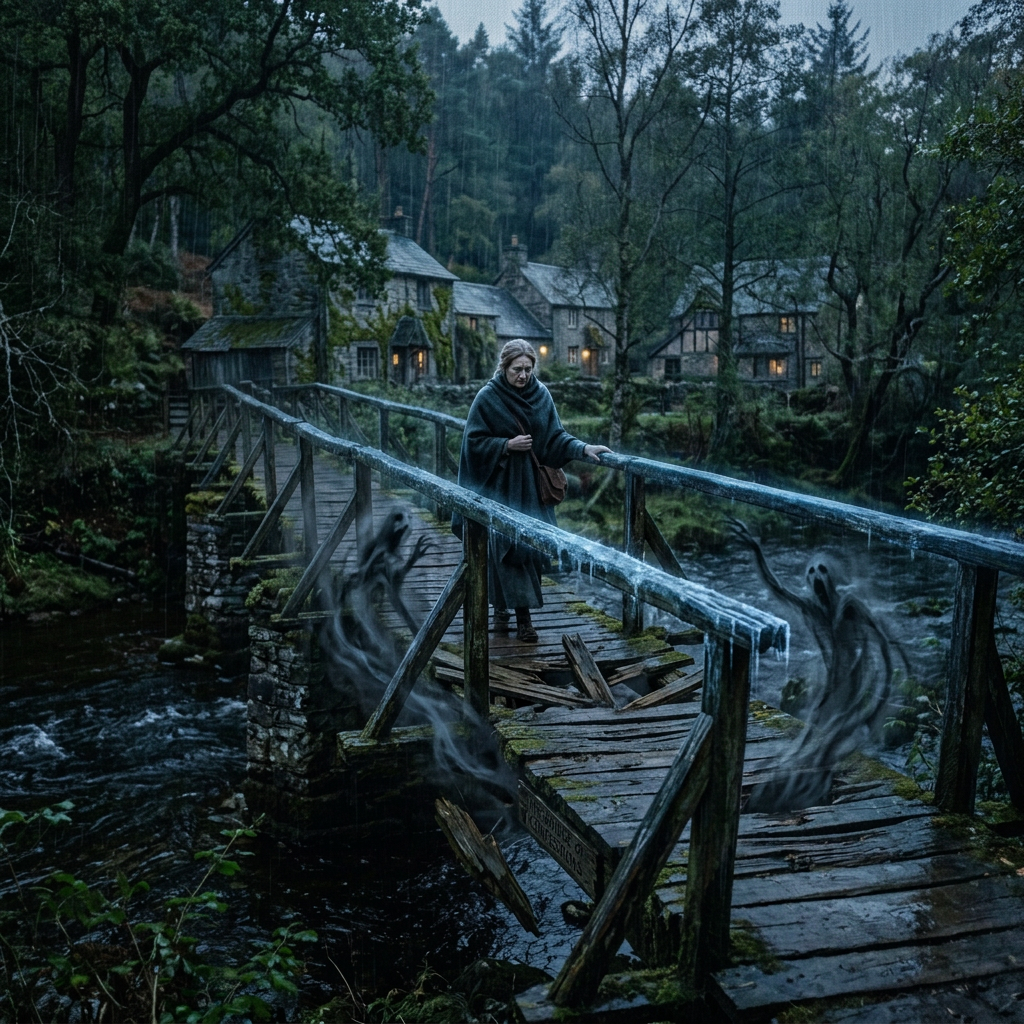
They say that in Rushbrook there stands a bridge no one calls by its proper name, because it has none — only the one the village gave it: the Bridge of Confessions. It is narrow, old, slick-planked in wet weather, and many claim parts of it are rotten through, because they’ve heard it give way beneath someone’s foot — yet the bridge never once gives way beneath anyone whose soul is clean that day. It only sways, only creaks, only turns its rail cold for those who try to cross it carrying an unspoken truth, or a debt of the heart that was never paid.
The stream running beneath it, Babbling Run, is no great river, just a hurrying trickle, ankle-deep in summer and frozen solid in winter, yet the bridge stands high above it all the same, because long ago, when the first bridge stood on that spot, a ravine split the two banks that only a good, strong timber span could close.
The people of Rushbrook have known the bridge since childhood, for the road to it cuts through the village center, and anyone bound for the mill, the church, or the market on the far bank must sooner or later face it. Parents teach their children to pause a moment before the bridge and “listen to themselves” — a phrase in Rushbrook that means quietly asking yourself whether there’s something you haven’t yet said aloud. Most children, of course, find nothing worse than a stolen lump of sugar or some small lie about school, and run laughing across the planks — but the habit soaks into them all the same, and grown, they stop instinctively before setting foot on it.
There is a game the village children have long played: two of them conspire, and one invents a small, harmless lie — that she fed the hens that morning, though she didn’t — then tries to cross the bridge to see whether the planks tremble beneath her. The wiser elders always tell them this isn’t a proper game, since the bridge doesn’t weigh words but hearts, and a child’s small, innocent invention is no lie in the bridge’s eyes, only play — but the children love trying anyway, and the legend holds that the bridge bears all this small testing patiently, as though it knows the children are still only learning.
The legend begins with the bridge’s builder, a man named Mihók, who made it not so long ago as people might think — perhaps five generations back — but its true story reaches further still, to another bridge that once stood in the same place, the one that gave way one night beneath Mihók’s own brother, a young man named Dávid.
*
Dávid and Mihók were brothers, sons of a widowed blacksmith, and stood as close to each other as only two brothers can who grew up sharing one poor house and had to share everything in it, bread and secrets alike. One winter their father fell through river ice and died, and the village talked for a long time about why he had gone out onto the ice on such a night, when everyone knew how dangerous it was.
The truth — known only to Dávid, no one else — was that he himself had called their father out that night, because he had stolen a small sum of money their father had been saving to repair the smithy, and when their father noticed it missing, Dávid told him he’d seen someone running off toward the ice with it, just to turn suspicion away from himself. Their father went out into the dark to chase the thief who did not exist, and the ice broke beneath him.
Dávid carried that secret for years, and it rotted him from within, the way water rots wood. One night, when he could bear it no longer and decided to leave for the neighboring village to start a new life where no one knew him, he crossed the old timber bridge over Babbling Run — and the bridge, they say, could not bear his weight. Not the weight of his body, but of what he carried in his soul. The beams groaned, one snapped, and Dávid fell, exactly as his father had fallen through the ice, and drowned in the shallow but swift-running water.
Mihók stood on the bank when it happened, for he had run after his brother, trying to hold him back, sensing something was wrong. He heard the crack, saw his brother fall, and leapt into the water for him, but could do nothing anymore. When he finally dragged him onto the bank, Dávid, with his last words, confessed the truth about their father — the money, the lie, everything — and then died in Mihók’s arms.
Mihók never recovered from that night. But instead of turning his grief to anger or bitterness, as many would have, he turned it into a vow. He rebuilt the bridge with his own hands, on the same spot, and when it was finished, he stood at its center and declared, loudly enough for the whole village to hear: “From now on, this bridge will carry no lie. Whoever speaks truth before setting foot on it crosses safely. Whoever tries to cross with a lie in their heart, the bridge will shake, to remind them: there is no safe crossing while fleeing from yourself.”
No one knows whether Mihók possessed some kind of power, or whether his grief and his vow were simply true enough that the bridge — or the place, or the river, or something no one fully understands — took the law upon itself. But the village holds that from that day on, the bridge truly behaved differently toward those who tried to cross it with a lie than toward those who stepped onto it with a clean heart.
Mihók himself never fully got over failing to notice in time how deeply something was tormenting his brother. For years he believed it should have been his task to guess what weighed on Dávid’s heart before it grew too heavy to bear. So when he built the new bridge, he did more than make the vow — he started a custom his family kept up afterward: every evening at sundown, he would stand at the bridge’s foot and ask the air aloud, as though speaking to Dávid, “Is there something you need to say?” He expected no answer; he only wanted the question to hang there, a reminder to anyone who heard it that there is still time, before it is too late.
The village slowly took up this custom. Even today, many who pass that way at dusk pause a moment at the bridge’s foot and quietly repeat Mihók’s question, not necessarily expecting an answer, but because the question itself is a kind of watch-keeping: a reminder that the burdens a heart carries do not vanish simply because no one speaks of them.
Mihók’s family tended the bridge itself across generations too, not only the custom. Every autumn, before the frosts set in, they walked its length, tightened its joints, replaced what water or beetles had gnawed, always using the same kind of oak Mihók himself had used, holding that the bridge’s memory lived in its very timber, not only in its story. The last Mihók descendant to personally tend it was an old man named Boldizsár Mihók, who in his final years taught everything he knew about the bridge to the village’s most skilled carpenter, a young man named Jónás Szabó, fearing the knowledge would decay with him otherwise. Jónás promised he would never let the bridge fall to ruin, and that promise passed down through his sons and grandsons, all the way to today.
Jónás’s grandson, a man named Pál Szabó, once faced a serious test in the bridge’s defense. An early spring flood, swollen far beyond anything anyone had expected by the melting snow, raised Babbling Run so high that the water lapped at the bridge’s lower beams, and one of the supporting posts slid loose in the softened bank. When Pál saw the bridge standing on the edge of collapse, he sent for no one, for there was no time — he waded in waist-deep in the icy water and tried with his own hands to brace the sagging post with another beam, until his son reached him with help.
They worked for hours, freezing, as the water climbed higher and higher, and by the time they had strengthened the bridge enough to survive the flood’s peak, Pál could barely feel his legs for the cold. When someone later asked why he had risked his life for a bridge, when he might easily have waited for the water to recede on its own, he answered only, “This isn’t an ordinary bridge. If it’s lost, and we don’t rebuild it in time, how many will go on carrying what they should have spoken, because there’s nowhere left for them to do it?” From that day the village took the bridge’s autumn upkeep even more seriously, and never again let a single suspicious crack or loosened beam go unrepaired through a whole season.
*
The signs the bridge gives are known to everyone in Rushbrook, for they have been told from generation to generation so that people would know what to watch for.
If someone spoke truth before stepping onto the bridge — whether aloud, or only to themselves, to the river, to the air — the planks did not move, and the rail’s wood was warm beneath the palm, even on the coldest winter day, as though the sun had shone on it all day, though it stood in shadow. The water beneath flowed quietly, and the fog that often drifted over Babbling Run at dawn or dusk seemed to part, granting a clear view of the far bank.
But if someone tried to cross with a lie in their heart, or an unspoken truth on their tongue, the bridge showed something else entirely. The beams began to creak, not all at once but one after another, as though the bridge itself were counting the steps and weighing them. The rope along the rail — for later a rope was added beside the planking — turned icy and damp, even at the height of a summer noon, as though dew had gathered on it in an instant. The river beneath swelled, or at least seemed to swell, and the fog thickened, hiding the far bank, as if the bridge were saying: you cannot see where you’re going until you see yourself clearly.
And if someone still tried to cross with their lie, without stopping to confess, the bridge sometimes truly swayed beneath them — not always as violently as it had with Dávid, but enough to make them slip, tumble into the cold water, and limp home soaked and shamed afterward, in full view of anyone passing by.
*
The village’s history is full of people who crossed this bridge, and each of their stories teaches something a little different about trust and truth.
There was once a soldier, Demeter, who came home after three years of fighting, and when he reached the bridge, he stopped, and could not go on. The villagers who saw him standing there, motionless, thought he was only resting, tired from the road, but he knew what was holding him back.
In the war, in one battle, Demeter had left a wounded comrade behind on the field, afraid that if he went back for him, he too would die. The comrade, a young man named Albert whom he had known since boyhood, bled to death there in the field, and Demeter lied to his commander, saying Albert was already dead when he found him, that there had been nothing to be done. That lie saved Demeter’s honor in the army, but it did not save his soul.
On the day it happened, smoke had settled so thickly over the field that one could barely see ten paces ahead, and Demeter, hearing Albert’s cry through the smoke, had stopped for one instant and told himself, “surely someone else hears him too, surely someone’s coming for him,” and run on with the others. That was the moment he relived every night afterward: a decision that lasted barely a heartbeat but shaped, for a lifetime, the man he became. When they went back after the battle, Albert was no longer found alive, and Demeter, when his commander asked what had happened, heard himself speak the lie as though someone else were using his mouth.
Now, standing before the bridge, he knew he could not cross as he was. He set his pack down on the ground, and turning to the river, spoke the truth aloud, loud enough to carry to the sky itself: that he had left Albert, that he had lied about it, that for years he had seen the boy’s face every night the moment he closed his eyes. No one stood there to hear it, only the water and the fog, but when he finished, and stepped onto the bridge trembling, the planking did not move, and the rail was warm beneath his hand, as though something had forgiven him that he himself had not yet learned to forgive.
Demeter crossed, went home, but did not stop there. He went to Albert’s family too, and told them the truth as well, however much he feared their anger. Albert’s mother wept, but in the end embraced him and said, “Thank you for letting me know now what truly happened. Not knowing was worse than the grief.” From that day Demeter went to the bridge every year and dropped a single flower into the water in Albert’s memory, and said the bridge had taught him that truth is not hard because it hurts to speak — it is hard because, once spoken, it cannot be taken back.
*
There was a bride too, Judit, who crossed the bridge on her wedding day to reach the church on the far bank, where her groom awaited her. Judit was lovely, and everyone believed her happy, but she knew she carried a secret she had never told a soul.
Years before she met her current groom, a good, honest farmer named Bálint Kocsis, Judit had loved another young man, a wheelwright’s apprentice named Elek Farkas, who had gone off to be a soldier and never returned — or perhaps he had returned, but not to her, for she had heard he had married in another village. For three years they had waited for each other through letters, until the letters simply stopped coming, and Judit never knew for certain what had happened — only a distant acquaintance mentioned, by chance, at a market, that she had seen Elek in another village, beside a wife and small child. Judit never told this love to anyone, and now, on her wedding day, standing before the bridge, she felt she would be stepping into a new life with a lie, if she said nothing of it.
She did not know whom to tell — her mother was no longer alive to listen, and she did not want to appear before her groom carrying this weight on this particular day. So she turned to the river, as Demeter had done, and quietly, only to herself, confessed: “I once loved someone else. I don’t love Bálint the way I loved him, but I love him the way a good, patient man can be loved, who stands beside me — and that too is love, even if it is a different kind.” When she spoke this and stepped onto the bridge, the planking stayed calm, the rail was warm, and Judit understood that the bridge did not ask that she have no past, only that she not carry it buried inside her like a lie.
Judit lived happily married to Bálint for decades, and never told him of her old love, but neither she nor the village considered this a lie, for — as they say — not everything we leave unspoken is the same as what we deny. The bridge asks only that a person confess, at least once, to themselves, what the truth is, before building a new life upon it.
In her old age, Judit once told her granddaughter that she had often wondered whether the bridge would have reacted the same way had she confessed her old love aloud before Bálint, not only to the river. “I don’t think that would have been the right path,” she said. “There are things a person must settle with themselves, and things they must share with whoever stays beside them. The wisdom lies in knowing which is which.” Her granddaughter recalled that sentence many times later, in her own marriage, whenever unsure what to tell her husband and what to keep quietly to herself.
*
There was a merchant too, a grain dealer named Gáspár Baráth, who years before Judit’s wedding tried to cross the bridge one winter evening after cheating a widow in a grain deal — paying her far less than her grain was truly worth, taking advantage of the fact that she could not reckon figures well and had no one to check the deal on her behalf. The widow was named Vera Tóth, and she raised three children alone since her husband’s death, and the grain Gáspár had underpaid for was meant to see them through the whole year. Gáspár knew this, and still reasoned that “business is business,” and riding home in his cart, tried to convince himself he had done nothing wrong, only struck a good bargain.
Gáspár, who until then had never taken the bridge’s true power seriously, only as legend, started across laughing, thinking the whole thing superstition. But the moment his foot touched the first beam, the wood groaned beneath him like a scream, and the rail he instinctively grabbed was so icy it burned his palm. The fog thickened suddenly around him, and Gáspár, terrified, believed the bridge was about to collapse beneath him entirely, and leapt back to the bank, his heart pounding, shaking with cold and fear.
He did not dare try again that winter. For weeks he avoided the bridge, taking the longer road to the neighboring village instead, though it cost a full day there and back, and even his horses wore themselves thin from the repeated trips. He returned to the bridge only once his conscience finally grew stronger than his fear: he went back to Vera, confessed the fraud, returned the money he had cheated her of, and even added more besides, to make up for the months of hardship he had caused her. Vera at first refused to accept it, so startled by the gesture that she suspected another trick, but in the end, seeing Gáspár’s tears, she forgave him.
Only after doing this — for though his life was no different for the widow’s forgiveness, his own soul no longer was — did he try crossing the bridge again, now an old man, for years had passed in between, and the bridge stayed calm beneath him this time, as though it accepted that he had finally done right, not merely spoken it.
*
There was a case quite different in nature from the others, one the village often brings up when speaking of how the bridge recognizes not only great sins but small ones too, which nonetheless leave deep wounds.
Two neighbors, Imre Páll and Dömötör Fekete, had stood at odds for years over a boundary line their fathers had once drawn wrongly, and which neither wanted corrected, because setting it right would mean admitting that one family or the other had once cheated. Both knew the truth — that Imre’s grandfather had once shifted the boundary stone a spade’s width over, to make his land larger — but both stayed silent about it, because silence was more comfortable than confession.
One year both of them had to cross the bridge on the same day, for a funeral at a relative’s house on the far bank, and by chance reached the bridge’s foot at the same moment. Both felt something was wrong the moment they tried to step on — the beams trembled faintly, not strongly, but noticeably, and both thought of the same thing at once: the boundary.
Imre was the first to speak, embarrassed, staring at the toe of his boot. “My grandfather moved the stone,” he said. “And I’ve known it my whole life, and let the land stay with us that we never rightly earned.” Dömötör was startled at this, but then confessed his own part: that he too had known of it for years, but never dared raise it, afraid the quarrel would be worse than the silence.
Once both had spoken what they had carried, the bridge fell quiet, and both crossed without trouble. The boundary was corrected that same week, and though they never became true friends, the resentment that had consumed them slowly eased. “Not every truth is a large one,” Dömötör later told his grandchildren. “But every truth has its weight, and the bridge measures every weight, however small.”
*
There was a priest too, a young assistant clergyman named Barnabás, who, freshly arrived from the city where he had studied theology, openly mocked the village’s superstition at a gathering. “God’s house doesn’t live in the beams of a bridge,” he told the congregation in a Sunday sermon, “and a piece of wood cannot judge anyone’s soul. If someone wants to speak the truth, let them speak it in the confessional, not to a stream.” The villagers listened in silence, but exchanged glances, for every one of them knew at least one story that Barnabás’s words could not refute.
To prove his point, Barnabás one day deliberately stood before the bridge and, loudly, before the gathered crowd, confessed an invented, trivial lie — that as a boy he had once stolen an apple from a neighbor’s garden — just to show that the bridge responded to nothing, since the whole thing was only a tale. The bridge indeed stayed still, and Barnabás smiled with satisfaction and crossed it, as though he had settled the matter for good.
But some years later, when he had become the village priest, and a young girl confessed to him something so grave he did not know what to do with it — she admitted to a sin that, by law, he should have reported, but which, if it came to light, would have ruined her entire life — Barnabás kept silent, and did not report it, out of pity for the girl, but that silence weighed on him more and more, for he felt he had betrayed his calling.
Months later, needing to cross the bridge to reach a sickbed on the far side, Barnabás stopped at its foot, and this time he did not laugh. He stood there a long while, and at last, quietly, only to himself, confessed: “I don’t know if I decided rightly, and that uncertainty torments me more than anything I ever preached from a pulpit.” When he stepped onto the bridge, the beams trembled faintly — not as strongly as with an open lie, but enough for Barnabás to feel it. From that day he never again spoke mockingly of the bridge, and something changed in his sermons too: he spoke less of the law, and more often of how hard it is for a person to be truthful even with themselves.
*
But the heart of this legend belongs not to Demeter, not to Judit, and not to Gáspár, but to a woman the village still calls Aunt Rozál to this day, though her true story is far more complicated than ordinary speech allows.
Erzsébet — for that was the name of the woman this story is truly about — lived as a young girl in the yard of a large farmstead, together with her sister-in-law, Rozália, her brother’s wife. They got along well, one might even call what they felt for each other love, though Erzsébet always felt a little overshadowed beside Rozália, who was prettier, more skilled at housework, and better liked by the villagers.
Rozália came to the house at nineteen, and in the first weeks Erzsébet, then sixteen, watched her stiffly, distrustfully, afraid her brother’s wife would push her out of the family in which she had so far been the only daughter. But Rozália did not behave as Erzsébet expected. She taught her to embroider more beautifully, to bake bread that didn’t stick to the pan, and in the evenings, once the others slept, they sometimes sat together by the fire, and Rozália told her about her own childhood, from a farther village where the river ran differently and the songs sounded different too. Slowly Erzsébet grew to love her, but mixed into that love was always a small, uncomfortable shadow: the comparison the village constantly made between them, in which Erzsébet always came up short.
One night, while the family slept, Erzsébet went into the barn with a lamp to search for something she had lost — a ribbon her mother had given her, before she died, and which she guarded like the light of her own eyes, for it was the only object that reminded her of her. She had lost it that afternoon somewhere in the hay while helping carry in the last load, and was so afraid it would be lost forever that she couldn’t wait until morning.
She hurried, since she had to rise early the next day, and set the lamp beside a bale of hay while she searched on hands and knees through the straw, not noticing how close the flame stood to the dry hay. A sudden draft — for the barn door hadn’t been properly shut — knocked the lamp over, straight onto the driest hay.
The fire caught fast, far faster than Erzsébet would have believed any flame capable of, and by the time she noticed, she could no longer fight it alone. Smoke already stung her throat when she ran out and woke the house, and everyone helped as best they could — carrying well water in buckets, trying to smother the flames with wet blankets — but the barn, and with it most of the winter fodder, was destroyed before the fire went out. The farm grew poorer that year, and faced a hard winter, for the animals had nothing to see them through the cold months, and some had to be sold at a loss just to keep the rest alive.
The question that arose was: who left the lamp there? Erzsébet, terrified of the consequences — her family’s anger, the weight of poverty now falling on them, which she had caused — said nothing. And when someone asked whether anyone had seen Rozália slip out toward the barn that evening — for Rozália genuinely had gone that way earlier, to fetch an egg from the henhouse — Erzsébet did not correct the assumption. She simply let the suspicion, in silence, fall on Rozália.
Rozália protested, wept, begged to be believed, but the evidence — or rather its absence, and the fact that she truly had gone that way — spoke against her, and her husband, Erzsébet’s brother, was so furious over the loss that he did not believe his wife, and at last, after months of bitter quarreling, Rozália left the house.
Erzsébet stood at the gate that morning when Rozália set out, a bundle in her hand holding little more than a few pieces of clothing. Rozália paused a moment before Erzsébet and looked into her eyes — not with hatred, but with a silent question, as though giving her one last chance to say something, anything, that might change things. Erzsébet looked down at the ground and said nothing. Rozália nodded, as if she had received her answer after all, and set off down the road leading to another region, fleeing the shame and the injustice no one understood, and never returned.
Erzsébet carried this secret for more than forty years, without a single word. She married, had children, grew old, and her brother died in the meantime too, never learning the truth about the wife he had wrongly accused and lost. Every time the village needed to cross to the far bank — for a funeral, a wedding, a market day — Erzsébet took the long way around, through the forest, never the bridge, because she knew what awaited her there, and was not ready to face it.
There was one occasion, years after the fire, when her husband, a patient, quiet man named Sebestyén Nagy, asked her why she never wanted to cross the bridge, when it would be so much faster a way. Erzsébet answered only that “heights don’t agree with me,” which wasn’t entirely a lie, but wasn’t the truth either. Sebestyén didn’t press further, for he loved his wife, and believed everyone has a few oddities better left unexamined. He never learned that his wife carried, for decades, a burden that a single word could have set down, but Erzsébet never found within herself the strength for that word.
There was one night when this silence very nearly cost something dear. Their eldest son, still an infant, was suddenly seized by a high fever, his cough turning so bad that Sebestyén was certain they needed a doctor at once, one who lived in the settlement on the far bank. “I’ll cross the bridge,” he said, already reaching for his coat. “I’ll get there far sooner that way.” Erzsébet, though the child burned with fever in her arms, seized her husband’s arm and begged him to take the longer forest road instead, insisting that “the bridge is even more dangerous at night, I don’t want anything to go wrong.” Sebestyén didn’t understand this sudden fear, but had no wish to argue at such a moment, and gave in, setting off by the longer way.
The boy survived, and the doctor eventually arrived, though far later than if he had come by the bridge, and the fever climbed dangerously high in that time before it finally broke. Sebestyén never learned that his wife, in that moment, had not feared the bridge’s danger at all, but feared that if he himself set foot on it, even carrying nothing but a passing thought of hers, the truth she had buried for so many years might somehow slip free of her. And Erzsébet, once her child survived that night, grew only more convinced that silence was the price of keeping her family together — never understanding that this very belief was what made the silence harder, with each year, to ever set down.
Her children grew up, and they too learned that their mother strangely always avoided the bridge, and in childhood took it only for a motherly quirk, sometimes laughing about it among themselves, never imagining something this heavy lay behind it. Erzsébet sometimes heard their laughter, and every time her heart clenched, but she never spoke.
She sat, too, at her brother’s deathbed, and there, for the last time, nearly told him the truth — the words already on her tongue, his hand in hers, the room silent but for the wind outside. But before Erzsébet could speak, her brother said, half lost in thought, “Rozália… I hope she had a good life, wherever she is. Sometimes I think I was unjust to her.” Erzsébet, for one moment, believed this might be the chance to set everything right, at least before her brother. But then he closed his eyes and said no more, and died a few hours later, and Erzsébet let slip this last chance too, and that failure haunted her for decades more.
*
The story turns toward its climax when Erzsébet was already an old woman, seventy-two, and received news that stopped her heart for a moment: Rozália, who had left decades before, had returned to the region — not to the village itself, but to a smaller settlement nearby on the far bank — because, it was said, she was dying, and had asked that, if possible, she be buried near her birthplace, even if not in her old home.
The news came by way of a merchant who had business in the small settlement, and mentioned it only in passing, as though it were nothing: “There’s an old woman there who keeps asking after her own name, says she used to live here, calls herself Rozália.” Erzsébet’s hand trembled when she heard this, and that night she didn’t sleep a single minute, staring at the ceiling, trying to grasp that after four decades the circle she had tried so hard to avoid was closing after all.
Erzsébet knew by then she had to do something before it was too late, but fear still sat in her stomach like a stone. The worst of it was that, that very week, heavy rain had washed out the long detour — the stream beyond the forest had flooded, and the old path had become unusable, muddy and dangerous, impossible to cross safely. Only the bridge remained.
Her granddaughter, a young woman named Ágnes, who knew nothing of the old secret, only that her grandmother “never liked the bridge,” tried to persuade her to wait until the path dried out, but Erzsébet knew Rozália might not have that much time. “I have to go now,” she said. “If I don’t go now, there may never be another chance.”
She spent three days preparing, though “preparing” is perhaps too calm a word for what she actually went through. At night she lay awake, trying to work out how to begin, what to say first, and every time her thoughts reached the point of having to speak the night of the barn fire, something tightened inside her, and she turned her mind elsewhere instead — to what she should bring Rozália, a jar of preserves, a warm shawl, small, trivial things with which she could put off the real work she needed to do. Once she even considered that it might be enough to simply tell Rozália “I’m sorry for what you went through,” without explaining exactly why she was sorry — but she knew, deep down, that this would be the same thing she had done for four decades: speaking half the truth to spare herself the rest.
She set out for the bridge on a rainy, overcast evening, with Ágnes beside her, though the girl didn’t quite understand why her grandmother’s hand shook so. When they arrived, Erzsébet stopped at the bridge’s foot and, for long minutes, could not move, as though her feet had taken root in the mud.
She tried to speak, but the first words that came out weren’t true enough, and she felt this herself. “I made a mistake, long ago,” she began, turning toward the river, “and I didn’t set it right in time.” She lifted her foot to step onto the bridge, as a test, but the beam beneath her cracked at once, with a sharp, warning sound, and the rail she grabbed was ice-cold. Ágnes jumped back in fright and begged her grandmother not to go any further, that it wasn’t safe.
Erzsébet, however, knew what the sign meant. Not that she should turn back, but that she had not yet spoken the whole truth. She stood a moment, Ágnes tugging at her arm, and the fear raging inside her nearly won — for an instant she thought of turning around, going home, sending someone else to tell Rozália she was ill, that she couldn’t come, that everything would be fine without her. But then she remembered Rozália’s face, the last time she’d seen it forty years before, standing at the gate with her bundle, and the question her eyes had carried, which Erzsébet had never answered. She drew her foot back, breathed deep, and began again, this time without avoiding the words.
“Rozália, my sister-in-law, did not set fire to the barn,” she said, loudly, her voice breaking the silence even over the drumming rain. “I did. I left the lamp beside the hay bale because I was searching for a ribbon I’d lost in fear, and I was too proud and too frightened to admit it. And when everyone suspected Rozália, I let them believe the worst of her, because that was easier than taking on what was truly mine. She lost her home, her husband, her good name, and I let it happen, because I was afraid.”
The words, once spoken, seemed to lift a physical weight from her body. She raised her foot again, and stepped onto the beam.
This time the wood did not creak. The rail she touched carefully was mild, almost warm, as though the sun had shone on it all day, though the clouds hung thick and heavy above them, and the rain had only just begun to ease. The fog, which until then had sat thick over Babbling Run, seemed to part for an instant, and Erzsébet, astonished, saw the far bank clearly, and on it a small, stooped figure, standing with a cane in hand, watching her.
*
Rozália, who had heard of Erzsébet’s approaching visit — for news always outruns the traveler between villages — had come out of the small house where she spent her final days, to come to the bridge, though her legs could barely carry her. She didn’t know exactly why she felt she had to come, only that something called her there.
When Erzsébet reached the other side, and the two old women stood face to face, after more than forty years, Erzsébet didn’t know what to say, but Rozália spoke first. “I heard,” she said quietly. “The wind carried your voice to me when you crossed the bridge. I don’t know how, but I heard what you said.”
Erzsébet sank to her knees in the mud at Rozália’s feet, weeping, begging forgiveness for four decades of silence, for the exile, for the ruined life. Rozália, her face thin now with illness, bent down as far as she could, and took Erzsébet’s hand.
“I hated you for years, for letting it happen,” she said. “But the years taught me something, which perhaps you’re learning now too: hatred is a heavier burden than what was taken from me. I left, built a new life as best I could, and there was good in it too, not only bad. But now, hearing this from you, I feel I can finally set down the part I’ve carried for forty years: the question of why they believed what they believed about me.”
The two women stayed at the bridge’s foot until the rain stopped entirely, and spoke of everything they had failed to discuss in forty years: Rozália told of her life in the distant village, how she had eventually found a good man who married her, though they had no children, and how she often thought back to the old farmstead, not with anger, but with a kind of aching homesickness. Erzsébet told her of her own children, her grandchildren, her husband who was no longer living, and how, every single time someone in the family spoke her brother’s name, something inside her flinched, because she knew what she had done to him.
Rozália died three weeks later, quietly, in the small house, and Erzsébet was there beside her when she went, for from that day on she crossed the bridge every single day to sit with her, and every time, the bridge stayed calm beneath her, as though nothing stood in her way anymore.
At the funeral, held in the small settlement’s graveyard, Erzsébet and Ágnes stood together beside the grave, and it was then that Ágnes first asked openly what had truly happened long ago. Erzsébet told her the whole story, from the barn to the bridge, and said, “For forty years I believed silence protected me. Only afterward did I understand it had held me captive the whole time too, not only Rozália.” Ágnes never forgot this story, and later, when her own children were born, always told it to them before letting them cross the bridge.
There was a sign, too, that the family’s tendency toward silence might have passed on further, had Ágnes not chosen to speak everything openly. One of Erzsébet’s daughters, Ágnes’s aunt, who had never known the story of the barn, spent years as a grown woman avoiding the bridge herself, over a smaller secret of her own — an old debt from her youth she had never repaid to a relative — and no one understood why, since she never explained it either. When Ágnes began telling Erzsébet and Rozália’s story openly within the family, her aunt drew her aside one evening and said, “Thank you for telling it. Now I understand what I was afraid of too, without ever knowing its name.” A few weeks later her aunt crossed the bridge calmly, having finally paid off the old debt that no one else had ever known about.
Ágnes added this second case too, to the story she told her own children, always closing with the same words: “You see, silence doesn’t stop with one person. It ripples on, father to son, mother to daughter, until someone finally speaks it aloud and stops it.”
*
In the village they still say that the bridge grew calm beneath Erzsébet that evening not simply because she spoke the truth — for many know how to speak the truth halfway, keeping themselves from the hardest part even as they speak — but because she finally spoke the whole truth, even the part she feared most. The bridge, they say, does not measure the words, but what’s left out of them.
Ágnes, who as a young woman had stood beside her grandmother that evening, later, once she was a mother herself, always told her children this story before letting them cross the bridge, and always added: “It isn’t the bridge that’s frightening. What’s frightening is what we carry inside us, until we dare to speak it. The bridge only shows how much we’re still carrying.”
Demeter’s descendants, Judit’s grandchildren, and even Gáspár Baráth’s great-grandchildren, all of whom have heard their own ancestors’ stories, still raise their children today to think, before stepping onto the bridge, whether there’s something in their heart they ought to speak first — not out of fear of the bridge, but because they’ve learned that the truth spoken before setting out on any road makes that road lighter to walk, wherever it leads.
The bridge is still called the Bridge of Confessions to this day, and in Rushbrook children are taught from early on that before crossing it, they should stop for a moment and ask themselves: is there something I should say before I set out? The elders like to add that the question doesn’t mean everyone must confess everything to everyone — a village couldn’t survive if every small thought came to light — but that a person should learn to tell the difference between the silence one can carry in peace, and the silence that slowly rots a person from within, the way it once rotted Dávid, and for decades rotted Erzsébet. Not everyone carries such a weight, and most children only run laughing across the planking, with nothing on their hearts but the joy of play. But those who do carry something, who learn in time to stop and speak what they hold, all tell the same thing once grown: that the bridge does not wish to punish, only to remind them that no river runs deep enough to hide a truth forever.
Ágnes, who later became a grandmother herself, often led her own grandchildren to the bridge’s foot, and before letting them cross, always told them Erzsébet and Rozália’s story, slowly, so the children would understand why it mattered. “My grandmother carried a burden for forty years that she could have set down in a single afternoon,” she told them. “Not because she was wicked, but because she was afraid. Fear lives longer than we think, if we let it take root.” The children didn’t always fully understand, but the words stayed with them, and grown, when they carried their own burdens, they often returned to them.
The village’s priests, Barnabás’s successors among them, still speak of the bridge in their sermons to this day, though no longer mockingly, but with respect, as a place where the human heart cannot hide from itself. Some say the bridge holds a miraculous power; others say it is only people’s own conscience that makes their steps tremble, so that the wood only seems to move. In Rushbrook no one settles for good which is true, and perhaps there’s no need to settle it, for the effect is the same: whoever speaks the truth before crossing reaches the far bank with a lighter heart, whatever name we give to what makes that possible.
Pál Szabó’s descendants still tend the bridge today, and every spring, when the snow begins to melt, they go out to check the posts, just as Pál taught his son, who taught his own in turn. One of the youngest Szabó children once asked her grandfather whether it wasn’t tiring, mending the same bridge, generation after generation, hunting the same cracks. The old man only shrugged and said, “Every village has something it cannot afford to let fall into ruin. Ours is this bridge. There are worse things to be given.”
And so, in winter and in summer, in rain and in drought, the Bridge of Confessions in Rushbrook still stands, sometimes calm, sometimes creaking, always showing whoever steps onto it exactly what they would most like to hide from themselves. The villagers don’t speak of it as a miracle, so much as a strict old grandparent who never lies, even when the truth it tells is hard to hear. And perhaps that is its greatest gift: that everyone who crosses it often enough learns, sooner or later, that the heaviest burdens are never washed away by the river, but by one’s own voice, finally speaking them aloud.
Even now, travelers passing through Rushbrook for the first time are warned, half as jest and half in earnest, to mind the old bridge at the village’s edge — not because the boards are weak, the locals say, but because the boards are honest, and honesty has a way of catching up with a traveler exactly where a river runs beneath his feet and there is nowhere left to look but inward. Most laugh it off as a quaint village tale and cross without a second thought, and the bridge lets them, since a stranger passing through rarely carries toward Rushbrook itself the kind of debt the bridge was built to weigh. But those who linger a season, who fall in love there, who quarrel and marry and bury their dead on either bank, sooner or later learn what every child of the village already knows: that the short walk across those old gray planks is never quite as short as it looks, and that the safest way over it has always been, and will always be, to arrive already telling the truth.


Leave a Reply