
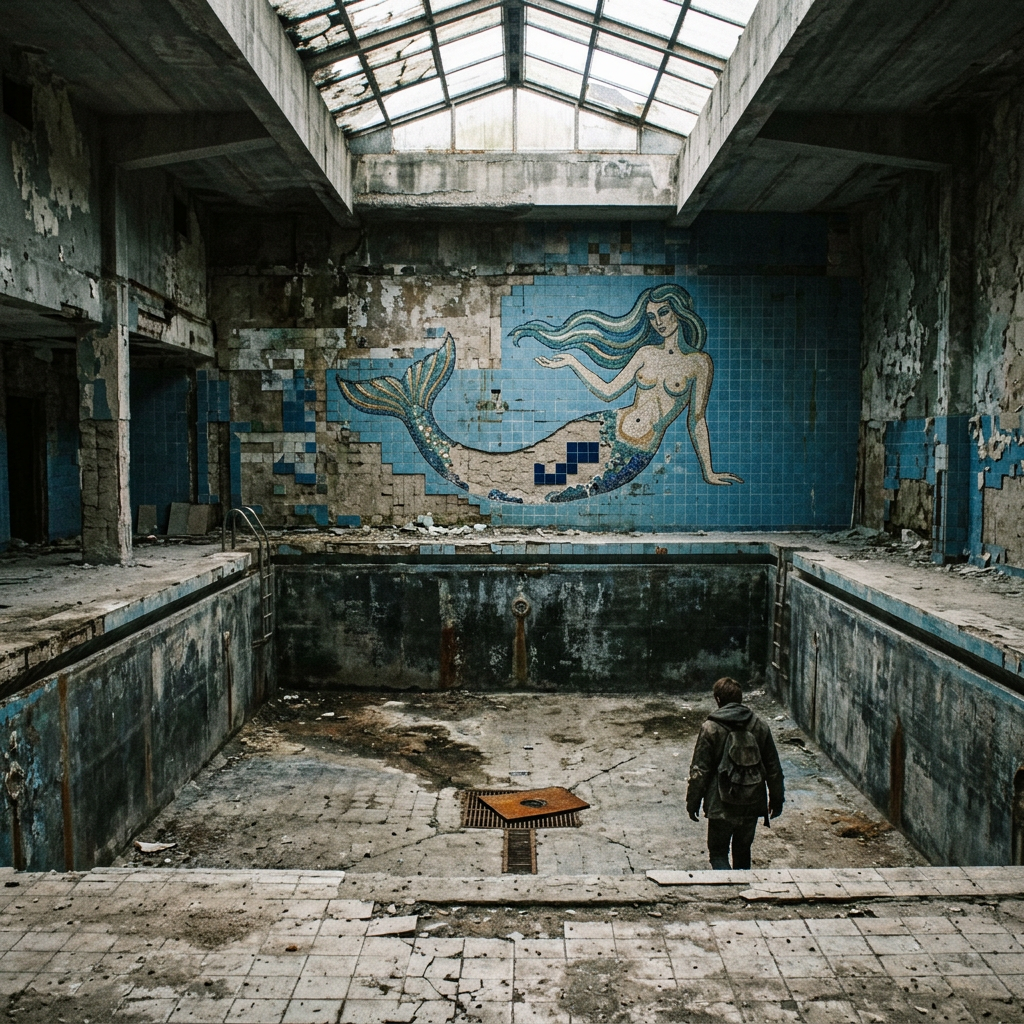
The pool always exhales the same temperature of air when I step into it. Not cold, not warm – like a room someone has just left, their body heat still caught in the furniture. The tile glows blue in the light that leaks through the broken skylight, and the water has been gone for years, leaving only the acid-stained basin, the drain grate, and the mermaid mosaic on the far wall, missing three tiles from the tail, as if someone had peeled the skin off it.
I know it’s a dream because I come here every night, and every night it’s the same. Not the way people mean when they wake up and say, oh, I was back in that school hallway before an exam again – not a recurring theme you shrug off over coffee. This is a place. A specific, measurable, walkable place, with boundaries, and the boundaries never move.
The Siren Baths. It doesn’t exist – I looked. There’s a real bathhouse in Újpest with a similar name, but that one runs, has water in it, chlorine and old men doing their morning stretches. Mine is dead. One wing of the glass roof has caved in, and through that gap comes exactly enough light to see by, and not enough to see everything.
I barely remember the first time, because I didn’t yet know I needed to be paying attention. Only an impression survives: going down a staircase, my foot finding a step colder than I expected, and a shaft of light cutting the dark at the wrong angle, the way light bends in an aquarium when someone’s holding the lamp wrong. In the morning I wrote myself a note – “weird pool dream” – and didn’t think about it again, because I had a deadline that day, and the note slid under an invoice on my desk and stayed there.
The place doesn’t always receive me from the same direction. Some nights I arrive through the entrance, down a sinking staircase with a broken railing; other nights I’m simply already standing at the deep end, as if someone had cut my dream in half and was only showing me the second part. The ceiling is high, the curved steel girders rusted, and from one beam hangs a broken light fixture that never lights and never falls. The floor tile is hexagonal, poison-green and white, and every time I cross it I know exactly which tile will creak under my foot, as if my body’s memory operates independently of what I remember when I’m awake.
There’s a row of changing cubicles by the entrance, brass numbers on the doors, one of which – the seven – always hangs half torn from its hinge, and a forgotten towel on one of the benches, blue-and-white striped, that nothing ever moves, not a draft, not even the water that will later reclaim the room. At first I thought this was just set dressing my own mind had built, the way a dream city can rise with no street names, no shopfronts, just leftover shapes. But the longer I kept going there, the less invented it felt. A made-up place would give a little. This one didn’t.
My name is Lívia Szabó, and I work as a sound engineer at a small post-production studio near Lehel Square, and I say that so flatly because it matters that you know: I’m not the type who believes in signs. My job is putting back into reality the part the camera never caught – the sound of footsteps, a door’s creak, wind murmuring through an empty room. I know what a well-built illusion sounds like. I thought I’d know the moment my own brain started lying to me.
Zoltán and I had been living together four years by then, and our life had settled into a shape that from the outside would have looked perfectly stable: a shared mortgage, shared friends, a cat we called Pötty, and a weekly rhythm that sent us to the cinema every Thursday because that’s when tickets were cheap. There was nothing wrong with it. It’s just that nothing in it asked anything of me, and I – this is hard to admit now, looking back – took a strange comfort in having a place that did ask something: my attention, my memory, my loyalty, toward a space I couldn’t even confirm existed.
The week the pool dream started, I happened to be chasing footstep sounds for a documentary, three days spent trying to record a believable walk across wet tile – barefoot, ankle-deep in water, in an empty pool we’d rented from a set designer after a shoot wrapped. I set the microphones over the water, and every step gave back a different echo depending on whether the tile was wet or merely damp with condensation, and that night, walking home, my own footsteps were still ringing in my ears, as if the day refused to let itself be put down. I didn’t think, back then, how literally I was carrying that sound into the night.
For the first few months I didn’t consider that the pool dream might be anything more than a side effect of overwork on a film whose main location happened to be a derelict swimming hall. A tidy explanation, close at hand. Then the film wrapped, I moved on to something else, and the pool came with me.
One evening – three months after the first time, maybe – I noticed that one of the deck chairs was standing somewhere it hadn’t been. Not a dramatic shift. Half a meter closer to the water, angled slightly. My mind reached for the obvious: it was probably there yesterday too, I just hadn’t noticed, dreams don’t follow logic anyway, the set changes a little each night. But the next night it stood in the same new place, at the same angle, and the night after that, and a month later there were six deck chairs arranged around the pool, each at a different angle, as if someone kept rearranging them, as if someone had taste, mood, a whim about this particular piece of furniture.
I didn’t tell Zoltán. We’d been sharing a flat in Óbuda for four years; he knew my face well enough to read what I’d dreamed from the shadows under my eyes at breakfast, but this I kept from him. Partly because it was ridiculous. Partly because – I can only say this now, looking back – it felt like mine. Like a locked room inside the apartment that no one else needed to know about.
After the deck chairs came the pebbles. Small gray stones someone had gathered into the cracks between tiles, always arranged into a new shape. One night a circle. Another, a crude arrow pointing at the mermaid mosaic. After a month – and I was keeping careful count by then, a spiral notebook by the bed, a sketch every morning of what I’d seen – the pebbles started forming letters. First just one, a B, at the edge of the deep end. Then, a month later, a whole word: OR. Just that. As if torn from the middle of a longer sentence.
Other small things piled up alongside it. The striped towel once shifted off the bench and draped itself over the nearest cubicle door, as though someone had picked it up to let it dry, though there was nothing there to dry it from. One morning the fogged-up mirror at the back of the changing room – because there was a mirror too, eternally misted though there was no water to mist it – carried a mark drawn in with a fingertip: a simple curved line that could have been a wave, could have been a smile, could have been anything. I didn’t wipe it away. I left it, and when I came back the next night it was still there, slightly smeared, like a message that had been drying on a wall for months.
I started experimenting. One night I deliberately left behind an object I’d “brought” with me – a button, to be precise, which I pulled from my pocket in the dream and set down at the edge of the pool, because I’d read somewhere that lucid dreamers test the permanence of a space this way. The next night it was there, exactly where I’d left it, but someone – or something – had turned it a centimeter, as if it had been picked up, examined, and set back down, not quite the same way.
After that the pebble-letters came faster. There was a week when a single word waited for me each night, as if I were being fed a longer sentence in doses so the whole weight of it wouldn’t frighten me: OR, then HEAR, then ME. Three nights, three words, and between them always the same uncertainty – whether my own mind was constructing this for itself, a carefully staged self-deception, or whether someone on the other end of the line was genuinely waiting for an answer I had no idea how to give.
I know how convenient a story of self-delusion this makes. Loneliness, work stress, a relationship that was good but had gone too familiar, too predictable – I had every ingredient for exactly this kind of fantasy. But the pebbles were there. Every morning I sketched their shape in the notebook, and every night I found them exactly as I’d drawn them. Dreams aren’t usually this consistent. They drift, blur, reshape themselves by the time you return to them. This one didn’t drift. It waited.
One night – I know the date exactly, because I wrote it down, March the eleventh – I saw him for the first time.
A man stood at the far edge of the deep end, back to me, holding something in his hand I couldn’t make out. I wasn’t afraid. Strange, but in that space I was never afraid of anyone, as if the place itself guaranteed safety, as if I knew in my bones this was a shared room, not an intruder’s. I called out. He didn’t turn. I said something else, and then I woke, as abruptly as if someone had flipped a light switch.
I didn’t see him again for three weeks – only the pebbles and the deck chairs, which now stood every night like a puzzle hidden inside a sequence of letters I couldn’t solve. Then one night he was there again, closer this time, pouring sand from an empty bottle into the cracks between the tiles, and when I looked up I caught his face for a second – not long enough to recognize him, just long enough to register that he was older than me, somewhere in his mid-thirties, and that there was something in the way he turned his wrist, no hesitation in it at all. As if he knew exactly what he was doing, and why.
The recognition didn’t happen in the dream. It happened in a piano shop near Blaha Lujza Square, on a Tuesday afternoon, when my colleague Petra’s piano needed tuning and I got sent to drop it off, because I had the most free time that day and it was on my way home anyway.
The tuner was a tall, lean man bent over the piano, holding a tuning fork beside the keys, and as he worked, he whistled. Not a known tune. Six notes, always in the same order, the fifth one sharpened on purpose, as if placing a dissonance at the end of the phrase like a signature. I stood in the doorway of the shop, and something under my skin went cold.
I’d heard those six notes in the pool. I didn’t work it out just then – I worked it out the instant he whistled, and my body reacted before my mind did: my throat closed, my hand curled into a fist in my pocket. In the pool, while the man worked with the pebbles, he always hummed these same six notes under his breath, so quietly I could barely make them out, and I’d never once thought they meant anything, assuming they were just the dream’s background noise, like an echo or the drip of a drain.
“Where’s that tune from?” I asked, and my voice came out strangely sharp in the shop’s quiet.
He looked up. I hadn’t really looked at his face until then, only his hands, his back. Now I looked, and I didn’t recognize him – not in the sense of “that’s him,” because a face is different awake than in a dream, the mind always fills in, distorts, simplifies. But the arrangement of the lines around his eyes, the small scar above his left eyebrow – they were familiar the way a word is familiar when you know it but can’t recall which language it belongs to.
“I don’t know,” he said. “I always whistle it when I’m concentrating. I thought I made it up.”
“Do you dream about swimming pools?” I asked, and regretted it instantly, because it sounded like the stupid setup to an even stupider joke.
He didn’t laugh. His hand stopped over the keys, and he finally looked at me fully.
“An abandoned bath,” he said slowly, as if setting each word down like a stone. “A mermaid mosaic on the wall. Missing three tiles off the tail.”
My heart was pounding so loudly I was sure he could hear it.
His name was Bence Varga. A piano tuner and restorer, eleven years in the trade, running his own small shop where he brought old instruments back to life. He told me that at fifteen he’d gone almost a full year barely sleeping – not in the usual sense, but in weeks-long stretches where rest came only in fragments, and the doctors found nothing to explain it, until at sixteen it simply stopped on its own, and never came back, at least not in any way he’d noticed. He only brought it up because he thought it had something to do with why it was him who found the bath in the first place – as if a door left ajar one particular childhood night had never quite managed to close again.
We sat in the back of the shop, next to a secondhand piano with its keyboard half-disassembled, and talked for two hours without a single thing we said sounding excessive.
He told me about the deck chairs. He told me about the pebbles – he’d been the one arranging them, trying for months to “write” to me that way, because whenever he spoke, I never heard it, or didn’t remember it after waking, as if his voice fell out of my memory the way a word spoken in a dream turns into a different word the moment you try to write it down. The pebbles, though, I remembered, because they were objects, not sounds, and objects stayed.
“I thought I was losing my mind,” he said. “Or that someone else was getting into this dream, and I had no idea who.”
“Now you know,” I said, and we laughed for the first time, a real, unguarded laugh that carried months of unspoken fear inside it.
After that the nights changed. Now that we knew the other was real, we grew braver. Bence taught me how to leave a mark without disturbing the bath’s fixed elements – a length of red thread tied to the railing at the pool steps, which we checked every night, proof the place went on existing when we weren’t in it. It always was.
We tried meeting on purpose rather than trusting the dream to carry us there on its own, agreeing on a time while awake – eleven-forty, because that’s when Bence usually fell asleep, and I could generally stay up a little later and catch up to him. The first three times failed: I landed somewhere else, a fragment that left nothing behind by morning but a smear of color, while Bence once tossed and turned fully awake until dawn and only dropped into the bath by accident, long after he’d stopped expecting it.
The fourth time it worked. I stood exactly where we’d agreed, at the foot of the entrance staircase, and so did he, and the feeling that we had done this, rather than it simply happening to us, was stronger than anything I’d felt there before. We sat on the steps and tried, three times, to say a full sentence we could both remember word for word the next day, until one stuck: “The water still hasn’t reached the seventh step.” Perfectly ordinary, but when I called him that morning, he texted me the exact same sentence before I’d said a word, and I spent the whole day at the studio feeling like everyone around me moved slower than the speed at which I thought.
We tried, once, to carry an object across into waking life – foolish, we both knew it, a dream object has no mass a hand could carry off, but the idea was more exciting than letting it go. We agreed to memorize the same pebble from the deep-end steps, flat, gray, chipped on one edge, and sketch it from memory the next morning. Our drawings matched almost exactly, chip and all, but when Bence searched the pebble bank in Óbuda for its “real” counterpart, he found only thousands of identical gray stones. We brought nothing across. From that day on, though, we each carried a Danube pebble in our pockets, as if it could stand in for what we hadn’t managed to bring home.
We started talking inside the dream, though words behaved strangely there – sometimes I felt I understood what he said, but if I tried to repeat it, only the feeling survived, the meaning, not the sound. Bence said it was the same for him. As if the dream’s language didn’t enter through the ears but somewhere else, and could only faithfully carry the simplest things: a name, a place, a time.
That’s why we started talking awake, too. Twice a week we met at a café on Király Street and compared notes – he kept a journal as well, a graph-paper notebook filled with the bath’s floor plan, the deck chairs’ positions, the pebbles’ patterns. When we laid our two notebooks side by side, they matched word for word, line for line, though we’d drawn them independently, in different rooms, in different lives.
We tried to find explanations, because the mind hates an unanswered question and fills it with something, even something bad. Bence guessed some rare, inherited quirk synchronized our sleep cycles to a shared external trigger – an electromagnetic hum the city gave off, maybe, or the Danube’s murmur reaching both our flats. I suspected we might not even be the only two dreaming this, that we’d simply found each other by chance among dozens. Neither theory got us anywhere. In the end we agreed we didn’t need one – the pebbles were there, the six notes were there, and that was proof enough to keep going without knowing why.
One afternoon, on the chance the bath resembled some real building either of us had seen as a child and filed away without knowing it, Bence scrolled through photos of defunct Budapest bathhouses – a side wing of the Lukács, a bricked-off section of the Dandár, a small district pool shuttered sometime in the nineties. Nothing matched exactly, but a black-and-white shot of the Dandár’s old changing cubicles was close enough to our brass-numbered doors that we both fell silent, staring at the screen as if looking at a photograph of ourselves neither of us had taken. The following Saturday a guard let us into the bricked-off wing for a five-thousand-forint note and ten supervised minutes. The smell was familiar, wet concrete and old chlorine, but the ceiling sat lower than ours, and the wall mosaic showed a sunflower, not a mermaid, and was missing entirely rather than short three tiles. Bence trailed his fingers along it and said it was like looking at the face of a relative who resembled someone you loved but wasn’t them. Walking out, we were both quiet, because the resemblance, instead of reassuring us, only made the whole thing stranger – as if places like ours existed all over the world, and ours just happened to be the one you could actually walk into at night.
On the tram home I asked Bence if he’d ever tell anyone about the bath, exactly as it was, with no hope of being believed. He shook his head. “Either they’d think I’d gone mad,” he said, “or they’d believe me and want to take it from me – an institute, an article, strangers wanting to ‘understand.’ I don’t want anyone else going in there with what we know.” I agreed, though later, alone at my own stop, it struck me that I felt exactly the same way about Zoltán – that the longer I stayed quiet, the more something became mine alone that I should have been sharing with the person I was building a life with.
We started calling our meetings “verification,” half joke, half entirely serious, because each time we brought proof the night had been the same. Once I brought a word I’d heard him say, though I couldn’t recall his voice, only its meaning: “slowly.” Bence went pale – that was the exact word he’d been trying to send me the night before, when the water had felt faster rising than usual and he hadn’t wanted to frighten me.
This was the point where – if I’m honest with myself – I should have stopped. Zoltán didn’t know about Bence. Not the café meetings, not the bath, nothing. I told him I was meeting an old university friend, and the lie came so easily it frightened me.
But I couldn’t stop, and it wasn’t simply attraction, though it was that too, I won’t deny it. There was something more urgent underneath it: neither of us wanted to lose the one person on earth who knew the same place we returned to every night. It was like a language only the two of us spoke, and if one of us vanished, the other would be left alone in an untranslatable space with no dictionary.
The bath began to change in those weeks, as our connection deepened. Small things at first. A crack appeared in the tile where there hadn’t been one. One night we found wet footprints at the edge of the deep end, though the pool was dry – dry, at least, as dry as a dream pool can be, which means as dry as the place’s own logic allowed. The prints belonged to neither Bence’s foot nor mine – too large, and strangely shaped, as though someone wearing shoes had walked there, not bare feet like ours.
“Maybe it’s just our own heads,” I said then, because I needed an explanation to hold onto.
Bence didn’t answer right away. He was looking at the prints, and something was on his face I hadn’t seen there before – not fear, more a kind of caution, the look you give an unfamiliar dog as you approach it.
“If it’s our heads, then whose head?” he asked finally. “Two of us can’t produce a third set of prints.”
I didn’t answer, because I had no answer, and because I suddenly realized that the bath, which we’d believed was the shared property of two people, had perhaps never fully belonged to us at all. Maybe we simply hadn’t noticed the others before, because we weren’t paying attention, or because they didn’t want to be noticed.
After that the cracks spread faster. The water – which until then had only been a memory in the basin, a smell, a dark shadow at the bottom of the pool – began coming back. Not like a flood, sudden and dramatic, but centimeter by centimeter, night by night, as if something were slowly opening a tap in a system no one was monitoring.
Zoltán, meanwhile, was increasingly sensing that something was wrong. He never said it outright, just showed it in small ways – looking at me a beat too long over breakfast before he spoke. One night he woke me because, he said, I’d said a name in my sleep, and it wasn’t his.
One early evening, walking home from the tram stop, I saw a man on the opposite pavement adjust his coat with the exact same impatient, sideways turn the third figure had made at the edge of the deep end. I stopped. He walked on, a stranger, maybe in his forties, and disappeared into a doorway, and I stood there for minutes, my heart in my ears, because I knew it was just a gesture, one of thousands that people make every day, and still I couldn’t stop myself from following a few steps, just to see his face. It wasn’t familiar. Of course it wasn’t. But from that day on, every dark doorway, every figure vanishing too quickly at the edge of my vision became, for a fraction of a second, that same slow turning I should only have been seeing in the bath.
We had a weekend booked in Tihany from before the bath, and we went as if trying to make good on an old promise that no longer fit who we’d become. At dinner I barely spoke ten sentences, and when Zoltán asked if I was tired, I said yes, because the truth was more than a dinner table could hold. I fell asleep early; he stayed out on the terrace, and when I came down in the morning he was still there beside a cold coffee, saying he’d watched my eyes move under my closed lids in some pattern that wasn’t like usual.
“Who’s Bence?” he asked, and there was no anger or heat in his voice, only a tired, careful curiosity, which was worse than shouting would have been.
I lied to him. I said it was a character from the film I was working on, a sound file with that codename. He believed it, or pretended to, and the silence between us afterward lasted for days, like condensation on a mirror that nobody wiped away.
I didn’t want to be unfaithful to Zoltán – I still maintain that, looking back, though I know words carry little weight in a situation like this. What I shared with Bence wasn’t physical. We never once touched each other in the dream the way a couple would touch, and awake we’d only held hands once, when I slipped on a wet pavement leaving the café and he caught me. But there was an intimacy I couldn’t place anywhere but under the heading of betrayal: that someone knew the place inside my head that no one else had ever reached, and that knowledge brought him closer to me than four years with Zoltán ever had.
Bence’s marriage – because he had one too, a cooled, formalized arrangement with a woman named Edit, with whom he was by then more roommate than lover – was straining under similar pressure. We didn’t talk much about Edit or Zoltán at the café. As if by some silent agreement we avoided the subject, because we both knew that speaking honestly about it would force one of us into a decision neither was ready to make.
Edit found out on her own, unlike Zoltán, who only sensed rather than knew. She found Bence’s notebook full of bath sketches and assumed he was dreaming about another woman – which, Bence admitted the next day, his hand still shaking as he set the tuning fork back in place, wasn’t as far from the truth as he wished. Edit didn’t question whether the bath existed; she simply didn’t believe a place could matter that much unless a person stood behind it. From then on Bence hid the notebook in a drawer under an old tuning machine, and when he talked about it, it wasn’t the secrecy that seemed to shame him, but the fact that it was necessary at all.
One evening, at the café, we finally said the thing we’d both been avoiding.
“What happens to us if the bath isn’t there one day?” Bence asked, and the question didn’t sound like it was about the place.
I didn’t answer right away. I watched the dried ring of foam at the bottom of my cup and tried to picture a life with no Zoltán and no bath, just Bence, awake, in ordinary daylight, the six-note tune no longer a secret but an unremarkable sound in his shop. I couldn’t make myself believe it. Maybe because neither of us had ever asked the other to leave – as if we both sensed what we gave each other in the bath was pure precisely because it cost nothing in waking life, and carrying it over here would ruin the thing that made it valuable.
“I don’t know,” I said finally. “But I know I don’t want to decide until I have to.”
Bence nodded, as if he’d expected exactly that answer, and it was the first time we both fell silent in the face of a question we knew couldn’t be put off forever.
One night it seemed our combined attention could actually shape the place, not just endure it. We tried putting back the three missing tiles from the mermaid mosaic – ridiculous, said out loud awake, but in the dream we stepped to the wall at the same moment, both thinking of the same cracked piece we’d found on the floor, and when Bence lifted it, it fit exactly into its gap. One tile of three. For days I felt we might become this place’s keepers, not just its guests, if we tried hard enough, together. The hope didn’t last. The other two tiles never turned up, and one night even the one we’d replaced fell out again, as if the bath had only shown us, briefly, what a repair would look like.
Cycling home from the studio one evening, I dozed off for a second at a red light, foot still on the pedal – just a second, everyone agreed afterward, a taxi driver who braked in time, a passerby who called my name, which he couldn’t have known except that my studio badge was still clipped to my coat. Nothing happened. But my heart hammered for days as if a third hand were holding it in my chest, and Bence, when I told him, went quiet before admitting he’d nearly fallen asleep that same day bent over a client’s piano, woken only by the tuning fork clattering out of his hand.
The cracks in the bath deepened further. One night an entire row of the mermaid mosaic fell off the wall, and the tiles sank into water that now reached our ankles. Bence said he felt more tired after waking, as if sleep no longer rested him the way it used to. I felt the same. My colleagues at the studio remarked that I looked pale, and once I fell asleep at the editing desk, face against the keyboard, accidentally overwriting part of a project file.
I booked myself into a sleep center, thinking my body’s side of things might at least be measurable, even if the bath couldn’t be explained. Two nights there, electrodes on my scalp, a pulse band on my finger, a camera on my eyelids. The results said my REM phases ran long, and that at one point – circled specifically on the printout – my eye movements synced for ten seconds with a rhythm the technician couldn’t place, nothing like a human breathing or pulse pattern, more like a second clock ticking somewhere in the room. He shrugged when I asked what it meant, said maybe equipment error, maybe not, but he’d seen it twice before and both times had the data deleted, because his supervisor wouldn’t let him file something with no explanation.
A second doctor, an older neurologist in another wing of the clinic, listened to the readout, asked if I’d been stressed, if I drank a lot of coffee, and when I mentioned the dream, smiled and prescribed what he prescribed everyone: melatonin and a notebook to “let out” my thoughts before bed. I paid the bill and never once opened that notebook for the purpose he had in mind.
“Maybe we should try what happens if we don’t go,” Bence said one evening, the coffee long gone cold between us. “Just to see what’s left, if we skip it.”
We tried. For two nights we deliberately stayed up past midnight, in different places so we wouldn’t drift toward sleep at the same moment – he at home on his couch, watching a film he wouldn’t remember half of, me at the kitchen table with a book I never read, just turning the pages. Both nights ended the same way: in the bath, in the water, ankle-deep, and the water now stood higher than when we’d left it, as if the place wouldn’t let us skip a night, or as if our absence itself had sped up the flooding.
On the night of our second attempt to stay away, and finding ourselves there anyway, we finally saw the third one properly. Not close. He stood at the far end of the pool, in the shadow of the broken skylight, a figure whose face we couldn’t make out, only his outline, and the motion of his hand, the same motion Bence made arranging the pebbles, only faster, more impatient. When Bence moved toward him, the figure didn’t flee – it slowed and faded instead, as if being erased from a photograph, detail by detail, from the farthest limbs inward to the torso.
“Did you see his face?” I asked when I woke, and called Bence immediately, though it was four in the morning.
“No,” he said, and his voice shook on the phone in a way I’d never heard from him, not even in our first, most uncertain conversations. “But I knew his gesture. My body knew it. As if I’d seen it before and only just noticed that I had.”
A week later it appeared again, and this time not at the far end of the pool but among the changing cubicles, behind the seventh door, the one that always hung half torn from its hinge. Bence was checking the red thread at the railing when we heard it – not footsteps, more a weight shifting from one foot to the other, the metallic creak of a locker door. We both froze. We didn’t speak, just searched for each other with our eyes in the half-light, and when we looked back at the seventh door, it stood ajar, though we both knew for certain it had been shut before.
“Don’t go over there,” Bence said, and for the first time I heard in his voice the kind of fear I’d only ever felt in my own body until then.
His hand closed into a fist on the railing, and I could see him measuring the distance to that door the same way I measure my steps awake on a dark street, walking home alone. Neither of us said it, but we both knew that if we ever decided to go over there, there would be no undoing it, whatever waited behind that half-open door.
We didn’t go. We pulled back to the edge of the pool and watched the door the rest of the night – or at least as long as the dream let us stay – but nothing came out of it. In the morning, when I called Bence, he said he’d dozed off even inside the dream, if that was even possible, and by the time he woke within it, he was already standing in the water, and the seventh door was shut again, as if nothing had happened. Only a thin, dark line had leaked from the keyhole onto the floor, a liquid neither of us wanted to name.
From that night on we couldn’t stop going back. Not because we wanted to – by then we feared it more than we anticipated it – but because the bath, it seemed, wouldn’t let us go. We tried sleeping pills, hoping a deeper sleep might skip past this layer, but the bath was there even underneath the sedation, only hazier, harder to recall, though the water level always stayed with us by morning, like a number we didn’t want but knew anyway.
I forgot our four-year anniversary. Not entirely – the date nagged at me all day – but when I got home and Zoltán was holding a box of pastries from our favorite bakery, I realized I’d bought nothing, planned nothing, and the worst part was that I didn’t really mind. I apologized, he accepted it, and the next night we went to a restaurant he picked to make up for it, but the whole time I caught myself staring at the rim of my plate, calculating how many tiles would be missing from a mermaid mosaic of the same size. Even Petra noticed, pulling me aside by the office coffee machine to ask if I was alright, because “you seem to be somewhere else lately” – and I had nothing to tell her except that I wasn’t sleeping much. Which was true, just not in the way she meant.
Zoltán kept drifting further away – not with anger, which might have been easier to bear, but a quiet, measured distance that frightened me more. One evening, doing the dishes, he asked if we were okay, and I couldn’t tell him the truth or lie either, so I said nothing, and my silence was answer enough for him to understand.
“I don’t want to know what it is,” he said finally, setting the plate in the rack with a care that made it seem more fragile than it was. “But I want to know if it’s going to last.”
My mother noticed too, at Sunday lunch – the weight I’d lost, the circles under my eyes – and accepted “work” as an answer, because for her generation too much work explained anything. I looked at my barely-touched plate and thought about how much you can’t say to someone who believes they know you.
Two days after the kitchen conversation, Zoltán sat facing me on the edge of the bed and said he couldn’t keep going like this, lying down next to me every night as if sleeping beside someone from the other side of a room, a stranger he barely knew. He didn’t threaten anything. He gave no deadline, didn’t say the word I feared most. He only asked me to tell him once I’d decided what mattered more to me, and that until then he’d try, somehow, to live inside this state of getting neither a yes nor a no. It was the hardest evening I can remember spending with him, because there was no shouting in it, no tears, just two people sitting beside each other, both aware that the answer had already begun somewhere, just hadn’t finished yet.
That night I couldn’t fall asleep next to Zoltán no matter how hard I tried, and when I finally did, the bath was empty. Bence wasn’t there, only the water, higher than it had ever been, and the red thread at the railing had torn, one half floating in the water, the other still knotted to the rail. I stood there alone for long, endless-seeming minutes, and for the first time I felt the same emptiness in the bath that I felt awake, beside Zoltán.
I called Bence the moment I woke, my hand shaking, and he said he’d been alone too, except in his bath the water stood lower, not higher, as if our two experiences of the space had begun to slide apart, drifting in separate directions, like two people who for a while now have been living not quite the same story, only a similar one. That frightened me more than anything else that night – not the higher water, not the torn thread, but the thought that maybe, for the first time, we hadn’t been in exactly the same place.
I couldn’t answer him, because I didn’t know either. The bath grew deeper every night, the cracks wider, and one night – I remember this precisely, because it’s the last entry in my notebook from that date – the whole mermaid mosaic came down off the wall, and the water reached our hips, dark, darker than it had ever been, and you couldn’t see the bottom of the pool anymore.
Bence stood with me in the water, and for the first time he took my hand the way we never would have, awake – not carefully, but like someone afraid of being swept away by a current.
“If I don’t come next time,” he said, “it isn’t because I don’t want to.”
“How would you know you wouldn’t come?” I asked, my voice catching in the water, though the water didn’t reach our mouths.
“I don’t know,” he said. “But I can feel the place running out. Like there’s less of it to share every night.”
The dark water above us moved, not in waves but in a slow rotation, the way liquid turns when someone stirs a pot with a big spoon, and in the middle of that turning I caught, for a second, the outline of the third figure, closer now than it had ever been, an arm’s length from the staircase we were trying to climb. It didn’t touch us. It only stood there, and its head – if that’s what to call the part of it that stood highest – turned slightly to one side, as if watching us, as if it had finally become curious who we were, the two of us who’d spent weeks settling into its space.
I woke before I could answer him, with the kind of suddenness that always leaves me feeling something tore in the middle, not at the end. Zoltán was already up, making two coffees in the kitchen, and when I sat beside him he asked nothing, just set the cup in front of me – the hardest thing I received that whole week, a gesture that asked nothing and offered everything.
I didn’t call Bence that day. My notebook still sits by the bed, unwritten in for days now, because I haven’t had the courage to look at what waits for me if I close my eyes again.
Four days later I went to the shop anyway, no excuse, just because my feet took me there. Bence was closing up, pulling the shutter halfway down, when he saw me, and for a moment we both stood frozen, as if caught in a photograph. We didn’t go inside. We stood on the pavement, in the shutter’s shadow, and talked about entirely ordinary things – the weather, an instrument he was restoring, the sticking keys on Petra’s piano – and that ordinariness was the most frightening part of the whole conversation, because underneath it, unspoken the entire time, was the fact that we were both waiting to find out whether we’d fall asleep in the same place tonight, and if we did, what we’d say to each other with no one else listening.
“If we don’t meet again,” he said as a goodbye, his hand brushing my arm for a moment, exactly the way it had in the water, “I’ll look for you. I just don’t know where I’ll be looking.”
I didn’t answer, because I had no words that wouldn’t have sounded like a promise and a surrender at once, and I was afraid of both.
Before I left, I asked him what would happen with Edit. He looked a long time at the light coming through the gap in the shutter before he answered.
“I don’t know,” he said. “But I think she’s already decided, she just hasn’t said it yet. Sometimes she looks at me like she’s remembering someone who isn’t in the apartment anymore, only his furniture left behind.”
I didn’t ask anything else. The whole way home I kept wondering whether Zoltán would look at me that way in a few months, and whether this slow, silent goodbye was worse than a sudden break, or just another way of arriving at the same place.
The bath is still there somewhere, I’m certain of it, because even closing my eyes for a moment in the middle of the afternoon, I can smell the chlorine, feel the cold tile under my bare feet, and hear – very faintly, as if filtering through from another room – the six notes Bence whistles when he doesn’t know he’s being heard. I don’t know if I’ll go back tonight, or whether he’ll still be there when I do, or if it will only be the third figure now, the one who knows his gestures but not his face.
Zoltán sleeps beside me, his breathing even, and I lie looking at the ceiling, trying to decide which exhausts me more: returning every night to a place coming apart around us, or the thought that one day I simply won’t be able to go back, and will never learn what became of it.
The pebble is in the pocket of the trousers hanging over the chair, and sometimes, before falling asleep, I roll it between my fingers and wait for its cold to change, for something to tell me which side of the line I’m standing on – the one neither of us has ever managed to show anyone else. It doesn’t change. Just a plain stone, cold, then warm, depending how long I hold it.
I close my eyes. The dark of the ceiling slowly turns into some other dark, and I can’t say at which exact moment I cross from one into the other, only that the next time I open my eyes, I won’t know which side I’ve woken up on.
Somewhere in the darkness, very far off, as if filtering down from another floor, I hear the six notes – except now I’m not sure it’s Bence whistling them. Maybe it’s just my ear playing tricks. Maybe it’s the sound of water, inching its way toward a drain somewhere beneath the tiles, down where neither of us can see.



Leave a Reply