
Aunt Ilona died at the end of October, quietly, in her sleep, or so the neighbors said after they noticed she hadn’t opened her shutters in three days. As her only living relative, it fell to me to clear out her house in Kisbárkány, a village in Nógrád County where the church stood at one end of the main street and the cemetery at the other, with maybe two hundred paces of actual village in between.
I was thirty-two, living alone in a studio flat in Józsefváros, working as an accountant for a mid-sized company, which meant my days were filled with numbers and spreadsheets and my evenings rarely left me energy for anything beyond sitting on the sofa watching some show without really following it. Aunt Ilona was the only relative I’d kept any real connection with after my parents died, one after the other; she’d been a widow for a decade, had no children, and called me every Christmas, at length, recounting everything that had happened in the village — whose tractor had broken down, whose tooth had fallen out. I never imagined I’d be the one settling her estate.
The house was low, thick-walled, with an actual stove in the kitchen instead of gas heating, and the attic, which you reached through a narrow, creaking door at the top of the stairs, hadn’t seen a proper cleaning in decades. I went down for what I thought would be one weekend and ended up traveling back and forth from Budapest for three weeks, because every box I opened concealed another box, and Aunt Ilona, who’d lived alone, never threw away anything she thought might still be useful. There were boxes of old newspapers she’d never reread, boxes of preserving jars holding jam that had crystallized years before, and an entire wardrobe containing nothing but photographs, in no order, no dates, no names, so most of the faces in those pictures I’ll never be able to identify.
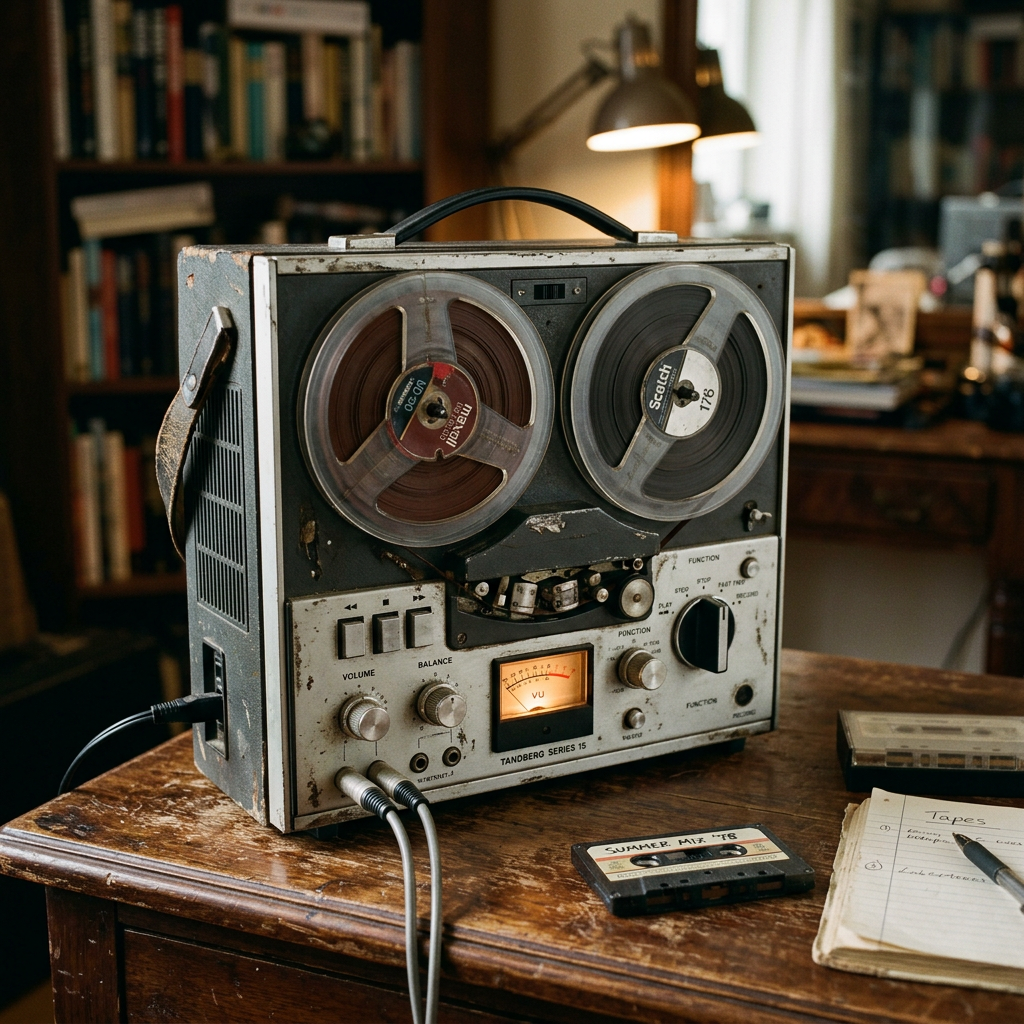
In the attic, in a chest someone had hidden under old curtains and a collapsed sewing machine — maybe Aunt Ilona herself, maybe even her father, my grandfather’s brother — I found a Tesla B41, an East German–Czechoslovak reel-to-reel tape recorder that had, surprisingly, kept its shape; it hadn’t rusted through completely, though its buttons had stuck and its power cord had frayed as if mice had been gnawing at the insulation. Beneath it sat a smaller cardboard box holding six reels, each with a handwritten label and a date: “September 3, 1979,” “September 9, 1979,” “September 14, 1979,” and so on, six dates, all from September and October of 1979, the last one marked “October 2, 1979.”
I had no idea whose machine it had been, and Aunt Ilona, who’d never once mentioned owning such a thing, wasn’t there anymore to ask. The neighbor, Aunt Margit, who’d come over to help me pack and spotted the chest, only said, “Oh, that old recorder — that was Judit’s, I thought someone would have carted it off with the rest of the junk long ago,” then changed the subject quickly, before I could press her further.
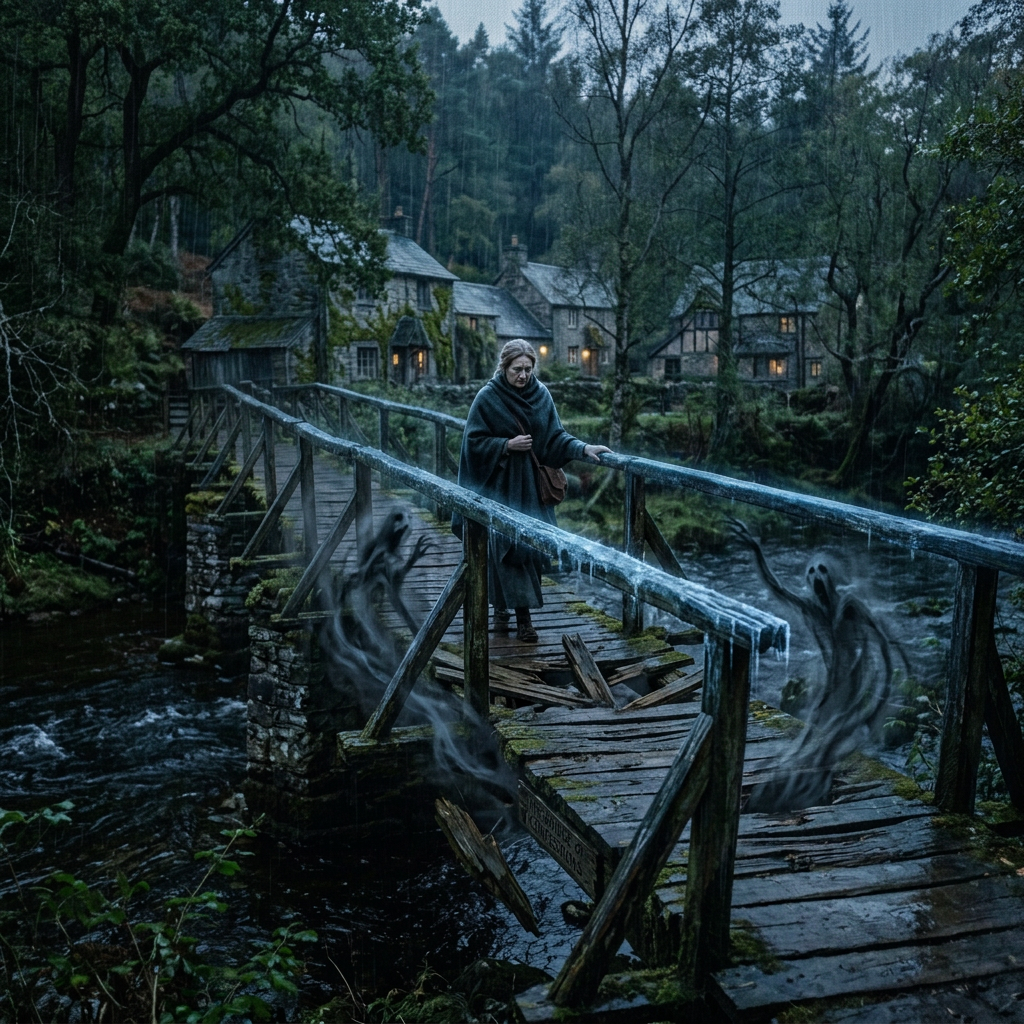
Kisbárkány was one of those villages where you learn everyone’s name within three days, and where more names repeat in the cemetery than live in the village at any given time. Aunt Ilona’s house stood at the end of the main street, beside a small stream the locals called the Devil’s Ditch, though no one could say exactly why; it dried up in summer and froze solid in winter, and at the back of her garden stretched an abandoned orchard that had once belonged to another house — torn down back in the eighties — leaving only the wild apple trees behind, crooked, untended, like a small forest at the bottom of the garden.
The first time I stepped into the attic, the door groaned as if no one had opened it in years, and the dust lay so thick on the beams that my flashlight beam seemed to cut through it in almost solid stripes. The chest holding the recorder sat in a corner, half-slid behind an old wardrobe, as if someone had deliberately tried to keep it out of sight, not merely store it.
That same evening I asked Aunt Margit exactly who this Judit had been, and where she’d lived, curious whether she too had been from Kisbárkány. Aunt Margit was still willing to talk then, before I pressed for real detail; she said Judit Varga had lived on the neighboring plot, right where the orchard now stood, alone, since her parents had died young, and that she’d been a very pretty, rather private girl who worked as a typist at the local council office. “We lived next to each other for years,” Aunt Margit said, “and then one day she just left, and they tore the house down, because no one wanted to move in.” I asked why no one had wanted to move in, and Aunt Margit didn’t answer that time, just got up and said she had to go herd the goats in.
I brought the recorder back to Budapest, curious what might be on it, and thinking that if nothing else, it would make an interesting ornament for my flat, a piece of the past. A week later, once I’d emptied every box in Kisbárkány and had the house ready for sale with an agent, I sat down at my own kitchen table beside the recorder, and one evening, with nothing else to do, set about cleaning the machine. I replaced the cord with a similar one I found at a retro electronics shop on the Grand Boulevard, and switched it on.
Before I did, I poured myself a glass of wine, because for some reason it felt like a solemn moment — a connection to a past that Aunt Ilona, whether she’d known about it or not, had left to me after all. I sat in the kitchen’s yellowish lamplight in front of the machine and wondered, for a second, what I hoped to hear — maybe an old radio drama, maybe a recording of some family celebration, something easily explained, pleasantly nostalgic.
The machine came to life surprisingly fast. The reels clicked, then began to turn, and a hiss of static came from the speaker, followed by a woman’s voice — young but firm, slightly hoarse, as if she smoked a great deal.
“September third,” the voice said. “I think I’m working too much, because these last few days I keep feeling like someone’s watching me. I don’t know how to tell anyone this without sounding crazy, so I’m just recording it instead — at least then I’ll have something to listen back to, in case it turns out this really is just exhaustion.”
Her voice was calm, almost distracted, as if reciting a diary entry for her own amusement. She said that in her garden, by the fence, for several evenings in a row, she’d felt as if someone were standing in the dark on the neighboring plot, where there was no house, only an abandoned orchard. The branches rustled sometimes, but that wasn’t strange in itself, she said — only that the rustling always started the moment she stepped out the back door, and stopped the moment she went back in.
Behind her voice, very faintly, you could hear the background noise too: a clock ticking without pause, and now and then a distant dog barking that seemed to swell every time Judit went quiet for a moment, fading back as soon as she resumed speaking. I didn’t think anything of it at the time, just the natural hiss of an old tape, but later, after replaying the same section many times over, I noticed that the rhythm of that barking matched Judit’s words precisely, as if the animal were listening to what she said, and reacting to it.
The recording ended there, with a soft click.
On the next reel, from September ninth, her voice was already less calm. “Recording again, because last night I finally saw what it is — or at least a piece of it. A shape, roughly the size of a person, standing in the orchard, half-hidden behind the biggest apple tree, and it didn’t move as long as I watched it, but when I went into the kitchen and looked out the window, it was already closer, right at the base of the fence. I never heard it cross the garden — no footsteps, no cracking branches — it was simply somewhere else than it had been before.”
Judit’s voice on this second reel was already more serious than on the first, though she still tried to take it lightly, laughing quietly at her own sentences now and then, as if trying to drain the weight out of them. She said she’d called her sister on the phone, but her sister had only laughed, said it was probably the neighbor’s cat, or a stray dog people sometimes saw on the hilltop. Judit — because by now I knew her name, since she’d introduced herself at the start of the recording, “I’m Judit Varga, today is September ninth” — didn’t buy the cat theory, because, as she put it, “cats don’t stand on two legs, and cats don’t cast a shadow at sunset as long as the one I saw stretching down the garden path, all the way to exactly where I was standing.”
That sentence scared me more than anything else I’d heard that evening. I stopped the machine, got up, and walked through my own flat turning on every light, though I knew it was ridiculous, that I shouldn’t be afraid of my own dark hallway because of a sentence recorded four decades ago. And yet, passing the bathroom door, I stopped for a second, certain something had moved in the mirror through the gap — though when I looked in, only my own face stared back, pale, more tired than usual.
The third reel, from September fourteenth, had an entirely different tone. Judit’s voice was tense, faster than before, and she kept falling silent as if listening for something mid-recording, and in those pauses the microphone picked up the background noise strongly enough that you could hear her own breathing, growing quicker with each successive pause.
“I locked everything early tonight, because last night something rattled on the windowsill, and when I looked, I didn’t see anything, but in the dew this morning I found footprints on the lawn, in a straight line from the fence to the window and back. The prints were strange — too long, and where the toes should have been there was no separation, just one continuous impression, as if someone had walked in boots, but boots unlike any I’ve seen.”
She paused, and on the recording you could hear her get up from the chair, walk somewhere, maybe to the window, then come back, the floor creaking under her steps exactly twice, as if she stepped on the same two spots every time.
“The worst part is that it knows which way I’m going to turn. This morning, when I went out into the yard and looked left, because I felt like that was where some kind of attention was coming from, it was already there, right through the gap in the fence, as if it had been standing there before I even looked, instead of appearing in front of me. I don’t think that’s a coincidence. If I look right, it’s on the right. If I look back, it’s already behind me. Sometimes I think maybe it isn’t behind me at all — maybe it’s inside me, looking out through my own eyes, just to see which way I’m going to turn.”
At this point I stopped listening. It was close to midnight, and the silence of my flat, which I’d never found particularly unsettling before, suddenly felt different, as if the walls had drawn a little closer together since I’d switched the recorder on.
The next day I told a friend of mine, Tamás, who enjoys this kind of old, odd object — he restores antique radios in his spare time — and he got very excited, said this was a classic piece of “found audio” that could be worth something to collectors if its story ever came out. He asked if I’d kept listening, and I admitted I was afraid to continue, which he just found funny; he said it was probably a performance, a radio-drama recording, or some seventies horror-radio experiment Judit — whoever she was — had made purely for fun, to show her friends.
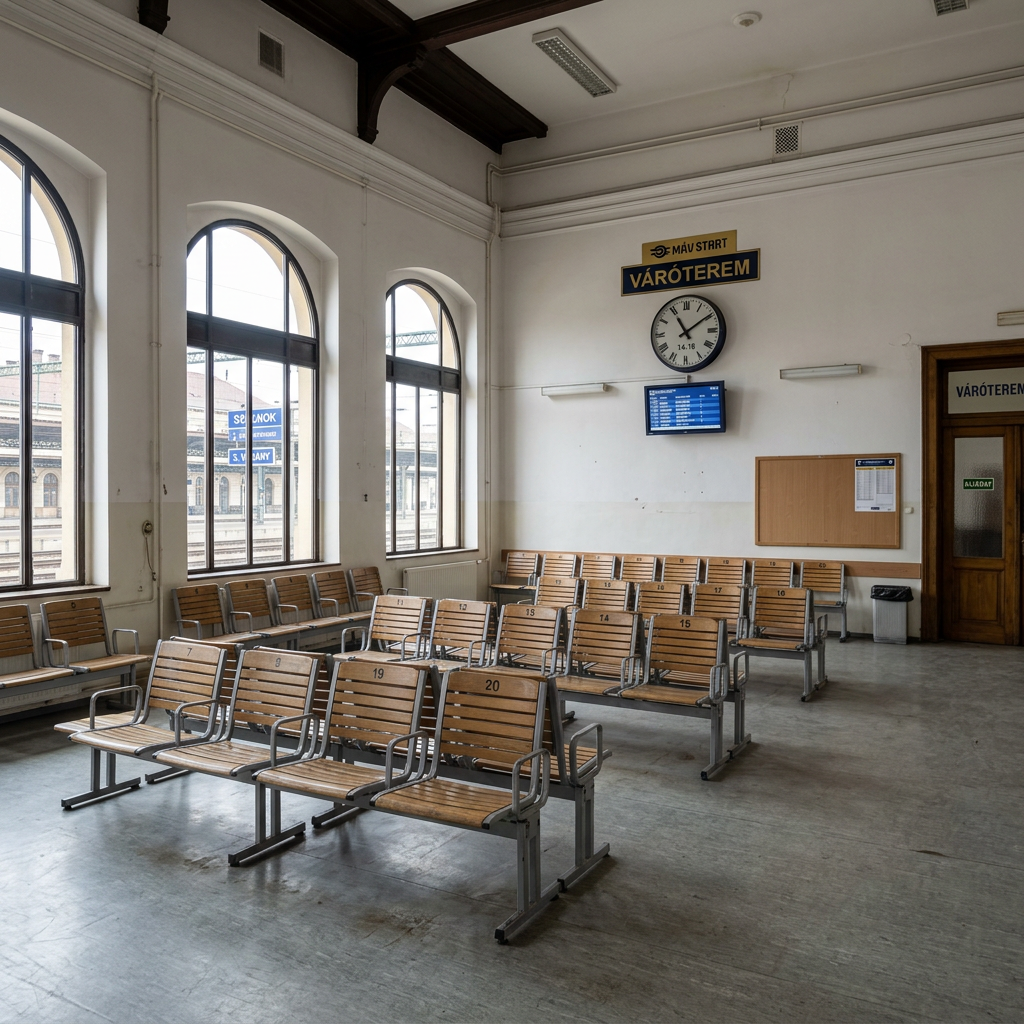
I asked Tamás if he’d want to come down with me to Kisbárkány for a weekend, thinking we might learn more on site than from the tapes alone. He agreed, and one Saturday we took the train down to Hatvan, then a local bus that only ran three times a day and jolted along narrow, potholed village roads for at least an hour before we reached the Kisbárkány town line. From the bus window I watched the harvested cornfields, brown and bare, and the hills on the horizon, behind which, Aunt Margit had once said, there used to be another village, though it had emptied out back in the eighties. The orchard Judit had described was still there at the end of the plot, neglected, the apple trees’ trunks blackish brown and cracked, the ground beneath them littered with rotting brown fruit no one had collected in years. We walked in among the trees, though the grass came up to our waists, and the air smelled strangely sweet-sour, rotting apples mixed with something else, harder to name.
The biggest apple tree, the one behind which Judit said the shape had first appeared, was still there, though one branch hung broken, like a dislocated arm, and its bark, at waist height, bore a row of parallel gashes cut deep into the wood, as if something long and thin had been dragged across it, long ago, and the tree had never quite grown over the wound, only closed around it like a scar. At the base of the trunk, where the roots broke through the soil, I found a hollow in the ground, oval-shaped, about the length of an adult foot, but with no separation where toes should have been, exactly as Judit had described on the third reel. It might have just been an old root scar, or some animal’s resting spot, but Tamás, when I showed him, looked at it for a long time and said nothing, just nodded and suggested we head back to the house. As we made our way out from among the trees, the sun was already sinking over the hills, casting long, thin shadows across the grass of the abandoned garden, and for a second, from the corner of my eye, I thought one of the shadows wasn’t pointing in quite the same direction as the tree it should have belonged to. I didn’t mention it to Tamás, afraid that saying it aloud would make it more real.
Before heading back to the train, we stopped in at Aunt Margit’s, who welcomed us happily, made coffee, put out some pastries — but when Tamás asked if she remembered anything specific about Judit, beyond the fact that she’d “left one night,” her face darkened, and she said that back then young people had talked a lot about someone watching them “from the garden” in the evenings — not just Judit, others in the village too — but no one dared talk about it much, afraid of drawing its attention by mentioning it too often. “There’s a saying here,” Aunt Margit said, “that whatever watches from under the gardens likes to be called by name. The more times you say someone’s name, the easier it is for it to find them.” I asked whose name she meant, and Aunt Margit just looked at me, strangely, for a long moment, as if weighing how much she should tell someone who hadn’t grown up here, and said: “Yours. The one it spoke.”
Just then an old man appeared in the doorway, whom Aunt Margit introduced as Uncle Pista, from the next street over, who’d heard there were visitors and dropped by for a minute. When he heard what we were discussing, he sat down at the table and, without anyone asking, started telling us that he too had known Judit, they’d gone to school together, and that in the last weeks before she disappeared, Judit wouldn’t let anyone into the house after dark, not even him, though he’d been close to her back then. “I knocked once,” Uncle Pista said, “and she shouted out the window for me to go away, because if I came in, ‘it’ might think I was like the one it was looking for, and then it would start watching me too.” I asked what happened after that, and Uncle Pista just shook his head and said the police searched for a few days, then called it off because “there was nowhere left to search,” and the village slowly agreed not to talk about it anymore, because “you shouldn’t feed whatever’s paying attention by talking about it too much.”
I asked Uncle Pista if he knew of others in the village something similar had happened to, and he sat quietly for a long moment, as if weighing how much to tell a stranger, then said that his own uncle had also “acted strangely” one winter, back in the early seventies, before moving to the city, and never once came back to the village after that, not even for funerals. “He said, before he left, that something had learned his voice,” Uncle Pista said, “and that once something learns your voice, you can’t hide from it anymore, because it can speak to you through it from anywhere.” Tamás laughed at that, a little forced, and said it sounded like a vampire story, but Uncle Pista didn’t laugh with him — just stood up and said it was time for him to go herd his own goats, same as everyone around here, and didn’t look back at us on his way out.
I would have believed Tamás’s theory, if not for that one detail in her voice that I don’t think could have been acted. The breathing, the pauses, the small tremor as she said “if I look back, it’s already behind me” — that wasn’t the voice of a prepared performer; that was real fear, the kind that isn’t easy to fake.
Two days later I continued with the fourth reel, from September nineteenth. On this recording Judit’s voice was barely controlled.
“I’m not sleeping,” she said. “I haven’t slept properly in three days, because when I close my eyes, I hear it getting closer. I locked the door early tonight, put in the bolt my mother left here too, and sat in the kitchen with the lamp on, waiting for the night to pass. Sometime around three in the morning I heard a knock on the window — not hard, just one finger, as if someone were gently trying to get my attention — but when I looked, there was nothing there, only my own reflection in the dark glass, and for a second — just a second — I thought my reflection wasn’t doing quite the same thing I was.”
The recording dissolved into a long silence here, maybe ten seconds, and sitting in my own kitchen, I found myself staring at the dark window glass, unable to stop myself looking, and though I knew it was absurd, it was a small relief when my own reflection moved properly as I moved. I got up, went to the window, and checked my reflection more closely, slowly raising my hand, watching whether it followed every motion in perfect time, and though it did, every single time, not slipping a second off, the simple fact that I’d felt the need to check was enough to send a chill down my skin.
The fifth reel, from September twenty-sixth, was short, barely two minutes. Judit’s voice on this recording was strangely flat, as if all the energy she’d spent fighting the fear had finally run out.
“I don’t know what to do,” she said. “I went to the council, said someone was harassing me, but they said there was no evidence, no one to look for. I went to the doctor too, because I thought maybe it really was all in my head, but he said I was healthy, just tired. No one believes it. And now it’s there all the time, not just at night. This afternoon, in broad daylight, it stood in the garden, by the side of the house, and when I started toward it, to finally face it, it simply wasn’t anywhere by the time I got there — but the footprints in the grass were still warm, as if someone had been standing on them only seconds before.”
Something about that last sentence sounded wrong to me — a strange hitch, as though a word had dropped out and another had slid into the gap, a stumble that didn’t sound like a simple stammer — and I rewound it, and listened again. The second time through, the hitch was there again, in the exact same place, folded into the sentence exactly the same way, like an error someone had deliberately left in, or that the tape itself had generated — a distortion that didn’t feel accidental.
Before continuing, I decided to back up the recordings, afraid the old tape might snap at any moment and whatever was on it would be lost forever. I took the machine to a small specialty shop on Wesselényi Street that, according to its sign, digitized analog audio recordings. The owner, an older, bespectacled man who introduced himself as Mr. Lőrincz, examined the machine carefully, praised its condition, and said the digitizing would take about a week.
Three days later he called, and his voice sounded strangely tense. He said there was some kind of problem with one of the reels — he couldn’t say exactly what, but when he worked on it, the equipment he used to digitize froze twice, and each time he restarted it, the file he’d saved so far came out corrupted. I asked which reel it was, and he said, “the fourth one, where the woman talks about the mirror.” I didn’t tell him what was on that reel; I didn’t even ask how he knew what the voice was talking about, because I was afraid of the answer. When I came to collect it the next day, Mr. Lőrincz handed over the machine and a USB drive with the digitized files in a hurry, and said he’d rather not take on another job like that again, though he didn’t explain exactly what he meant. When I asked how much I owed him, he just shook his head and said it was free, just take it and go, and not to tell anyone he’d done the work.
At home, going through the files on the drive, I noticed that one of them, the recording from the fourth reel, was three seconds longer than the original tape’s length should have allowed, as if some extra material had gotten into it during digitization that I hadn’t heard on the original tape before.
A few days later, when it occurred to me to look into what exactly Mr. Lőrincz had gotten out of handing the machine back in such a hurry, for free, I searched his name and found a short post in the archive of some defunct forum, where other collectors had written that Mr. Lőrincz had abruptly closed his shop for a few months some years back, then reopened it, but from then on refused to take on “private recordings of unknown origin,” only commercial material. No one described exactly what had happened, only that he’d made the decision over “something personal,” and that he didn’t like talking about it.
I tried calling to ask him about it, but the number I’d written down earlier now returned a “number does not exist” message, and when I went to the shop, I found it closed, a sign on the door reading “Closed for inventory” — though the same sign was still hanging there two weeks later, when I passed by again.
I let the machine rest for a day, because my hands were shaking when I switched it off, and I didn’t want to go straight into the sixth, final reel.
That evening, after stopping the fifth reel, I called my sister Kata, who lived in Debrecen, and though I didn’t want to tell her everything, for fear of sounding crazy, I mentioned I’d found an old tape recorder in Aunt Ilona’s house, with some strange recordings on it. Kata laughed and said it was probably some radio drama, and asked if I remembered how, when we were kids, Aunt Ilona always used to say that something “lived” at the edge of the village, by the orchard, that you weren’t supposed to look at after dark, and that she herself never walked that way after sunset, even as an adult. I didn’t remember that, but when Kata said it, a faint, old memory surfaced — a summer evening when Aunt Ilona had practically dragged me into the house before it got dark, and wouldn’t let me stay out in the garden, though at the time I hadn’t understood why she was so anxious. Kata, as if sensing the tremor in my voice down the line, suddenly turned serious and asked if I was sure I was all right, because I sounded “strange lately.” I reassured her I was just tired from all the cleaning, though my eyes drifted to the recorder sitting silent and still in the corner, and for a moment I wished I’d never brought it up from that attic.
Meanwhile I started noticing things I’d never paid attention to before. My flat, where I’d lived six years without a single problem, suddenly filled with small, unexplainable sounds. One evening, sitting in the kitchen, I heard something rattle on the windowsill outside, exactly as Judit had described on the third recording. I looked out, and there was nothing there, just the dark street, a car or two parked, the neighboring building’s wall. But the next morning, stepping out onto my small inner terrace, where I kept a few potted plants, I found one pot shifted, slid a few centimeters out of place, as if someone had stumbled into it in the dark.
I didn’t tell anyone, knowing how ridiculous it would sound to say I’d started being afraid of my own terrace because of a recording made four decades ago.
One evening, about a week after listening to the fifth reel, walking home from work I decided to take a detour through Klauzál Square instead of my usual route, because it was cooler there and I liked the square’s atmosphere at sunset. Crossing the square, I saw a dog sitting alone on one of the benches, no leash, watching me — exactly the way I’d already described to myself before, though I hadn’t actually encountered this particular dog yet; I only realized afterward, looking back, that its stare matched exactly what Judit had called “too attentive” on the fourth reel, in a part I hadn’t heard yet at the time, but would later stumble onto in a further replay. The dog didn’t bark, didn’t move, just followed every step I took with its eyes until I disappeared at the far end of the square.
That night I woke sometime around three in the morning, exactly as Judit had described on the fourth reel, and lay in the dark for long seconds, listening to the silence of the flat, before I realized what had woken me: something was knocking lightly but firmly on the window, once, then again, in a rhythm too regular to be a branch or an insect. I didn’t go to look. I pulled the duvet over my head and told myself I’d think about it rationally in the morning, but by morning even the memory of the knocking had blurred enough that I wasn’t sure anymore whether I’d simply dreamed the whole thing.
Early in October I went back to the fourth reel to listen again, feeling there was something in it I hadn’t registered precisely enough. When I reached the part where Judit talks about the mirror, I heard a new sentence I was certain hadn’t been there before: “I think I recognize that face in the mirror, I just don’t think it’s me.” I stopped, rewound, listened again, and the sentence was there, in exactly the same spot where it hadn’t been the first time I’d listened — or at least I didn’t remember it being there.
I started telling myself that I simply hadn’t paid close enough attention the first time, that I must have missed that part because I was tired, or because her voice had faded and I hadn’t noticed. That was the most reasonable explanation, and I clung to it for days.
But that evening, just to be sure, I went back to the first reel too, which I’d thought of until then as calm, almost boring, and listened to it again start to finish. At the beginning, where Judit talks about “working too much,” there was now a new sentence I was certain hadn’t been there before, because the first time I’d listened I’d written down, separately, in a note, what she said — and this wasn’t in it: “I hope it’s all right if I come back to this part later, and add something more, once I know who this recording is really for.” Her voice was exactly as calm as it had been through the whole first recording, as if that sentence had always belonged there and I simply hadn’t picked it out before, or as if the tape itself had decided when to let me hear it.
That was the moment I stopped assuming my own inattention was to blame. Something in the tape — or through the tape — was gradually revealing itself, in an order and at a pace that wasn’t mine to set.
In mid-October, Tamás came over to listen to the recordings, curious about them, and suggested we listen through the first three together, in case he noticed something I’d missed. We listened through, and he nodded excitedly, said this was a fantastic piece, probably the work of some underground playwright or performance artist who’d deliberately left details like this in the recording to make it seem more authentic.
But when we reached the end of the third reel, the part where Judit says “if I look back, it’s already behind me,” Tamás’s face darkened, and he said it was odd, because a second earlier, right as the voice said that line, he’d seen some movement behind me, from the direction of the front hall, out of the corner of his eye, but when he looked up, there was nothing there. We laughed it off, told each other it was just the mood getting to our imaginations, but Tamás went home earlier that evening than he’d planned, and told me to call him if anything happened.
Two days later, on a Wednesday evening, I decided to listen to the fifth and sixth reels back to back, because I was tired of waiting and wanted this uncertainty finally over with.
I already knew the fifth one, with its odd hitch in the sentence, but this time, when I reached that point, I heard another flaw I hadn’t noticed before: right after that sentence, before Judit continued, another voice cut in, very briefly, barely a second, and it wasn’t Judit’s. It was deeper, and said a single word I couldn’t make out for certain, though it sounded most like a name — maybe my own, though I couldn’t have sworn to it at the time.
I rewound, listened again. The second time, the word came through more clearly: “Bence.” My own name.
I switched off the machine and sat in the dark for several minutes, trying to rationalize it, telling myself it was surely just my own tired brain, that the long listening, the dim light, the tension had all added up, and my mind was seeing patterns in a noisy, distorted, four-decade-old tape that could have held any word I wanted to hear in it.
But I couldn’t continue that evening. I went to bed, though I barely slept, and the next morning, heading out to work, I saw a stray dog standing motionless in the shadow of the gateway across the street from my building, watching me — not barking, not moving, just watching, until I turned the corner, and when I looked back, it was gone.
In the days that followed I barely slept, and when I finally did, the same dream kept returning: I stood in a dark garden, knowing someone was among the trees, but unable to decide which way to look, because whichever way I turned, the thing was already there before I looked. One morning I woke to find my pillow damp, as if I’d been crying in my sleep, though I couldn’t remember any specific detail of the dream itself, only the constant, persistent sense of being watched.
My coworkers, in the office where I worked, started giving me odd looks, and one of them, a woman named Petra at the next desk, asked once if I was feeling well, because I kept “staring off into nothing like I was listening to something.” I told her I just wasn’t sleeping well, but at home, remembering Aunt Erzsi’s line from the sixth reel, which I hadn’t even heard yet at the time but which was already there, I found myself thinking that maybe Petra’s remark had been exactly the same thing another older woman had once said to Judit forty years before, only in different words, from a different mouth.
At work I found it harder and harder to concentrate on the spreadsheets, and my boss asked twice if I was all right, because I seemed “elsewhere,” which I could hardly have explained to him without sounding completely unreliable. I started closing the blinds earlier every evening, though I’d never bothered with that before, and once, when I forgot and only remembered around two in the morning, I didn’t dare go near the window — I slept in the bathtub instead, wrapped in a blanket, which was hard enough to admit even to myself.
That evening I couldn’t hold out any longer, and started the sixth, final reel.
Judit’s voice on this recording was barely recognizable. She whispered, fast, hurried, as if expecting at every moment that someone might walk into the room.
“October second. I’m not going to record anymore, because I’ve realized something I can’t explain, and that scares me more than anything so far. I listened back to the recordings I made before, today, and they were different from how I remembered them. There were things in them I didn’t say — I’m sure I didn’t say them — and yet there they are, in my own voice, hidden among my own words. I don’t think it only watches me from outside anymore. I think it can get inside what I’ve already recorded too, and watch from there as well, backward, from a time that hasn’t happened to me yet, but has already happened to it.”
She said that in the last few days she’d stopped even trying to leave the house after dark, that she’d taken her dog, which she hadn’t even mentioned on the recordings until now, to her sister’s, because the animal hadn’t eaten in days and spent the whole day staring motionless at one point in the house, as if it saw something she didn’t — and that when she tried to draw its attention away from that spot, the animal had started trembling and made a sound she’d never heard from it before, not a growl, not a whine, but a long, deep groan, as if it came from the throat of something far larger than a dog. She said her coworkers at the council office had started giving her odd looks, because twice they’d found her staring blankly over her typewriter, and that one of her older colleagues, a woman named Aunt Erzsi who’d worked there for years, had once pulled her aside and told her: “I know that look, dear. My grandmother had it too, before she disappeared. But we don’t talk about that. We never talk about that.”
I heard Judit take a deep breath, and her voice sank even lower, barely audible.
“If anyone’s listening to this, if this tape ever reaches anyone besides me, please, don’t keep listening. Don’t play back the parts you’ve already heard. Every time you replay it, you bring it closer to yourself. I’ve already gone too far with this, and now—”
The recording cut off there, not with a soft click like the earlier ones, but with a sharp, crackling noise, as if someone had suddenly switched the machine off, or as if the tape had torn — though when I checked the reel, the tape was intact, no break, no splice.
Then there was silence, a long silence, maybe half a minute, and I was just about to stop the recorder when another sound appeared on the tape, very quietly, barely perceptible beneath the background noise: footsteps, slow, even footsteps, as if someone were approaching through a room the microphone hadn’t fully captured, and the footsteps didn’t seem to be receding — they seemed to be moving straight toward the recording’s “now,” as if someone were about to step out of the speaker itself.
I switched off the machine and stepped back in the kitchen, my heart pounding so loudly it thundered in my own ears.
In the days that followed I tried not to think about any of it. I went to work, met up with Tamás, tried to live a normal life, but Judit’s last sentence kept circling in my head: “every time you replay it, you bring it closer to yourself.” I’d already listened back to the third and fifth reels three times each. If what she’d said was true, it had to be a great deal closer now than when I’d started.
I tried searching the internet for Judit Varga’s name, hoping to find something about her — an obituary, an old article, anything — but nothing relevant came up, only a few living people with completely different lives who happened to share the name. I called Aunt Margit and asked what had happened to Judit, who’d owned the recorder, and after a long silence Aunt Margit said, “You’d be better off not getting involved with that girl — that was all a very long time ago, and it didn’t end well.” When I asked how it had ended, she only said, “She left one night, and they never found out where,” then changed the subject quickly and refused to continue, no matter how I tried to steer it back.
A week later, more unsettled than I’d ever been, I called her again, and this time asked outright whether she’d ever heard about recordings Judit had made for herself near the end. Aunt Margit’s voice trembled strangely then, and she said yes, she remembered Judit always carrying that little machine around, and that in her last weeks she’d told everyone she had to record everything, “because if something happens to me, at least there’ll be proof,” but that no one had taken it seriously, because at the time the whole village believed Judit had simply started acting strange from loneliness. “Now I think I believe she wasn’t alone on those nights,” Aunt Margit said, “though I would never have said that out loud before.” I asked why she was saying it now, and she only answered, “Because you’re listening to those tapes too, aren’t you? So it hardly matters what I say anymore.”
That answer gave me nothing concrete, only more questions, and a feeling that whatever the villagers still, four decades later, refused to talk about must have been far worse than anything I’d heard on the recordings.
One night, when I could no longer bear the uncertainty, I decided to get rid of the recorder. I put it in a large sports bag along with the reels and carried it down to stand by the bins in the stairwell, thinking the garbage truck would take it in the morning and the whole matter would be over. When I got home from work the next day, the bag wasn’t by the bins — the building caretaker said there’d been nothing like that there that morning when he’d gone out, though the trash was always collected right on schedule. My own flat door was locked exactly as I’d left it that morning, but when I stepped inside, the recorder stood in its usual spot in the corner, the bag nowhere to be found, and the reels neatly arranged beside it on the table, in the exact order I’d originally found them in the chest in Kisbárkány.
I couldn’t explain this to myself, and I didn’t try to explain it to anyone else either. From that moment I knew this wasn’t simply an old, interesting object you could get rid of once you decided to.
Two days after that, one morning, stepping out onto my small inner terrace to water the potted basil I kept on the windowsill, I found tracks running in a straight line through the thin layer of dust on the terrace floor, from the railing to the door and back. The tracks were long, too long for a human foot, and where the toes should have been there was no separation, just one continuous impression, exactly as Judit had described on the third reel, from her own garden’s lawn. I knelt down and ran my finger along the edge of one print, and though I knew it was absurd, it was a relief when the dust under my finger remained simple dust, nothing more — no strange cold, nothing I could put a name to.
I didn’t sweep the tracks away. I left them there for days, because for some reason it felt like sweeping them up would be admitting to myself that they’d really been there, and that they really meant something. Every evening, before going to bed, I checked the terrace, and every evening they were still there, exactly as sharp, as if the rain and wind that regularly hit that terrace simply couldn’t get a grip on them.
Around October twentieth, on a Thursday evening, while I sat in the living room trying to work on my laptop, the recorder, which I’d left in one corner, clicked on with a snap, signaling it had power — though I was certain I’d unplugged it from the wall two days earlier. I looked up, and the small red indicator light was lit, though the cord hung loose on the floor, far from any outlet, connected to nothing.
I didn’t go over right away. I just sat and watched the red light, burning steady, calm, as if there were nothing extraordinary about a disconnected machine being switched on.
Finally I went over, and the reels, which had stood motionless since I’d stopped the machine at the end of the sixth reel, slowly began to turn, though the play button wasn’t pressed, and from the speaker came a very quiet but clearly distinguishable voice — a voice I recognized immediately, because I hear it every day when I talk, when I play back my own voicemail, when I watch my own videos back: it was my own voice, with my own inflection, my own breathing rhythm, saying, exactly the way Judit had said it forty years earlier, except now about me, now, in this very moment:
“October twentieth. I think I’m working too much, because these last few days I keep feeling like someone’s watching me.”
My voice — because I forced myself to think of it that way, even though I knew in every fiber of my being that I hadn’t actually spoken into any microphone — continued, with exactly the inflection Judit had used on the first reel, as if reading from a script someone else had written for her, except now the words were about my life: my flat’s address, closing the blinds every evening, the dog on Klauzál Square, the knocking on the window at three in the morning. I heard my own voice say, “Today it came right up to the window,” and at the end of the sentence there was a small pause, exactly like the ones Judit left in her own recordings before continuing.
I stepped back in the kitchen, my back hitting the fridge, and from there I watched the recorder working on its own, the reels turning steadily though nothing had started them, the red light still burning, calm, as if nothing out of the ordinary were happening. The voice from the speaker fell silent for a moment, and in the quiet that followed, I heard something tap lightly against the window, outside, from the dark street, once, then again, in exactly the rhythm Judit had described on the fourth reel.
I didn’t dare look over. From the speaker my own voice continued, faster now, hurried, in a rhythm I’d never heard from myself when actually awake and actually speaking: “I’m not sleeping. I haven’t slept properly in three days, because when I close my eyes, I hear it getting closer.” The words matched Judit’s fourth reel exactly, only now in my voice, with my breathing, and the tapping on the window continued through it, steady, as if patiently waiting for the recording to reach the right sentence.
My phone, which I’d left on the table, began lighting up, though it hadn’t received a call, and when I turned toward it, a voice-memo app I’d never installed had opened on its own, and the recording counter started climbing from zero, as if something were beginning to record right now, in this moment, and there was no way to stop it, because my finger, when I touched the screen, didn’t register on any button. The screen glowed cold in my hand while the recorder kept my own voice going through the sentence I’d never spoken, but which I now heard, word for word, coming out of that speaker.
The tapping on the window stopped for a moment, then started again, no longer all at once but in pairs, as if two fingers were knocking one after another, in exactly the rhythm Judit had described hearing on the windowsill on the fourth reel, and the recognition of that made my stomach clench, because it meant that whatever stood outside my window now knew the pattern from the tape precisely, as if the same intelligence had authored both, across four decades, one and the same hand. From the speaker, my own voice — faster now, hurried, in the rhythm of Judit’s final recording — said: “If anyone’s listening to this—” The sentence cut off, in exactly the same place Judit’s sixth reel had cut off all those years ago, with that same sharp, crackling noise, and on my phone’s screen the counter kept climbing, second by second, toward a recording I hadn’t started and couldn’t have stopped, even if I tried with everything I had.



Leave a Reply