

They say that in Stonecleft there lives a family whose house never knows silence, because ravens always perch along the roof ridge and in the old oak in the yard, and this is no curse but a blessing, though the village sometimes finds the two hard to tell apart. This family is the Ravensworth line, and their name did not come down with their blood, but from a vow made by a great-great-grandfather of theirs, many generations ago, on a night when the ravens saved the village.
Stonecleft is not a large village — a few streets of houses, pastures around them, and a narrow river that comes down from the mountains, deceptively calm, because when heavy rain falls in the hills, it can rise suddenly and with great force. The villagers have lived alongside this danger for a long time, and perhaps that is exactly why they took the ravens into their daily life so readily, like people who know it would be foolish to refuse nature’s warnings, whatever shape they arrive in.
The story begins with Stonecleft not yet called Stonecleft, but simply the Village by the Stream, and a shepherd named Bálint Black who lived at the village’s edge, sleeping out beside his flock in a hut each night, since it was his task to guard the sheep from wolves.
*
One autumn night, when the moon barely showed through the clouds and the air felt strangely restless, Bálint woke to find the ravens, who usually sat silent in the branches of the nearby trees, suddenly breaking into loud, chaotic shrieking, circling above his head, some even diving at him, beating his face with their wings as though trying to drive him from the hut.
Bálint at first waved them off angrily, thinking some madness had taken hold of the birds, but when one raven struck him hard enough to knock off his hat, and another flew to the roof of the hut and circled there, as if trying to point something out, he crawled outside to see what was happening.
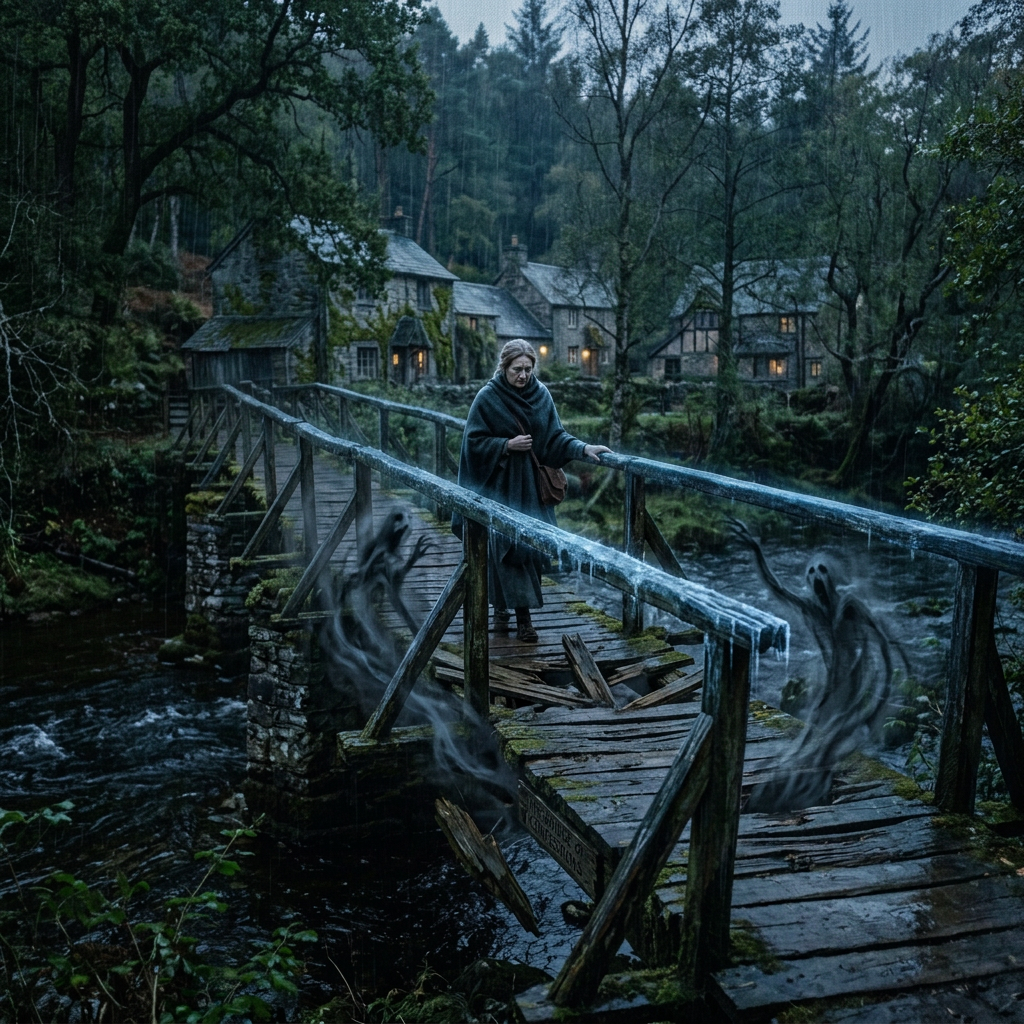
He had barely stepped out when he heard a distant roar — not wind, not thunder, but something deeper, a sound that seemed to come from beneath the earth, as though the mountain itself were groaning. The stream, which usually ran quietly past the village, had suddenly risen, for higher up in the mountains, after days of rain, a landslide had dammed the riverbed, and now that the blockage had given way, the gathered water was rushing down all at once, a sudden flood that would reach the village within minutes.
Bálint did not think twice. He ran as fast as he could into the village, shouting and waking the houses, and though many at first cursed him angrily for raising such a racket in the dead of night, by the time the first water reached the village’s edge, everyone was already out in the streets, fleeing to higher ground. The water flooded the bases of the houses and carried off the roofs of a few sheds, but no one died that night, and this was owed entirely to the ravens not letting Bálint sleep.
When Bálint went back to his hut the next morning to see what remained of it, he found a handful of grain scattered on the ground — left there by someone, though he himself did not recall pouring it out — and above it, on a branch of the old oak, sat the very same ravens that had startled him, quiet now, as though waiting for something.
Bálint, before he even fully understood what he was doing, knelt beneath the oak and vowed aloud that as long as he and his descendants lived, they would leave grain and scraps of meat beneath the tree every dawn for the ravens, and would never, under any circumstance, harm, kill, or drive off a single raven on their land, in exchange for the ravens warning them again, whenever danger approached, as they had that night.
When the village heard what had happened, and saw that Bálint truly kept his vow, they began calling him by a different name — not Black, but Ravensworth, for, they said, “whoever hears the ravens’ voice is given a name by the ravens too.” The name stuck to his family as well, and his descendants carry the name Ravensworth to this day, though the original family name, Black, faded from memory long ago.
*
The rules of the pact were simple, but the Ravensworth line always took them seriously, for they knew that a single broken rule could put the whole village in danger.
Every dawn, before sunrise, someone from the Ravensworth house had to walk out to the old oak — which the village came to call the Raven Oak — and leave a bowl of grain there, and, when there was any to spare, a piece of meat or fat too, for ravens, it is said, love meat as well as seed. This could never be skipped, even when the family itself went hungry, for belief held that the ravens took offense if the bowl stood empty even a single day, and that the memory of such an insult lingered long in them.
A raven could never be harmed, neither at the Ravensworth house nor anywhere in the village, and if someone, by accident or intent, wounded or killed one, the Ravensworth line had to make amends at once with a larger, special offering — a whole lamb, or a sack of grain — carried beneath the oak, the apology spoken aloud as they did, naming the fault plainly.
And every year, around the winter solstice, the head of the Ravensworth line — always the eldest, who bore the vow — stood beneath the oak in a special ceremony the whole village gathered to witness, and repeated Bálint’s original vow aloud, word for word, as it had been learned across generations, so that the pact would never fade with time.
In return, the ravens warned the family — and through them the village — of every approaching danger, though not always in the same way. Over the years the village learned to read the signs: three sharp cries, one after another, from atop the oak meant fire was coming, or had already begun somewhere nearby. If the ravens suddenly began circling above the village at dusk instead of settling into their usual roosts, it signaled death approaching — not necessarily a particular person’s, but some general danger soon to threaten someone’s life. If a single raven landed alone on someone’s roof and stayed there, unmoving, it signaled the arrival of strangers, perhaps robbers or raiders. And if the ravens ever abandoned the oak altogether — all of them, at once, with no warning at all — this was, by family tradition, the gravest sign anyone had ever seen since Bálint’s time: it would mean some danger so great approached that the village could not survive it alone, only by fleeing at once.
The Ravensworth line always knew that the pact did not exist only in this form in their own village. Bálint once, in his own lifetime, traveled to a market in a distant region, and there heard of another family who, generations earlier, had followed the flight of a pair of swallows instead of ravens, and made a similar vow to them. There, however, the third generation — a young man who no longer believed in the old ways — once tore down an entire swallows’ nest from beneath his roof’s eaves, because “the mess bothered him,” and from that day the swallows avoided the house, and never returned. Two years later a nighttime fire destroyed the whole quarter of the village where the house stood, and no one warned them in time, because there was no longer anyone left to give the warning.
Bálint carried this story home and told it to his son, Mátyás, who told it to his own son in turn, and so it passed down, all the way to Zsóka, who as a child heard this tale often from her grandmother, as a warning of what can happen when a family forgets what it owes to those who keep watch over it. “I’m not telling you this,” her grandmother always said at the story’s end, “to frighten you, but so you know: our pact isn’t some singular miracle, only one among many that people and animals have made with each other over the years — and not all of them survived, because not everyone guarded theirs as faithfully as we have.”
When Zsóka herself began to doubt, years later, this story stirred in the back of her mind too, though at the time she used it mostly to reinforce her own doubt: what if they too would end up disappointed one day, like that family with the swallows; what if the ravens, too, would simply leave one day, like the swallows had, not because they’d been offended, but because they were only animals after all, who went wherever suited them better. Only after the dam broke did she truly understand why her grandmother had always told the story so gravely: not to prove that the pact always works, but to show what it costs to let it go.
*
Across generations the Ravensworth line faithfully kept the pact, and the village learned to trust it, even when the signs seemed strange or excessive.
Bálint’s son, Mátyás Ravensworth, once as a young man faced down a band of outlaws who, without the ravens’ warning, could never have taken the village by surprise. One early morning, as Mátyás carried out the usual grain beneath the oak, he noticed a lone raven land on the roof of a barn at the village’s edge and stay there motionless — not flying off, not cawing, just sitting, like a sentry. Mátyás, who had known this sign since boyhood, ran straight to his father and told him what he’d seen. “Strangers are coming,” said Bálint, and though there was no way to know whether they came with good intent or ill, the village’s men leaned toward caution, and armed themselves with weapons, scythes, and spades, waiting to see what would happen.
Around midday a band of roughly ten outlaws arrived, clearly planning to fall upon the village by surprise, drive off the livestock, and carry away what they could before anyone could prepare. They came up the road from the south at a trot, confident of an easy raid, and the look on their leader’s face when he saw the whole village armed and waiting in the square was, by every account passed down, worth remembering on its own. But because the village was already waiting, and their first attempt at attack met resistance at once, the outlaws quickly saw they had no chance, and withdrew without managing to plunder a single house. Mátyás, only seventeen at the time but already versed in the signs, held the ravens’ warnings in especially high regard from that day on, and later, when he took the office from his father, always told this story first to his own children.
Mátyás’s son, Illés Ravensworth, lived through a harder test: one spring, when the river rose dangerously again, as it had in Bálint’s time, the ravens once more woke him with a loud alarm, and this time it was not only he who fled in time — he ran from house to house all night, waking everyone before the water could reach the village. He pounded on the doors with his fists, and those who didn’t want to believe him, who said, “go back to sleep, Illés, nothing’s wrong,” he simply pulled from their beds, leaving no time for argument. By morning, when the water truly did reach the village’s lower streets, everyone he had woken was grateful, even those he had dragged most roughly from sleep.
Illés later told his son that night had taught him that “the pact isn’t just an old story — it’s a living bond we renew every day by keeping it, and sometimes by believing for others too, when they cannot yet believe for themselves.”
Illés’s son, Márton Ravensworth, lived through the hardest trial of all in a year of want, a drought year when the harvest failed almost entirely and the village went hungry. Márton’s own family went hungry too, and one evening, when his children cried from hunger and he had nothing to give them, Márton stood in the pantry, the last piece of bacon in his hand, the very piece he was meant to carry beneath the oak at dawn, and stared at it a long while, wondering whether he might give it to his children instead.
His wife, Zsuzsanna, standing beside him, said, “If we break the vow now, and the ravens leave us, what becomes of us when the next danger comes, and no one is left to warn us?” Márton had no answer to this, but he did not sleep that night, and at dawn, when he went out to the oak, his hand trembled as he set down the bacon, for he knew his own children lay at home with growling bellies.
Three days later, when his youngest son, a boy of five, had grown so weak with hunger he could barely rise, and Zsuzsanna, even that same night, could only rock him with tear-filled eyes, for there was no strength left in his body even to cry, Márton, in his desperation, set out for the neighboring village to beg for help, and on the road, which he had never walked before, found an abandoned but still-bearing orchard no one knew of, belonging to some old, emptied estate. He carried the fruit home, and it helped his family through the worst weeks of want, until the spring harvest ripened. Márton never thought this chance. “The ravens don’t give us food directly,” he told his son later, “but I believe they sometimes show us the way, if we look closely enough.” He never forgot the sight of his wife’s face when he returned with the fruit slung in his shirt, nor the way his youngest son managed, for the first time in days, a weak but real smile when he tasted it. That memory alone was enough, for the rest of his life, to settle any doubt that ever tried to take root in him again.
*
Márton’s son, Dezső Ravensworth — the generation between Márton and the one after, taken by an early illness before he could fully teach his own son — though he lived a short life, stood through one memorable test the family went on telling for years. One winter night, when he was only twenty and had taken the office from his father not long before, the ravens signaled approaching strangers with the landing of a single bird, and Dezső, though he doubted, for he had never yet seen this sign prove true with his own eyes, leaned toward caution anyway, and woke his neighbors. It turned out a roving band of robbers was ranging the countryside, and though in the end they did not turn toward Stonecleft, the readiness Dezső organized that night later discouraged another band that truly meant to attack, for word had spread that this village never slept unprepared.
This was the inheritance Zsóka Ravensworth received, for her grandfather, Dezső, died of that early illness before he could fully teach his own son, Zsóka’s father, who thus learned only half, and had to work out the rest of the pact’s details on his own — and who then, through his own untimely death, passed the office to Zsóka very young, because there was no one else to take it.
Zsóka’s father, Gábor Ravensworth, led the pact with an uncertain hand of his own, for as a half-taught man he always feared he might ruin something he didn’t even know he was supposed to know. Despite this he took his task seriously, and from the age of five carried Zsóka, his only child, to the oak with him every dawn, so she would learn the custom before she even truly understood what it meant. “I don’t know everything my grandfather knew,” he often told her, “but I know that what I do know, I must pass to you, so that at least as much as can be saved will be.” Gábor died in a hunting accident when Zsóka was only fifteen, and the office fell to her then, suddenly, unprepared, far sooner than she had ever expected.
In the first years she learned what she could with the help of her father’s wife, her grandmother, but many details were lost along with them, and so Zsóka always experienced the pact a little like a house she had not built herself, whose every corner she did not know, but in which she had to live, and which she had to maintain, whether she fully understood it or not. There were signs her grandmother couldn’t fully explain either, gestures and habits passed down more as motion than meaning, so that Zsóka sometimes found herself performing a small part of the ritual without knowing exactly why, only that it had always been done that way, and that stopping felt more dangerous than continuing in ignorance.
Zsóka was a widow, raising two children alone — a ten-year-old boy, Boldizsár, and a six-year-old girl, Erzsi — since her husband’s death from a winter illness some years before this story truly begins. Her life was hard, and grew harder still when another drought year settled over the region, and the harvest again came in thin.
Zsóka often thought back, in these hard years, to her grandmother, to how she had taught her as a small child, standing beneath the oak, though her grandmother herself had known only a fragment of the pact’s full detail. “It’s no matter if we don’t understand exactly why it works,” her grandmother once told her. “We only need to know that it works, if we stay faithful to it.” As a child Zsóka had taken this for simple wisdom, but grown, in the middle of her own doubt, she found it harder and harder to recall why she had once believed it so easily.
*
Zsóka kept the custom faithfully in the first years, going out to the oak every dawn, but her heart grew more and more bitter. She heard the village whispering behind her back: “Poor Zsóka, still believing those old tales about the ravens,” or “Why does she waste food on those birds when her children go hungry?” Some asked her outright, to her face, whether she thought it foolish to keep up such an old, unprovable tradition in a year when every mouthful counted.
Zsóka snapped back angrily at first, but in time her own doubt began to grow as well. After all, she thought, when had the ravens truly warned of anything serious in her own lifetime? Nothing like what had happened to Bálint or Illés had ever happened to her — only small signs, minor alarms, sometimes proven true, sometimes not, which the village had slowly come to treat as background noise rather than real warning.
There had been one incident, three years earlier, that had badly damaged Zsóka’s credibility, and which the village often brought up whenever they doubted her. One night the ravens suddenly broke into loud alarm, three sharp cries, which tradition held meant fire, and Zsóka, frightened awake, roused the entire village, driving everyone from their houses, certain fire approached from somewhere. But there was no fire anywhere — no one ever learned for certain what had disturbed the ravens that night; perhaps a fox had wandered too close to the oak, perhaps the whole flock had simply been seized by some bad dream, if birds can have such things. The village, needlessly roused in the dead of night, woke the next morning more annoyed than grateful, and many, from then on, took Zsóka’s alarms less seriously, saying among themselves, “See, the ravens are only birds — they play the fool sometimes too, like anyone else.”
Zsóka herself thought often of that night during the dry summer, and it too contributed to her growing uncertainty. If the ravens were capable of false alarm, she thought, perhaps they weren’t as reliable as her family had always believed, and perhaps the meat she sacrificed to them daily was truly just the price of an old, needless superstition her own age could no longer afford.
Around the same time, a traveling schoolteacher also appeared in the village, a man who made his way through the countryside from a nearby town, bringing books and new ideas with him. When he heard of the pact of ravens, he told the crowd gathered at the market, laughing, that “birds fly the way they fly simply because the wind blows them that way, and the human mind is prone to see a pattern where there is only chance.” He spoke of the movement of clouds, of air pressure, of how birds feel a coming storm in their very ears, not through some secret knowledge but through ordinary bodily sense, which every animal knows. Zsóka, standing in the market listening, could not truly refute this — for she herself did not understand precisely how the ravens “knew” what they knew — and the teacher’s words haunted her for days afterward, because they sounded so reasonable, and Zsóka was, just then, most susceptible of all to seeking shelter from her own doubt in things that sounded reasonable.
*
On a hot, dry summer evening, when her children had eaten less than they needed for days, and Boldizsár asked her, “Mother, why do the ravens get meat when we have none?” Zsóka could not at first answer. That night, once the children were in bed, she went to the pantry and looked at the last piece of meat, which she was meant to carry to the oak the next morning, and decided this time to keep it for her children.
She told no one what she had done. In the morning, when she went out to the oak, she left only a smaller portion of grain, no meat, and tried not to look at the ravens, who, she felt, watched her with a strange quiet as she turned quickly and went home.
For days nothing happened, and Zsóka took this as confirmation: see, the ravens hadn’t taken offense, the world hadn’t fallen apart, perhaps the whole pact was only an old tale her family had taken too seriously across the generations. The next day she brought only grain again, an even smaller portion, keeping the meat for her children. On the third day she didn’t go out at all, having overslept, exhausted from the day’s work, and only noticed around noon that she had missed the custom entirely.
Meanwhile, more and more in the village spoke of how perhaps it was time for someone else to take over the Ravensworth line’s role, or to abandon the custom altogether, since “if Zsóka herself doesn’t truly believe in it anymore, why should we bother.” A plain-spoken farmer named Kelemen Varga declared openly at the market that “ravens are just birds, and anyone who trusts the village’s safety to a bird is a fool.”
On a market day Kelemen confronted Zsóka openly, in the middle of the market square, within earshot of many. “Tell us, Zsóka,” he began, arms crossed, “when did your birds last truly help anyone? In your father’s time, perhaps. In yours, nothing — only a false alarm one night, when you drove us all from our beds over an imagined fire.” Those standing nearby fell silent, and Zsóka felt everyone’s eyes on her, waiting for her answer.
“I can’t promise every sign will prove true,” Zsóka answered, though her voice was quieter than she wished. “All I know is that my ancestor once owed his life to such a sign, and the whole village’s life with it. If the need is ever real, and we aren’t ready for it, the cost will be far greater than a few nights of lost sleep.”
Another woman standing nearby added quietly, “I still believe in it, for my part. My own grandmother was once saved by a single raven, when she stood alone in a field and a mad dog came at her — the bird dove at the dog again and again until it ran off.” This remark didn’t silence Kelemen, but it at least showed Zsóka she wasn’t entirely alone in her belief, even if her own voice had sounded weak in the square.
Kelemen only waved a hand and walked off, but the words stayed in Zsóka’s mind for days, deepening her own uncertainty, for she herself was no longer sure she still believed what she had said.
*
Four days after Zsóka broke the custom, on a hot, stifling afternoon when the air hung so heavy that even the flies buzzed sluggishly, something strange began to happen that no one in Stonecleft had ever seen before — or at least no one remembered having seen it.
The ravens, who normally scattered among the trees of the surrounding countryside by day and only gathered on the Raven Oak at dusk, suddenly, in the early afternoon, began flying toward the oak all at once, from every direction, from every corner of the village, breaking into such loud, simultaneous shrieking that the whole village came out of its houses to see what was happening.
Zsóka, who had been working in the garden, looked up, and her heart stopped for a moment. She had never seen so many ravens gathered at once on the oak — perhaps a hundred, perched on top of one another, screeching, and as she watched, all at once, as if on some given signal, every raven took flight from the oak, and instead of circling the village in their usual pattern, they set off in a straight line, south, toward the mountains, vanishing over the horizon within minutes, and the oak stood there empty and silent, its branches unmoving, as though nothing had ever perched on them at all.
Zsóka knew what this meant, for her father, though he himself had never seen it, had told her what he’d heard from his own grandfather: this was the sign no one had seen since Bálint’s time, the gravest warning the ravens could give. The ravens had gone.
But as she stood there in the garden, alongside the dread rose another feeling she hadn’t counted on: doubt. What if this too was only some strange coincidence, some unusual behavior of a flock of birds, with no connection at all to the pact she herself had broken these past days? What if the ravens had simply left because she had offended them, and this sign spoke not of approaching danger, but was only the consequence of her own faithlessness?
For one moment it crossed her mind that the safest thing might be to simply go home, finish her garden work, and say nothing to anyone, so the village wouldn’t mock her further if it turned out nothing was wrong. How many times had she already heard, “Zsóka’s chasing birds again”? But then she remembered what her father had told her once, as a little girl, standing beneath the oak: “Doubt is no excuse not to look. If you doubt, go and see for yourself before you decide.” The words rang so clearly in her mind now, as though her father stood beside her, and Zsóka drew strength from the thought, and set off toward the center of the village to tell the others.
*
Zsóka stood motionless for a few minutes, her thoughts spinning, while the villagers too came out into the streets, staring in confusion at the empty oak, asking one another what it could mean. Some turned to Zsóka, for she was the head of the Ravensworth line, and they waited for her to answer.
“Well, Zsóka,” said Kelemen Varga, among the first to arrive, with a touch of mockery still in his voice, “what are your birds saying now?”
Zsóka could not answer at once, for shame and fear gripped her throat together. But then she remembered Boldizsár’s question a few days earlier, and the way her small son had looked at her when she kept the meat for him — not with anger, only confusion, as though he sensed something wasn’t right, even without quite understanding what. And she remembered Márton’s story too, her great-grandfather, who had kept the vow even in a year of want, and the path the ravens — or something the ravens had set in motion — had shown him.
“This is the gravest sign,” Zsóka said at last, her voice trembling but growing steadier as she spoke. “The ravens have abandoned the oak. That means something is coming greater than anything we’ve seen since Bálint’s time.” She did not mention that she herself had broken the vow a few days before — there was no time for confession — she only knew she had to act, and quickly.
Boldizsár, standing beside her, hearing the tremor in his mother’s voice, took her hand and said quietly, “I believe you, Mother.” Those two simple words meant more to Zsóka in that moment than anything the adults around her could have said, for she saw no doubt in her son’s eyes, only trust, and it gave her enough strength that her voice no longer shook in the next breath.
“How do we know it wasn’t just a random flock of birds?” Kelemen asked, though there was less mockery in his voice now than before, for the oak’s emptiness, the silence that now sat in its place, unsettled everyone, whether they believed in the pact or not.
“We don’t know for certain,” Zsóka answered. “But we can see which way they flew.” The ravens had headed south, toward the mountains, where the river had its source, and where an old, neglected mill dam stood, one no one had properly repaired in years, since the mill no longer operated and no one had the money or time to maintain it.
*
Zsóka, with Boldizsár at her side — for the boy would not leave his mother alone, and was already old enough to run fast — set off toward the mountains to check the dam, while a few men, Kelemen among them, followed uncertainly, for the oak’s emptiness had frightened them all more than they wanted to admit.
When they reached the dam, they saw at once what the trouble was: the past weeks’ rains — which, despite the dry summer, had suddenly poured heavily in the mountains these past few days, though the village had felt almost none of it — had filled the lake behind the dam so full that the water already reached the dam’s crest, and a long crack ran down the side of the old earthen wall, water already seeping from it in small trickling streams.
“This could give way any minute,” said an older man named Döme Fazekas, who in his younger years had helped build another dam in the neighboring region, and knew the signs. He bent down and touched the seeping water, which had already cut muddy streaks into the earthen wall’s side, and his voice shook as he went on: “If this breaks, the water will rush straight toward the village, and with far more force than what they saw in Bálint’s time, because this lake is far larger than that stream ever was — and if I’m reading it right, we don’t have hours, maybe only an hour, or less, before the crack gives way completely.”
Kelemen, who had followed them this far in silence, now looked at the dam, then at Zsóka, and for the first time his face showed a fear no one had ever seen on him before. “If you’re right,” he said quietly, “then every minute counts. Let’s go.”
Zsóka paused one more moment, looking out over the lake, which seemed calm on its surface, glinting in the light of the setting sun, as though it hid no such destructive power within it at all. The traveling teacher’s words about wind and air pressure crossed her mind again, and for an instant her doubt rose once more: what if Döme too was only overreacting, the way she had with the false fire alarm three years before? But then she saw the crack widening before her own eyes, millimeter by millimeter, and every doubt fell away. There was no time left for guessing. Only for action.
Zsóka did not hesitate. For one breath she thought of the day her father died, of how suddenly the office of the Ravensworth line had fallen to her without warning, and how she had spent years since feeling she was guessing at a task others had mastered. That feeling had no place here. She sent Boldizsár back to the village to raise the alarm, while she and the other men tried, as best they could, to examine the dam further, to judge at least how much time they had. Boldizsár ran as he never had in his life, his lungs burning, his feet barely holding against the stones and roots on the path, but he did not slow for a moment, for his mother’s voice echoed in his head, and when he reached the village, he cried out with the same desperate force Bálint once used to wake the houses: “The dam! The dam is breaking! Everyone has to run!”
The village, already unsettled by the oak’s emptiness, sprang into motion the instant it heard the news of the dam. Some who had doubted only minutes before now had no time left for argument. People grabbed what they could, drove the animals out of their pens, and everyone set off for the high ground, the very same place they had fled to in Bálint’s time.
The chaos was great: children cried, not understanding why they had to leave their homes so suddenly on a hot afternoon; women tried to gather what they could — a chest, some old but valued dish, a bundle of clothing — and the men shouted to one another to help the old and the sick, who could not move quickly. One old woman, known to everyone only as Granny Terka, refused to leave her house, saying, “I’m old already, let me stay,” and only gave in when Erzsi, Zsóka’s six-year-old daughter, took her hand and begged her to come with them, because “the ravens don’t lie, Granny Terka, my mother said so.” Granny Terka gave in at last, grumbling and complaining, but giving in to the little girl’s insistence all the same, and later, once they sat on the high ground, she took Erzsi’s hand and told her, “Thank you, child. An old woman’s stubbornness could easily have cost her life, if you hadn’t stood there.”
Another family, the Potters, argued for several minutes over which animals to drive out first, the cows or the horses, since they couldn’t manage both at once, and without their neighbors’ help they might well have stood there arguing still when the water reached them.
A few still grumbled as they climbed, unconvinced even now, saying under their breath that they’d lose a night’s sleep for nothing again, just as they had three years before. But most moved in a strange, tight silence, carrying what little they’d managed to snatch up, glancing back again and again at the empty oak on the skyline behind them, as if it might explain itself if they looked at it long enough.
By the time everyone had reached the high ground, the sun had already begun to set, and the village’s people stood there, exhausted, trembling with fear, looking down into the valley where their homes stood, waiting to see what would happen.
*
The dam broke an hour and a half later, far sooner than anyone would have thought, and the water rushed down into the valley with such force that it swept away several houses standing in the village’s lower quarter entirely, and finally washed out the ruins of the mill, which had stood crumbling for years already. But by the time the water reached the village, no one was home anymore — everyone stood on the high ground, watching as part of their homes was swallowed by the flood.
No one died that day. A few houses were destroyed beyond repair, and some of the livestock was lost as well, since not all of it could be driven out in time, but every person survived, and the village, though poorer that day than it had been before, knew that everything could have ended far, far worse.
The traveling teacher stood on the high ground too that day, for he happened to be passing through the village when the warning began, and he too only watched, in mute astonishment, as the dam broke and the water swallowed part of the houses, exactly as Zsóka had said it would, within minutes of when she’d said it, counted from the moment the ravens abandoned the oak. The next day, before continuing on his way through the region, he went to Zsóka, and turning his hat awkwardly in his hands, said, “I don’t know what happened yesterday, and I don’t believe the science I teach could explain how the birds knew how much time we had. But I can tell you this — from that day I’ll teach things differently. I won’t say there’s nothing in the world beyond what we can measure, only that we ought to stay open to what we cannot.” Zsóka answered with nothing proud or triumphant, only nodded and said, “I don’t know exactly what happened either. But from that day I don’t want to understand it anymore — I only want to be faithful to it.”
The rebuilding took weeks, and the village came together in a way no one had seen in a long time: those whose houses remained took in those whose homes the water had carried off, and worked together clearing the wreckage. Döme Fazekas, who had recognized the dam’s danger, helped design the new, stronger dam the village built afterward, so the same disaster could never happen again. The new dam was built on a wider base, faced with stone, and every year, in spring and in autumn, a chosen group walked its length and checked it, not because any law required it, but because no one wanted to live through that afternoon again, watching the crack widen before their eyes. Kelemen Varga, who had doubted so loudly before, was among the first to offer his own labor and what timber he had left to those who had lost everything, and when someone asked why he’d grown so eager all of a sudden, he answered only, “Because I owe the birds something that can’t be paid back in grain.”
Zsóka, when she finally sat down on the high ground, holding her children close, watching the water flood the village’s lower quarter, only then allowed herself to break down. She wept, partly from the fear she had just lived through, partly from the shame she felt over her own faithlessness, and partly from some strange, hard-to-name gratitude she didn’t quite know where to direct — to the ravens? To luck? To her own great-great-grandfather’s old vow, which she herself had so nearly betrayed?
*
When the water receded, and the village began counting its losses and rebuilding, Zsóka was the first to go out to the Raven Oak, to see whether the ravens had returned. The tree stood empty for days, and every dawn Zsóka went out and left whatever grain and meat she could gather, even while her own family still ate little, because now she knew the price of failing to.
A week after the dam broke, on a gray, quiet dawn, when Zsóka went out to the oak as she did every day, she saw a raven — one, perched on the topmost branch, watching her quietly. Zsóka stopped, and a strange mixture of joy and fear settled into her heart. She set down the bowl and said quietly, “Thank you for coming back. I promise I will never forget you again, in good times or bad.”
The raven did not answer, of course, only watched her a while, then took flight, and within a few days the others returned too, one by one, then in groups, until the oak was as it had once been, full of loud, black-feathered life again.
Boldizsár and Erzsi came out with their mother to the oak every morning in those days, watching as more and more birds returned, and once Erzsi asked, “Will they always be here now?” Zsóka couldn’t promise anything for certain; she only said, “They’ll be here as long as we’re here for them, every dawn, in rain and in sunshine alike.” The answer sounded simple enough to a six-year-old’s ear, but Zsóka knew how much that sentence truly carried, and hoped that her daughter, grown, would one day understand its weight too.
*
Zsóka spent days wrestling with whether to tell the village the truth about her own faithlessness before anyone asked. It would have been easier to stay silent, to let everyone believe the ravens had simply sensed the danger on their own, and that she had remained faithful to them the whole time, as her forebears had. But every time the thought crossed her mind, Márton’s face rose before her, the one who had kept the vow even in a year of want, and Zsóka knew that a half-spoken truth would weigh the same as a whole lie: silence, even when no one asks, is a lie told to oneself.
From that day Zsóka never once skipped the custom, and when villagers who had heard what happened at the dam asked whether it was true that she herself had broken the vow before the ravens left, she did not try to deny it. “It’s true,” she told them. “I broke it because my children were hungry, and I believed the pact was only an old tale. I don’t know whether the ravens left because I had offended them, or because they truly were signaling the dam, and the two things simply happened at once by chance. But I know I never want to find out what happens again if I don’t trust them.”
Kelemen Varga, who had questioned the pact most loudly, became one of those who afterward helped Zsóka most faithfully with the duties around the oak, whenever he could, because — as he put it — “I saw that lake, and I saw that the ravens knew before we did. I don’t dare doubt again from that day on.” A few years later, when Kelemen’s own son asked him why he too carried grain beneath the oak on every morning Zsóka was ill or away, he only answered, “Because I once laughed at a woman who was telling the truth, and that shame lasts longer than any unnecessary morning walk to an oak tree.”
Years later, when Kelemen had grown old, and Zsóka’s daughter Erzi was already leading the storytelling in the village, Kelemen still came to the winter solstice ceremony every year, standing in the front row, hat in hand, while the vow was repeated. No one quite remembered anymore how long he’d been doing it — only that he never once missed a single one, as long as his legs could still carry him there.
Boldizsár, who at only ten had run the length of the village with the warning, grew up to take over leadership of the Ravensworth line from his mother, and he too, like those before him, taught his own children the vow, and went out to the oak every dawn, but always added to the teaching what he had learned from his mother: that the pact is not strong because it never wavers, but because there is always someone to set it right again when it has.
Erzsi, who at six took Granny Terka’s hand and talked her into fleeing, chose as an adult not to tend the oak — that fell to her brother — but something else: she became the village’s memory, the one who told the story to every generation, exactly, faithfully, just as she had heard it from her mother. In the evenings, when the children gathered around the fire, Erzsi always told them of Bálint’s night, of Illés running from house to house, of Márton’s year of want, of Dezső’s short but faithful life, and at the end, always, of Zsóka’s story too — her doubt, her fault, and how she found her faith again before it was too late. “I don’t tell her fault,” she always told the children, “to shame my mother, who is no longer living. I tell it so you’ll know: there is still a way back, even when we waver once, as long as we set it right in time.”
Erzsi herself grew old in turn, and her daughters, and then their daughters, carried the storyteller’s role onward, until by now it would be hard to say how many had told the same story on, each with small variations, each in their own voice, but the heart of it never changing: the ravens warn, the Ravensworth line listens, and loyalty is sometimes harder than we’d think, but always lighter than the loss unfaithfulness can bring.
*
In the village they still say that every dawn someone from the Ravensworth line stands beneath the Raven Oak, and the bowl they set down is never left empty, for everyone knows Zsóka’s story, and knows that the pact’s price is small compared to what it buys, even if years, decades pass with nothing happening to prove their faith. For the greatest danger, they say, always comes when we believe in it least, and that is exactly why loyalty must rest not on certainty, but on the vow itself.
In Stonecleft children grow up knowing: if the ravens ever abandon the oak, everyone must run, not ask why. This isn’t a lesson only the Ravensworth children learn, but everyone in the village, for the pact was never truly only one family’s, even if the responsibility fell to a single line — the attention, the faith, and the readiness to act the instant the sign arrives must belong to the whole community, or else even the most careful keeping comes to nothing. And if you ask a Ravensworth descendant why they still believe in the birds, they all, across generations, give the same answer Zsóka once gave her daughter Erzsi, who grew up to learn the office herself: “I don’t believe because I’m certain every raven’s cry means something true. I believe because once, when I doubted, I very nearly came too late, and I never want to come that close to being right again.”
The Raven Oak still stands at the edge of Stonecleft, older and more gnarled than in Bálint’s time, but its branches are still strong enough to hold the birds who wait every dawn for the bowl someone from the Ravensworth house brings them. And if anyone asks how many ravens live there now, since over the years sometimes more, sometimes fewer have nested in the oak, the answer is always the same: the number isn’t what matters, only that someone remains to hear them when they speak, and someone remains who remembers what each of their voices means — before that knowledge, as it once nearly did, is lost in the silence of some hungry, doubting night.
Everyone in Stonecleft also knows the new lake that formed where the dam once stood, which the village, in gratitude and remembrance, named Raven’s Mere, though it still appears under its old, forgotten name on the maps. The younger generations, who never lived through that day, sometimes ask why such honor is paid to a few black-feathered birds, when so many other things might signal danger just as well — the color of the sky, the restlessness of the animals, the direction of the wind. The elders always give the same answer: all these signs matter too, and a careful person watches for every one of them, but the ravens are the ones who have stayed faithful across generations, and faithfulness is the thing most worth a person’s regard, because it cannot be forced, only earned, year after year, with a bowl of grain and a piece of meat, at dawn, before the sun rises.






Leave a Reply