

They say that above the village of Stonefoot, where even the tallest pines give up and only bare crag climbs on toward the sky, there sleeps Slumbrock, the mountain that everyone in that country knows is not quite like other mountains. The old folk say Slumbrock is no dead stone but a vast, vastly old body, one that breathes so slowly that a single human generation amounts to no more than one of its breaths, and that moves so slowly no living eye has ever caught it in the act — only those who come after, who measure where the mountain’s foot once stood against where it stands now. Once in every generation it takes a single step toward the village, scarcely an arm’s length, but that step has always been enough to frighten the old, and to teach the young to fear something they themselves have never seen move.
The mountain’s shadow reached the village every afternoon earlier than sunset touched the neighboring valleys, and the people of Stonefoot knew that shadow the way other people know a clock: when Slumbrock’s shadow reached the church steps, the women knew to bring in washing left out to dry before the cold came down; when it reached the blacksmith’s iron fence, the children were called home from school. In spring, when the snow began melting along the mountain’s flank, a hundred little streams broke loose among the rocks, and the villagers were grateful for them, since they watered the fields, but they always watched with one eye whether the streams carried more gravel and mud than usual, for such a change, it was said, was sometimes the first sign of the mountain’s unrest. In autumn, when the trees in the lower forests lost their leaves, the mountain seemed, through the bare branches, to have stepped closer already, though everyone knew this was only a trick of the eye, the bare trees’ deception, and not the real, slow step that could only be known a generation later.
The village kept sheep and a few lean cattle on the lower pastures, and grew grain on the fields Slumbrock’s foot had left free, and though the soil was stony and tired, everyone knew at least that they could work it in safety as long as the village kept up its side of the bargain — though no one called it a bargain, since no one had ever sat down to negotiate its terms; it had simply been inherited, generation to generation, like a debt that could never be paid off all at once, only in small installments, once every twenty years.
The village stands where it stands, and nowhere else, because once it had to flee the mountain. In the oldest memory, so old that even the name of the one who lived through it had been lost, the village lay lower, closer to Slumbrock’s foot, and in those days the people did not yet know the trial that later became part of the village’s life. A young man was chosen then to climb the mountain, but he, out of fear, would not go, and told the elders that the mountain was only stone, and stone held no power over him. That winter the mountain took a step the likes of which no one had heard of before: a piece of the crag broke away, and a river of stone poured down into the valley, sweeping away the lower half of the old village, and from that day the surviving people moved higher, farther from the mountain’s foot, and never again questioned whether the trial had meaning.
According to the legend, the young man who had refused to climb that time was not an evil-hearted man, only one who could not bear the thought of spending a night alone in a place with no wall, no roof, no other human voice, only wind and stone. The village elders of that time, who did not yet know every rule of the trial, since the first few generations were still learning them only by experience, did not force him, thinking perhaps the mountain would not even notice one missed night. That winter they learned otherwise: the mountain, in every generation, waits for company, and if it does not receive it, the price is paid not by the one who refused alone, but by all who live beneath its foot. The ruins of the old village, they say, can still be seen at the mountain’s base when the stream runs low in dry years, and the oldest farmers sometimes lead their grandchildren there, so they can see with their own eyes what is left of a warning no one heeded in time.
Below the village, where Slumbrock’s foot spreads widest, stood a row of worn, moss-covered boundary stones that the eldest called the Stepstones. At the end of every generation, when the day of the trial arrived, the village judge and a few trusted farmers measured the distance from the last stones to the mountain’s nearest rock face, and if the distance proved shorter than before, a new stone was set in the old one’s place, the year marked on it with a rough notch. So anyone old enough to walk the whole row could see with their own eyes how far the mountain had stepped in their own lifetime: an arm’s length, two arm’s lengths, never more, but always something. Children, the first time they were brought to the Stepstones, learned to count the stones, and learned too that every single stone belonged to a name, to a young person who had once climbed to the summit, and through whom the step had stayed as short as it was.
Every year in early spring, before the fields were worked, the village held Measuring Day, when the whole population walked out to the Stepstones, and the children raced each other to see who could touch the newest stone first. On this day the women baked festive bread, not because anyone was preparing for a trial, but simply to celebrate that there was still room enough between the stones to last a whole lifetime. On this day the old told the young the story of the stones in the row, one after another, and so every child of Stonefoot, by the time they were grown, knew by heart the names of everyone who had climbed the summit before them — even those whose stories had long since faded, leaving behind only a phrase, like “the one who went up weeping” or “the one who sang the whole way.”
The people born in Stonefoot grew up knowing that in every generation a young person would be chosen, and that person would have to climb to Slumbrock’s summit, spend a night there alone, and return by morning, and if all this was done rightly, the mountain would settle again for a while, and its step, already barely perceptible, would grow slower still. No one could say exactly why the trial was needed, only that whenever it was skipped, or whenever the one sent up failed, the mountain grew more restless, and that restlessness always expressed itself as some kind of harm: a rockfall, cracked ground, or that deep, underground rumbling the eldest called the mountain turning in its sleep.
*
The rules of the trial had been shaped by generations, and by the time this tale was told, everyone knew the steps exactly, even those who had never lived through them themselves. Every twentieth year, when the village felt the time had come, Father Tóbiás and the council of elders gathered into a sack the names of all the young people who had turned seventeen in recent years, each painted onto a small pebble, and mixed among them, unmarked, a single grey pebble taken from the mountain’s own stone. In the village market, before everyone’s eyes, a child would reach into the sack, and whichever pebble that child drew decided the matter — if a grey stone was glued beside a name, that person had to climb the mountain. Some said it was a cruel custom, to trust fate to a child’s hand, but the village had long ago learned there was no other fair way to choose, for if the elders themselves named someone, it would always be met with suspicion, while blind fate could not be argued with.
Whoever was chosen to climb had to follow a few simple but strict rules. They had to go alone, for it was said that two presences confused the mountain’s sleep, unable to tell which one to watch. They had to carry a bundle of dry branches, gathered from the forest below, since nothing grew among the bare rocks of the summit to make a fire with, and without fire the night at the highest points brought a deadly cold. They had to pass through the Stone Gate, a narrow path between two leaning rocks so tight that only one person could pass through at a time, and through which, it was said, the mountain breathed in and out. From there they had to reach the Listening Wall, a tall slab of rock where an echo returned strangely, unlike the voice that made it, as though the mountain were trying to learn the voice of whoever approached. And finally they had to reach the flat plateau of the summit, where a great, smooth stone lay that the village called the Heart-stone, because if someone lay upon it and stayed quiet, they could feel, deep within the mountain beneath it, some slow, enormous pulse beating, rarer than once an hour, but all the more certain for it.
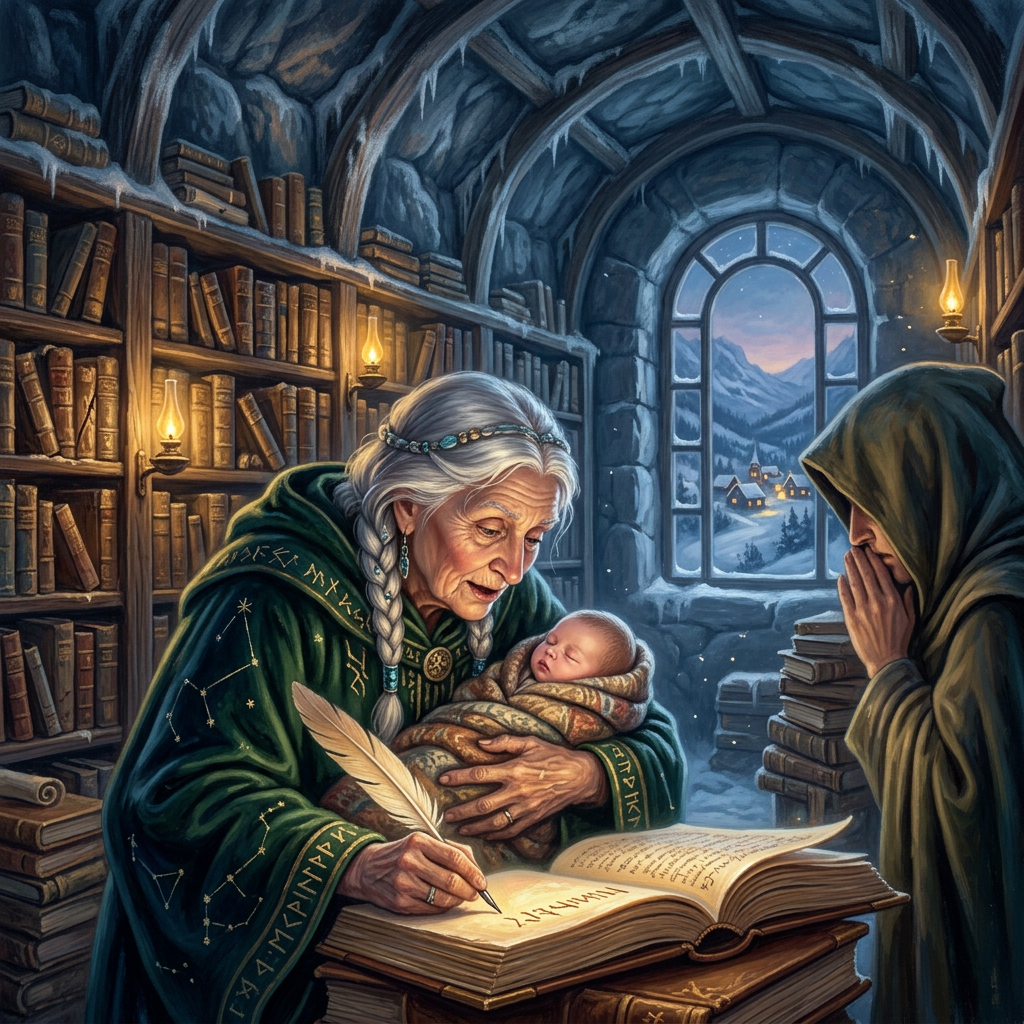
Before the chosen one set out, the village held a short but ancient ceremony before the church. Father Tóbiás placed a roughly woven brown cloak into the young person’s hands — the same cloak every candidate for the trial had worn for generations, patched and patched again, for it was said that a cloak which had already seen so much fear and so many returns carried within it a calm no new cloth could offer. The village women always baked festive bread, not for the one setting out, but for the family staying behind, since custom held that those who remained at home also had to wrestle with their own night, and the bread was meant to show they were not alone in the waiting. No one slept in that village until the chosen one returned: the women sat by the fire, the men kept watch on the church steps, and the children, though put to bed early, were often found in the morning to have lain awake all night, turned toward the window, watching the mountain’s dark outline.
The heart of the trial was neither a battle nor a bargain, but a kind of nightly companionship: the young person had to stay on the Heart-stone, surviving the cold, the dark, and whatever the mountain stirred or revealed over the course of the night, and when its hour came — for it always came, the old ones said — when that deep sound broke from the mountain’s depths, the sound of a giant turning over in its sleep, the young person must not run, but must turn to the stone, or lie upon it, and speak, or sing, the old, simple melody every child of Stonefoot learned small, though most never thought they would truly need it one day. The melody held no request and no bargain, only soothing words, the kind a mother might say to a child startled from a nightmare: hush now, quietly, I’m here, it’s all right, sleep on. The mountain, they said, needed nothing more than for someone to be beside it when it was restless, and not to fear it so much that they left.
*
The village’s memory held two names with particular weight from this trial, and the generation living at the time of this tale knew both well, for the elders told them again and again, sometimes as warning, sometimes as encouragement.
The first name was Gál’s, a young man who had drawn the grey pebble three generations earlier, and who, though reckoned a strong and brave boy by day, could not bear the fear in the middle of the night, when the mountain first stirred beneath him and that deep, turning sound broke from its depths, and ran down from the summit, past the Listening Wall, through the Stone Gate, all the way to the village, arriving at dawn muddy, his hands and knees bleeding, for he had fallen many times on the dark path. That week the mountain took a step the likes of which had until then only been heard of in the oldest tales: a new crack opened in the upper pastures, swallowing three families’ sheep flocks, and the rockfall took out a stretch of the path by the Stone Gate that could not be repaired for years. Gál never spoke afterward of what happened that night, and the village, though it never blamed him openly, never looked at him quite the same way again, and he too, as if carrying his own shame, withdrew more and more, in the end living alone in a small house at the village’s edge, tending only his animals, speaking little to people. By the time of this tale Gál was already an old man, bent-backed and silent, and the children were afraid to walk past his house, for it was said he sat outside his gate at night, just watching the mountain, as though waiting for a forgiveness he would never receive.
There was a third story too, older than Gál’s, though not as old as the village’s founding: a girl’s, named Franciska, who had drawn the pebble four generations earlier, and who climbed to the summit, but when the mountain moved, neither ran nor lay upon the stone, only sat beside it all night, rigid, silent, too frightened to sing or speak, but too proud to flee. She returned alive in the morning, and the village celebrated her, for she had not run — but the mountain did not truly settle that year either, only moved a little slower than after Gál, and it was then the elders began to understand that surviving the trial was not enough: true companionship had to be given, not mere silent presence. Franciska herself never regretted what she had done, for she felt she had needed every ounce of strength just to stay at all, with nothing left over for singing or speaking, but her grandchildren, who later heard the story, said their grandmother always looked at the mountain a little sadly, as though she felt she remained in debt for something she could never truly repay.
The second name was Zalán’s, who had drawn the pebble one generation earlier, and who, at the time of this tale, was already an old man, though still sharp-minded, and who liked to tell of his own night to anyone willing to listen all the way through. By Zalán’s account, he too had been afraid when the mountain first moved beneath him, but he remembered Gál’s story, and that fear, instead of driving him to flee, reminded him that he must not run. When the deep sound rumbled beneath the Heart-stone, Zalán lay down upon it and began singing the old melody, though his voice trembled, and as he sang, he felt, as he later told it, something strange: the mountain’s unrest was not simply blind rage, but something more like the restlessness of a sore wound, and when he laid his palm upon the stone, he found in one spot a rough, irregular surface, which he learned afterward, by daylight, climbing down, was an old mine shaft his great-grandfathers’ generation had cut into the mountain’s flank searching for ore, and which they had then abandoned, finding nothing of value inside. Zalán, in the dark, did not know what he had found, but he felt it was right to speak separately to the mountain at that spot, and to ask forgiveness for what people had once carved into its body — and this apology, he said, he spoke in his own words, not according to the old melody, for he felt this wound called for something other than the rest of the unrest.
*
In the year this tale concerns, the village was more uneasy than usual, because two years earlier Kálmán the miller, seeking a new millstone, had asked the elders’ permission to quarry stone from the mountain’s lower rock faces, saying the stone there was especially hard and fine-grained, suited to making millstones. The elders, who had forgotten, or never properly heard, Zalán’s story of the old mine shaft, granted the permission, and for a whole winter they blasted and quarried the rock at the mountain’s foot, until an old woman, Aunt Ilona, reminded them that this was exactly the place where Zalán had once found the old wound. By then it was too late to stop the work, since the millstone had already been carved, but the village watched the sky and the ground anxiously after that, knowing they had struck a new wound into an old place.
That same year the day of the drawing also fell due, and the whole village gathered at the market to see upon whom the mountain’s trial would fall. The child chosen for the task — a six-year-old boy, Marci, who did not fully understand what he was doing — reached into the sack and drew out a pebble painted with a name, beside which lay the grey mountain stone. The name read aloud was Enikő’s, a seventeen-year-old girl who served alongside Father Tóbiás in the church, and who was known for never losing her calm, not even the time a lost bear cub wandered into the churchyard and everyone else fled, while she alone stayed, and quietly called out for the shaggy parent to come fetch its young.
Enikő had a ten-year-old brother, Albert, who, hearing her name, went pale and burst into tears, for he had heard Gál’s story and believed he was about to lose his sister. Enikő, though she too felt a cold grip in her stomach, sat down beside him and told him to remember what they had learned at church: that fear was no shame, only forgetting who we really are because of fear was. Albert did not quite understand this, but nodded, and from that day on came to his sister every evening to tell her how many times he had prayed for her that day.
There was also a young man in the village, Barnabás, who had long secretly turned his heart toward Enikő, though he had never dared tell her, and when her name was drawn, Barnabás was among the first to go to the elders, asking to be allowed to climb in her place, since his arms were stronger and his back broader. The elders explained to him that the drawing could not be substituted, for the mountain, they said, did not come to know the body approaching it, but the name fate had drawn, and if someone else went up in the chosen one’s place, the mountain would find only an empty, foreign presence, perhaps worse than none at all. This did not truly settle Barnabás, and for the two weeks that followed he sat every evening on the fence before Enikő’s house, saying little, only wanting to be near, and Enikő, though she never spoke to him of what she felt for him, on the last evening before she set out, gave him a small, simply knotted ribbon, asking him to keep it safe for her until she returned.
*
Two weeks passed between the drawing and the day of the trial, and in that time Enikő spent every afternoon with Zalán, who had volunteered to prepare her, as his own elders had once prepared him. Zalán took her to the mountain’s foot, showed her the entrance to the Stone Gate, told her where to gather dry branches, and warned her not to be frightened at the Listening Wall if she heard her own voice echo back strangely, for that was only the mountain’s way of learning who was coming to it. He also taught her the old melody, though Enikő, like every child in the village, already knew the words, and only now learned to truly understand why it had to be sung quietly, evenly, without a tremor, for the mountain, Zalán said, heard the voice too as another deep pulse, and if that pulse trembled, it carried unrest, not peace.
Zalán also told her his own night in detail, and when his story reached the mine shaft, he warned her that if she found a rough, irregular surface near the Heart-stone again, it was likely that same old wound, and that this year, because of the fresh quarrying, it might be even more sensitive than before. He told her that if she found that spot, she should not speak the learned melody there, but her own words, for a true wound called for true words, not an inherited saying. Enikő asked how he knew what to say to a wound, and Zalán only answered that on that night, when the time came, she would know, for her heart would tell her, if she listened closely enough.
Every day of her preparation, Zalán also gave her trials — not to strengthen her body, he said, for that was already strong enough — but to teach her how to stay still in the middle of fear. He asked her to sit at the edge of a high rock, her legs dangling over the drop, and stay there while he counted to a thousand, and in the first days Enikő’s hand trembled so badly she could barely hold the rock’s edge, but by the seventh day she sat calmly, and could even watch the birds flying over the valley, as though the height no longer threatened her. On another day Zalán, without warning, made a loud noise behind her — striking an empty barrel with a piece of wood — to see how Enikő reacted to sudden fright, and every time they discussed together what she had felt, where in her body she had felt the terror, and how that terror could be not suppressed, but simply stayed beside, until it passed on its own.
Zalán also told her that during the trial, it was not only the mountain watching her, but she too watching her own body, and that the two kinds of watching somehow met on that night, for both sought the same alertness — not the alertness of one preparing for battle, but the kind with which a mother listens to her child’s breathing at night, half awake, half asleep, always ready to move if needed, but staying quiet until then.
In the days of her preparation, Enikő’s father, a quiet farmer named Gyárfás, said little, but went out to the end of the garden every evening and looked long at the mountain, the way, it is said, Márton the bellfounder once did in another village, in another tale, while he waited for his daughter. Enikő’s mother, Zsuzsanna — not the Zsuzsanna the weavers tell of, but a plain village woman bearing the same name — cooked something special for her daughter every evening, as though trying to make up with food for all she could not say in words.
*
On the last evening before she set out, the whole village gathered before the church, and Father Tóbiás read aloud the names of everyone who had climbed the mountain before, all the way back to Franciska and beyond, in a voice the village heard from him only on this one evening, deep and even, as though he too were trying to imitate the mountain’s slow pulse. Enikő stood at the head of the line, the old brown cloak over her arm, and when the priest finished reading, she stepped up to him, and he laid the cloak over her shoulders, saying that now she too was one in the row, whatever happened by morning.
The day of the trial dawned clear and cold, early autumn, and the whole village walked Enikő to the Stone Gate, though from there she had to go on alone. A bundle of dry branches on her back, a small flint and a leather bag in her hand, in which her mother had packed bread and a bit of bacon, so she would have something to gather strength from before the long night. Zalán took her hand at the last moment and said: remember, you are not going to fight, you are going to give company. Enikő nodded, and stepped between the tight rocks, where the air changed at once, growing colder and more still, as though she had truly stepped into the body of some great creature.
The way up was long, and Enikő, though a strong girl, felt the weariness in every muscle by afternoon. Along the way, at the lower edge of the pine forest, where she could still gather dry branches, she saw the tracks of an old lynx in the soft ground, and though the lynx itself never showed, Enikő felt watched for a while from the forest’s depths, not with hostility, only curiosity, as though the forest’s creatures too knew that something unusual was happening that day. Gathering the branches, she remembered her mother teaching her as a child which branch of which tree burned cleanest, and which smoked too much, and though this had nothing to do with the trial, Enikő was grateful that in at least this one small thing she could set out with sure knowledge, for the uncertainty she felt about the mountain and the night might otherwise have grown unbearable. She also had to cross a dried-up streambed, which Zalán told her had once, in his own childhood, run full, but after an earlier step the mountain had changed the spring’s course, and the water now flowed into another valley, where the neighboring village was grateful for it, though Stonefoot had lost a spring once reckoned the best in the region. The neighboring village, Lowerbrook, therefore sent a cartload of apples to Stonefoot every year on the day of the trial, not as payment, but as simple thanks for the fact that the people of Stonefoot bore the whole burden of the mountain’s closeness, while they alone enjoyed its benefit — and this custom had become so familiar that the children of Stonefoot already knew, by the apples’ arrival, that the day of the drawing was near, even before the elders announced anything.
Zalán told her this story too as they climbed, for he thought it good for someone setting out on the trial to know that it was not only her own village watching her that night, but farther neighbors as well, who had never paid anything for the mountain’s calm, but had always been grateful for it.
She stopped to rest at the Listening Wall, and when she tried her own voice, calling out a greeting, the echo returned strangely, deeper, as though another, larger voice had joined her own. She trembled, but remembered what Zalán had taught her, and called out again, smiling instead of afraid, saying that she was Enikő, daughter of Stonefoot, and that she came in peace. The second echo, she said later, returned more gently, as though the mountain had accepted the introduction.
Halfway up, a sudden wind rose, and a line of grey clouds gathered above the mountain’s summit, so dark that Enikő feared for a moment a storm was coming, and that she would not even be able to light her fire up there. She stopped beneath a jutting rock until the wind quieted, and remembered what her mother had told her before she set out: that the sky too was only another face of the mountain’s breath, and that if clouds came quickly and went quickly, it did not always mean ill, only that the mountain, like any sleeping body, sometimes sighed harder than usual. The clouds eventually passed without bringing rain, and by the time Enikő continued on, the sky was clear again, only the sun stood lower than she would have liked.
By the time the sun leaned toward the mountain’s far side, Enikő reached the flat plateau of the summit, and saw the Heart-stone, larger than she had imagined, its smooth surface already painted gold by the dusk light. She set down her bundle of branches, and by the time darkness fell, had lit a small but steady fire, close enough to the stone to feel its warmth, but far enough not to foul it with smoke. She sat beside the fire and watched the mist settle down toward the valley, and how the village’s windows lit one by one below, small, warm lights in the great darkness. She tried to guess which light might be her own house, and which Barnabás’s, and this game, childish as it seemed, drew her attention a little away from the cold and the loneliness that the summit’s total silence pressed upon her more and more.
She thought of her grandmother, Mária, dead ten years now, who had once, in her own youth, prepared another girl for the trial before Enikő was even born, and who often told her in the evenings what it felt like to lead someone by the hand to the Stone Gate, and to stay awake all night, only watching the smoke from the chimney, as though even the shape of the smoke might carry a message. Mária once told her, when she was still a small girl, that the mountain was like a very old grandparent, one who barely remembered anymore how many times it had been bored or hurt, but who still rejoiced whenever someone sat beside it — and this thought now, on the summit, touched Enikő’s heart with particular closeness.
*
The first half of the night passed calmly, and Enikő, who had earlier believed fear would grip her throat all night long, noticed with surprise that the firelight and the mountain’s silence gave her more a feeling of peace than of dread. From time to time she laid her palm on the Heart-stone and felt that slow, deep pulse everyone spoke of, and each time she felt it, she smiled quietly, as though holding a sleeping giant’s heartbeat in her hand.
Once, well before midnight, a loud crack sounded from the dark, close to the fire, and Enikő leapt to her feet, heart pounding, before realizing it was only a piece of rock that had split off a nearby boulder from the fire’s heat, as often happens in the night cold. She laughed at herself, though her laugh trembled, and sat back down, trying to reassure herself that if she startled this badly at everything now, how would she stand firm when the real trial came. This small fright, she told Zalán later, helped her: she learned that her body reacted faster than her mind, and that this in-between moment, before her mind could catch up to her body, was the one she would most need to know.
Toward midnight, though, the rhythm of the pulse changed. It did not grow faster, but somehow more uneven, as though a pain were interrupting the otherwise steady beat, and Enikő, her palm still on the stone, felt something tighten beneath it, like a muscle seizing into a cramp. It was then she first heard that deep, turning sound Gál and Zalán had both spoken of: a long, rumbling sound, not like thunder, more like some vast body turning over in its sleep, every bone of it creaking as it moved. The flames of the fire shuddered, though no wind blew, and far below, on the mountain’s other side, Enikő heard stones rolling down a steep stretch. The sound did not come once, but several times, in waves, as though something ran through the whole of the mountain’s body, side to side, and after each wave came a moment of total silence, a silence in which Enikő could hear her own heartbeat too, hammering faster than the slow pulse beneath the stone.
Once the ground beneath her trembled too, barely noticeable, only enough that the small stones by the fire clicked against each other, and Enikő instinctively jerked her head up, looking around in the dark as though searching for an escape route, though she knew well that the path to the Stone Gate would be more dangerous in the dark than staying put. This was the moment Zalán had spoken of too: when the body wants to act on its own, before the mind can decide what is right.
The air changed too, just then: a dry, stone-dust smell spread, the kind Enikő had only ever smelled at the miller’s quarry, when she had passed by there once as a child, and this smell now, on the summit, seemed far stronger and far closer, as though the mountain itself were breathing out the dust that people had sought within it. The fire’s smoke swirled strangely, not with the wind but inward, toward the Heart-stone, as though something were drawing it there, and Enikő, though she tried to explain this to herself too with some simple, earthly cause, found her calm harder and harder to hold onto.
It was then she felt real fear for the first time, the kind Gál too might have spoken of, had he been willing to speak of it: a cold instinct that clouded every thought, urging her to stand and run downhill, back through the Stone Gate, back to the village, anywhere, only away from this place where the ground itself moved beneath her. Her legs had nearly risen when Albert’s pale face came to her, and Zalán’s words: you are not going to fight, you are going to give company. She took a deep breath, and instead of standing, lay down on the Heart-stone, pressing her whole body against it, the way a child presses against a parent startled from a nightmare, and began singing the old melody, in a voice that trembled but did not break off.
*
Beneath the melody, the tension under the stone did not yield at once, and Enikő, still singing, ran her palm along the stone, searching for something, though she did not quite know what, until her hand found, in one spot, a rough, irregular crack, colder than the rest of the stone, exactly as Zalán had described. She understood that this was the place where the old mine wound ran, and that this year’s fresh quarrying had indeed reopened what the mountain’s slow, patient healing had only half closed over the decades.
Enikő stopped the melody, and pressing her palm to the crack, began speaking in her own words, as Zalán had advised. She told the mountain that she knew people had caused it pain, long ago and now again, in the quarrying for the millstone, and that she could not undo what others had done, but that she knew she was there, that she was not running, and that she knew pain, too, for her own family carried wounds that could never be fully healed, only borne, and that perhaps this was what they could give each other now: not healing, only company in the pain. She spoke of her father, who watched the mountain every evening, and of her brother, who feared losing her, and of how she too was afraid, but stayed despite the fear.
For a moment, as the tension beneath the stone grew to its strongest, it occurred to Enikő that perhaps Franciska had been right after all: perhaps it was enough simply to endure, silent, unmoving, without needing to find words too. But as this thought passed through her, the trembling beneath the stone grew stronger for an instant, as though the mountain too sensed her hesitation, and Enikő, startled by her own thought, quickly went on speaking, no longer even wondering whether she phrased it rightly, only letting the words come one after another, the way one speaks to a child who cannot be half soothed, only fully, or not at all.
The tension beneath the stone slowly, gradually began to yield, not as though it ceased in an instant, but the way a cramped muscle slowly relaxes when someone gently works it loose. In the midst of this, one more, shorter wave returned, perhaps half as strong as the first, and Enikő, though her arm already ached from the cold and the long lying, did not move from the crack, only pressed her palm deeper against it, and began her sentences again, now in a calmer voice, for she felt that her fear, however much it was still there, was not the strongest thing in her that night. The deep, turning sound died away, the distant rolling of stones stopped, and the pulse Enikő felt beneath her palm returned to its own slow, even rhythm, though perhaps — she could never say for certain — a shade calmer than it had ever been before.
*
Dawn grayed slowly along the eastern sky, and Enikő, who had not slept all night, nonetheless felt a strange, rested peace as the first rays of light touched the Heart-stone. She gathered the ashes of the fire and scattered them to the wind, as custom required, and set off downward, past the Listening Wall, where now, when she called out a greeting, the echo returned gently, warmly, as though a familiar voice were greeting her back.
When she passed through the Stone Gate, the whole village was waiting, for no one had slept that night, only kept vigil, prayed, and watched the mountain’s silhouette against the dark sky, hoping to see some sign. Albert was the first to run to her, clinging to her as though he would never let go, and Gyárfás, her father, who rarely showed his feelings, now wept openly as he embraced his daughter. Zalán, standing further back, asked only, when Enikő stepped before him: did you find the wound? Enikő nodded, and Zalán’s eyes filled with tears too, for he knew how hard it was to find one’s own words on that dark summit.
Barnabás did not dare step forward among the crowd, only stood at its edge, and when Enikő finally caught sight of him and walked over, he took out the ribbon he had been given and offered it back to her, saying he had kept it in his pocket the whole time, and every time they heard the sound of a rockfall from the village below, he had squeezed it, as though that might help somehow. Enikő smiled, and did not take the ribbon back, only told him to keep it, for it was already his.
Old Gál too came out to the edge of the crowd, though he rarely left his house, and when Enikő noticed him, she went over and took his hand before the old man could turn away. She asked him nothing, only said that she knew he had felt the same fear on that old night that she had felt on her own, and that no one who had not stood on the Heart-stone could truly understand what that moment meant. Gál’s eyes filled with tears, and for the first time in many years he told someone in the village what he had never spoken aloud before: that on that night he too had wanted to sing, but his voice would not come out of his throat, and that he had carried that silence with him his whole life, like a second, invisible wound. Enikő only answered that the fear he had felt then did not make him a smaller man, and that the village had perhaps erred, letting him carry that burden alone for decades.
At the mountain’s foot, where Kálmán the miller had done his fresh quarrying, some of the village’s people found something strange that morning: at the edge of the quarry, where sharp, raw cut-marks had shown before, there now lay a fine layer of grey dust, as though the mountain itself had drawn a thin, healing film over the wound. Kálmán the miller never again asked permission to quarry further at that spot, bringing stone instead from another, more distant rock face, though it meant more work. When he heard what Enikő had found beneath the stone, he went to her in person, and though the words came hard to him, he apologized for having reopened that old wound for his mill’s sake, and from that day on, every year, on the anniversary of the quarrying, he left a sack of flour at the entrance to the Stone Gate, saying it was his way of making right what he could.
That evening the village held a feast such as it had not seen in years: every house brought its table out before the market, and they ate together what they had cooked, while Father Tóbiás said a prayer of thanks, and the children, awake all night, now ran exhausted but happy between the grown-ups’ legs. Gyárfás, Enikő’s father, who rarely drank wine, raised so many toasts with his neighbors that evening that he held his head all the next day, but no one held it against him, for everyone knew what weight had lifted from his heart that morning.
*
Enikő and Barnabás married a year later, and though Barnabás could never quite put into words what he had felt standing at the edge of the crowd all that night, Enikő never asked him to, for she believed that waiting too was a kind of company, even if not the kind the mountain had received from her. The years passed, and Enikő, as she grew, became herself the one the village regarded as the wisest counselor in matters of the mountain, though she always said she knew no more than what she had learned that night: that the mountain was no enemy to be defeated, and no god to be bargained with, only a vast old body that hurt, and that sometimes needed someone beside it when the pain broke open. Albert grew up, and though he himself never drew the grey pebble, he remained grateful to his sister his whole life, and every year, on the anniversary of the trial, carried a bouquet of mountain flowers to the Stone Gate, leaving them at the entrance, as though sending a message to the mountain that his family had not forgotten.
Zalán did not live to see that day: a few years after Enikő’s trial he died quietly one winter, and the village, in his memory, extended Measuring Day by a day that spring, so that anyone who wished could share their own memory of him. At his funeral, Enikő said that Zalán had never taught her courage, but rather that fear and staying could fit in the same heart together, and that she would pass this lesson on too, when her own time came.
Twenty years later, when the time of the trial came again, and the drawing pulled out a young boy’s name, Enikő, who had by then begun to age herself, volunteered to prepare him, as Zalán had once done for her. She took the boy to the mountain’s foot, showed him the entrance to the Stone Gate, and when their story reached the mine shaft, told him that if he found a wound there, he should not speak the learned melody, but his own words, for a true wound called for true words. The boy asked how he would know what to say, and Enikő only smiled and gave the answer she had once heard from Zalán: that on that night, when the time came, he would know, for his heart would tell him, if he listened closely enough.
When the boy returned, alive and calm, Enikő took him down to the Stepstones and showed him where, beside his own name, the notch had been cut into the stone that year, and told him that one day his name too would land on another stone, and that this would not be the end, only another stone in the row, which the next generation would count. Albert, by then a grown man, who still carried mountain flowers to the Stone Gate every year, once told his own children that his sister had never defeated the mountain — only taught him that fear and staying could fit together in one person at once.
Enikő and Barnabás’s daughters never drew the grey pebble, for the drawing, as always, was blind and chose no favorites, but their younger daughter, Terka, when grown, volunteered on her own to prepare the next generation’s chosen one, feeling that her mother’s and Zalán’s knowledge must not be lost, even though she herself had never stood on the Heart-stone. Enikő, hearing this, only told her she did well, for the mountain’s company was given not only by the one who lay alone on the stone for a night, but by all those who kept vigil at home, and baked festive bread, and walked out every year to the Stepstones to count how much room was left.
In her old age Enikő could barely walk even to the village’s edge, but every spring, on Measuring Day, she had herself carried out in a small cart to the Stepstones, and sat there while the children ran around her, listening to them tell each other the stones’ stories, one after another, her own name among them now, cut into an old stone between Franciska’s and Zalán’s. She told her youngest grandchild once, sitting on her knee and counting the stones, that every stone was a night, and every night a person who had learned that fear need not be defeated, only endured beside — and that this knowledge was the only inheritance truly worth passing on.
In the village they still say, looking up at the mountain and seeing how it sits there motionless decade after decade, that Slumbrock does not sleep quietly because it lacks the strength to move, but because in every generation it finds someone willing to stay beside it when it grows restless — and that this companionship, not strength, not fear, is what has kept the mountain and the village alike alive until now. And if anyone asks why they do not simply send up several at once, to make the thing more certain, the eldest only answer that a sleeping giant cannot be soothed by a crowd, only by a single, faithful hand willing to stay beside it until it quiets.




Leave a Reply