
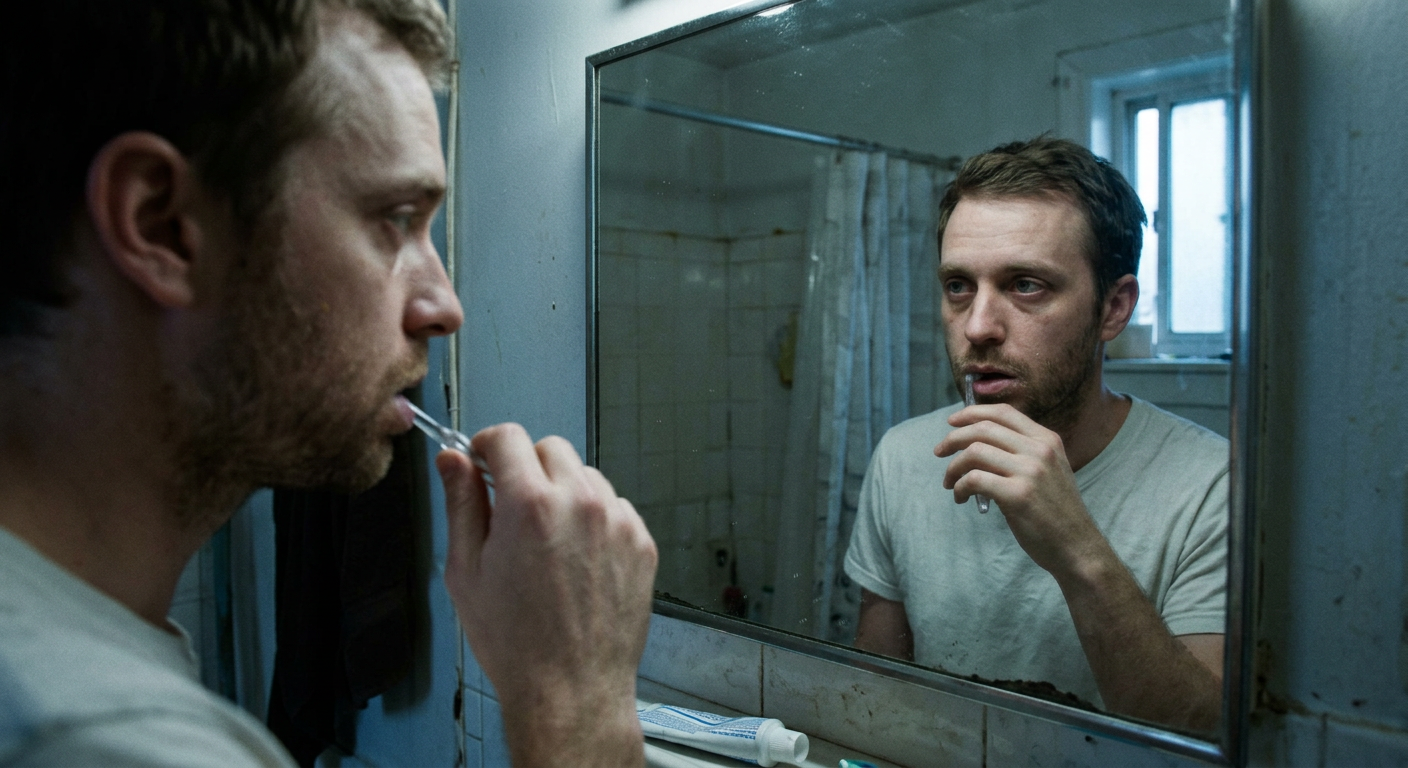
I noticed it first in the bathroom mirror, on a Tuesday morning, while brushing my teeth. I raised my hand to wipe my mouth, and in the mirror my hand moved half a second after the real one.
I didn’t panic right away. I’m thirty-two, and by that age you know the body plays strange tricks on you sometimes, especially when you’re not sleeping enough, and I hadn’t been sleeping enough for weeks, because my taxi shift ran nights, ten p.m. to six a.m., and my days passed in a kind of half-awake drift rather than real rest. I figured exhaustion plays ugly tricks on the eyes, that my attention had simply slipped for a second, and that I’d mistaken my own slowness for the mirror’s.
I repeated the motion. Raised my hand again, slowly, deliberately, to see exactly what was happening. My reflected hand stayed still for a beat after mine was already in the air, then — like an old, stuttering video recording trying to catch up a second behind — it started moving, following my gesture, but always a hair’s breadth behind.
Vivien, my partner, who was still in bed, called out from the bedroom to ask if everything was okay, because she’d heard me muttering to myself, and I said yes, just thinking something over, because I couldn’t have explained to her that I was having a conversation with my own reflection, trying to work out which of us was the slower one.
The whole day I had a strange, mildly dizzy feeling, like coming off a plane before your ears let go of the pressure change. I kept passing the kitchen window, which isn’t a mirror but glass, and in the evening, when the lamp hits it at the right angle, it faintly reflects a person’s shape, and every time I stopped for a second just to see whether the faint reflection moved after me or stayed in sync. It stayed in sync. Only the real mirrors were lagging — not the windows, not the shop windows, not yet, at that point — only the surfaces specifically made to give back whatever stood in front of them.
*
Vivien and I live in a two-room apartment in the Rókus district of Pécs, together four years now, and I drive a taxi for a small company that mostly takes night fares — driving people home from clubs, airport transfers in the small hours, hospital emergencies when the ambulance can’t get there in time. The work is lonely but not bad: you get used to the nighttime city, the empty streets, the faces that cycle through the rearview mirror, always heading somewhere, fleeing something, rushing toward something.
I’ve driven a taxi for ten years, ever since the construction company where I used to work an office job shut down, and I couldn’t find anything similar in the city. At first I thought of it as a stopgap until something better came along, but then I grew to love the freedom of it, the fact that no one stands over your shoulder, that the nighttime city holds silences you never hear during the day, and that the people who climb into a taxi at two in the morning are often far more open, far more genuine, than the people you’d meet in daylight, because exhaustion and darkness strip away the layers they wear the rest of the time.
The rearview mirror, by the way, is the most important tool in my job, sometimes more important than the wheel itself, because that’s where I see what’s happening in the back seat, what’s approaching from behind, and — though I’d never thought of it this way before — that’s also where I see what my back can’t feel, what my eyes can’t see looking forward.
A few days after the bathroom incident, during a night shift, the delay showed up in the rearview mirror too. I was stopped at a red light, at the intersection of Zsolnay Vilmos Street and Magyar Lajos Street, and I glanced back in the mirror to check the car coming up behind me before pulling off, and for a moment the mirror still showed the previous scene — the road empty, the way it had been a second earlier — before it updated and the headlights of the actually approaching car appeared.
I shook my head like someone trying to wave off a mosquito, and told myself this was just another sign of exhaustion, that maybe it was time to see a doctor, that my eyes weren’t keeping pace with my brain, or the other way around.
*
Over the next two weeks the delay didn’t go away — if anything, it grew, little by little. In our entryway there’s a large oval mirror Vivien bought for our first apartment together, the one we always check ourselves in before stepping out the door. One morning, heading out to the shop, I stopped in front of it to straighten my coat collar, and my reflection — which had always done exactly what I did, just with a slight lag — now moved two or three seconds later, not just half a second.
In the elevator of our building, where there’s a large, scratched mirror against the wall, I noticed something similar: stepping in to check myself before meeting colleagues, my reflection briefly continued the motion of the elevator’s previous passenger — an elderly woman who’d gotten out a few minutes earlier — as if the mirror hadn’t managed to switch over to me right away.
I went to an optometrist, who examined my eyes and said everything was fine, no abnormalities, that it was probably just fatigue and too much screen time causing the strange sensation that the world “wasn’t keeping pace” with me. I asked if he’d ever heard of anything like this from anyone else, and he just gave me an odd look and said mirrors don’t “lag” — that’s physically impossible, the speed of light is constant — and if I was feeling something strange, the cause was most likely in my brain’s processing speed, not in the mirrors.
I didn’t believe him, though I couldn’t have explained why not.
There was another incident around this time, less dramatic but just as unsettling: in the staff bathroom at the depot, where my colleagues and I swap shifts, there’s a long, cracked mirror over the sinks that’s never been replaced since I started working there. One night, before heading out, I washed my hands and looked up into the mirror, and my reflected face, which by then lagged three or four seconds, was still showing the face of my colleague Feri, who’d stood there just before me — or rather some strange, bleeding-together image somewhere between his face and mine, as if the mirror couldn’t decide which of us to follow.
When I mentioned it to Feri, he just laughed and said someone else must have looked in the mirror before I came in, and my brain had scrambled the order afterward, because that’s what tired brains do. I didn’t tell him the same thing was happening with my own bathroom mirror at home, because I knew I’d get the same answer, just a longer version of it.
That week I started keeping a little notebook, logging when and what kind of delay I noticed, hoping that with enough data some pattern might emerge — maybe tied to moon phases, or how much I’d slept the night before, or how many times I’d looked into a mirror that same day. Within three weeks the notebook filled up with short entries: “bathroom, 0.5 sec, Tuesday,” “elevator, 2 sec, Friday evening,” “rearview, 4 sec, Saturday dawn.” No pattern emerged, or at least none I could recognize, and eventually I stopped keeping the notebook, because I felt like the harder I tried to decode the system, the more I was just documenting my own obsession, not the mirrors.
*
The shop windows downtown, which had always tracked me exactly, slowly started lagging too, though less dramatically than the real mirrors. The window of the bookshop on Király Street, where I usually check myself in the evening before a quick errand, showed a half-second delay one night that grew to a full second within two weeks. I started avoiding streets with a lot of storefronts, because every pane of glass was one more chance to see something strange, and after a while I could no longer tell which surfaces were “safe” — a shiny car window, a rain-slicked paving stone, another taxi’s windshield facing me at an intersection — and which weren’t.
*
The first time the mirror showed something that hadn’t happened yet was on a Wednesday night, a month after the bathroom incident.
I was driving a young woman home from some cycling-season event at the Expo Center, going fairly fast down Siklósi Road because the street was empty, when the rearview mirror — which by then lagged about four seconds behind actual reality — showed a dog running into the road. More precisely, the mirror showed the dog already on the road, though when I looked ahead through the windshield, the road was still empty.
I had no time to think about what this was, or whether I could believe it. I braked on reflex, started slowing down, and two seconds later, exactly where the mirror had shown it, a stray dog really did dart into the road from behind a fence, and if I hadn’t already been slowing down, I would have hit it.
The woman in the back seat screamed when she saw the dog, and asked how I’d known to slow down, because she hadn’t seen anything suggesting something was about to run into the road, and I just said I’d had a feeling, because I couldn’t have explained to her that I’d seen the future in my own rearview mirror, four seconds ahead of time.
Before getting out at her house, she thanked me again and said I must have some kind of special instinct, that reflexes like that were rare among drivers, and I just nodded, not telling her it wasn’t instinct at all, but an image four seconds late in my rearview mirror, one I didn’t understand myself, and which for exactly that reason frightened me far more than it reassured me.
That night, getting home, I couldn’t stop thinking about what would have happened if I hadn’t trusted the mirror. If, as always before, I’d simply written it off as a visual glitch and not slowed down. The dog would almost certainly have died, or at least been badly hurt, and I’d have been standing over a dead or injured animal while a terrified passenger screamed in the back seat. That was the first time I seriously considered that the mirror might not be a malfunction at all, but some kind of tool I’d been given, for some reason, though I had no idea by whom, or why me.
*
Back home that night, I couldn’t sleep. I sat in the living room in the dark, trying to work through what had happened, and concluded that the mirrors’ delay wasn’t simply a visual glitch, or even some kind of window onto the past — because I could have believed it was just a stuck, lingering image, like an old recording — but that sometimes, under certain conditions, it pointed forward instead.
Over the following days I started consciously watching for when and how this kind of “future-image” appeared within the delay, as opposed to the usual, simple lag. I realized that most of the time the mirror genuinely just moved after me slowly, like a tired companion, but sometimes — and I couldn’t work out the pattern, what triggered it — the image would suddenly “jump ahead,” showing a moment that hadn’t happened yet, as if the mirror occasionally grew tired of following and would rather run ahead to rest before reality caught up to it.
I started living in a way where I looked into every mirror I could, not out of vanity, but to check whether it was showing me anything. The bathroom at work, the elevator, shop windows when I walked somewhere — in every one there was the faint hope or fear that it might show me something I needed to know before it happened.
*
I can’t say exactly when this watchfulness turned into obsession, but a month later I was living in a way where, before every decision — which route to take on a fare, whether to pull off now or wait two minutes, whether to answer a call from an unknown number — I checked a mirror if one was nearby, looking for a sign.
This kind of dependency produced a strange feeling in me, hard to describe in a single word. On one hand, I was grateful, because I felt protected, like I had a warning system no one else had. On the other hand, every time I successfully avoided something with the mirror’s help — a pothole that could have cracked a rim, a drunk pedestrian who nearly stepped into the middle of the road — a strange, unsettling feeling settled into me too, as if I were cheating something, cutting in line ahead of fate, and there was no guarantee that didn’t come with a price.
One evening, walking home after a shift, I stopped in front of a shop window on Király Street, a clothing store, just to look at my own reflection in the glass, and I realized I wasn’t even looking for my own face in it anymore, but for whatever the image might show behind me, ahead of me, or at some other time. That realization frightened me, because it meant I was no longer living in the present, but constantly in the shadow of some possible moment that hadn’t arrived yet.
There was a thought that kept returning to me in those weeks, one I didn’t dare say aloud to anyone, not even Flóra: that every time I avoided something with the mirror’s help — the dog, the wet floor, the hot coffee — maybe I wasn’t escaping something so much as taking something away from the world that would show up somewhere else, with someone else, in its place. As if the trouble the mirror showed were a fixed sum that never disappeared, only relocated, and every time I dodged a pothole, someone else without their own mirror to warn them fell into it. I knew this was probably just an exhausted brain’s paranoia, but every time I successfully avoided something, that faint, cold uncertainty sat in me, as if I’d cheated at something that couldn’t be cheated, and the luck I’d won by it had been drawn from somewhere else.
Two smaller incidents around this time reinforced my belief that the mirrors really were showing me something worth paying attention to. One happened one morning when, in the cracked bathroom mirror at the depot, I saw myself — the image by then lagging some six seconds — slip on a wet floor and fall, grabbing the sink with my hand. When, a few seconds later, I actually stepped further in, carefully, watching my feet, I saw the wet tile the cleaner hadn’t finished drying, and sidestepped it. The other happened at a gas station, where for a moment the bathroom mirror showed my hand spilling a hot cup of coffee on myself, and when I stepped out and walked to the counter, I took unusually careful hold of the cup the attendant had just set down, so it didn’t slip from my hand when I tripped over my own shoelace — because one of my laces had come undone without my noticing.
In both cases the danger was small, not life-threatening, but that’s exactly why they convinced me more than the dog had, because they weren’t dramatic enough to write off as coincidence. No one, afterward, stops to think that they “coincidentally” didn’t spill a coffee, or “coincidentally” didn’t slip on a wet floor, unless they’re watching every single step the way I was, because a mirror had shown them in advance what to watch for.
Around this time Vivien started commenting for the first time that something about me had changed. One evening, sitting in the living room, when I’d already gotten up for the third time in five minutes to go check myself in the entryway mirror before sitting back down on the couch, she asked what that was about — whether I always did that, or whether it was something new, because she’d never noticed the habit in me before.
“Just checking myself,” I said, which explained nothing, and she didn’t push it further, but a small shadow stayed in her look, a careful watchfulness that’s been there ever since, whenever she thinks I’m not noticing.
One Sunday afternoon, when we went to a mall together to buy Vivien a dress for an upcoming wedding, we went to a fitting room — meaning she went in, and I stood outside waiting — and in front of the large three-panel mirror next to the booth, the kind that shows you yourself from every side, I stopped for a moment while I waited, and looked into it.
The mirror’s center panel, which showed me straight on, behaved normally, moving in perfect sync with me. But the two side panels, which carried the center mirror’s reflection further, mirrored into each other the way these three-panel setups work, for a moment showed a different figure. In the left panel stood my own shape, arms crossed, exactly as I was actually standing. But in the right panel stood a figure that resembled me, except its arms weren’t crossed — they hung loosely at its sides — and its head tilted at a slightly different angle, as if it were paying attention to something else, not to whatever I was looking at.
I stepped back, and the image vanished, returning to the usual nested sequence where every panel showed exactly the same thing, just from a different angle. When Vivien came out of the fitting room and asked if she liked the dress, I could barely focus on her, because the image from the mirror was still running through my head, and I kept wondering whether the figure in the right panel had shown me at some other moment, or someone else entirely who just happened to resemble me closely enough that the mirror couldn’t tell us apart.
“You look great in it,” I said finally, though I’d barely actually looked at the dress, and Vivien, turning in front of the large mirror to see herself from every angle, didn’t notice that my gaze wasn’t on her but on the edge of the mirror, on that particular right-hand panel, which by then was once again showing just the two of us, exactly as we actually stood.
*
The second really significant incident involved a young man I picked up downtown one weekend night, sometime around two in the morning — a passenger who was very quiet, too quiet for a typical weekend dawn fare. Most passengers at that hour are at least a little drunk, talkative, or asleep in the back seat, but he just sat looking out the window and didn’t answer when I asked which exact street we were heading to.
When I checked the rearview mirror to make sure everything behind us was clear, the reflected image — lagging eight or nine seconds by then, much longer than ever before — showed the man’s face, but not as it looked that day. The reflected face had blood on it, a streak running from his temple to his chin, and his eyes were closed, as if he were unconscious, or worse.
I turned to look at him directly, not through the mirror, and the man — the real, present man — just sat there, unharmed, looking out the window as before.
I didn’t know what to do. I slowed down and asked if he was sure he was all right, and he gave me an odd look and said yes, of course, why was I asking, and there was an alertness in his voice that didn’t match his earlier silence, as if he’d suddenly noticed me, as if his attention had been somewhere else until now and had just snapped onto me.
I pulled over at a well-lit, busy stretch of road, not where he’d asked to go, and told him I was sorry, but he’d have to get out here, because the road to his destination was closed — a lie, but I couldn’t think of anything else on the spot — and he got out angrily but without a word, leaving him on the roadside.
I never found out what would have happened if I’d kept driving. Maybe nothing. Maybe the blood in the mirror showed a future that would only have come true if I’d continued the ride, and by changing the situation, I avoided it. Or maybe it had nothing to do with me at all, and the man’s face would end up in the state my mirror showed at some other time, somewhere else, in an accident that had no connection to me whatsoever.
For days I watched the local news, hoping to find some report of a man who’d been in an accident or gotten hurt somewhere in the city that week, but I found nothing, and that didn’t really reassure me either, because I had no idea how much time could pass between the moment shown in the mirror and the real event — it might happen years later, or never, or it might have already happened, in a past the mirror had only reported late, in reverse, from how I’d been thinking about it until then.
*
I told my sister, Flóra, who lives in Pécs too, not far from us, and whom we see weekly, because she’s the only person in the family I’d ever tell something like this without fearing her reaction.
Flóra listened all the way through, and when I finished, looked at me for a long time before speaking.
“How long since you’ve slept properly?” she asked, and there was no mockery in her voice, more a kind of concern — the kind you feel when your sibling says something you can’t quite believe but that sounds too serious to simply laugh off.
I told her this wasn’t about lack of sleep, that I knew exactly what I’d seen, and that the dog proved it wasn’t just happening in my head, because the woman in the back seat had witnessed me slowing down before the dog ran out.
“Maybe you caught the dog out of the corner of your eye without realizing it,” Flóra said. “The brain does that. It assembles the story afterward and convinces you that you knew in advance.”
I didn’t argue further, because I knew I wouldn’t convince her, and besides, part of me wanted her to be right, wanted this to be nothing more than a trick of sleep deprivation and a tired brain, because that would be simpler than the alternative.
“Go see a doctor,” Flóra said before I left. “Not necessarily to prove I’m right. Just to rule out worse things. Optic nerve damage, some neurological issue, I don’t know what doctors do about this kind of thing, but at least afterward you’ll know it isn’t something treatable that’s wrong with you.”
I promised her I’d go, just to get her off my back, and three days later, one morning when I happened to be awake after a shift anyway, I went to see my GP, who listened, shone a small light into my eyes, asked if I drank a lot, smoked, how much I slept on average, and eventually said it was probably chronic sleep deprivation and night work causing the “visual processing disturbance” I’d described to him — though that was my phrase, not his, since all he actually said was that “the eyes do strange things when they don’t get enough rest.” He ordered bloodwork to rule out anything more fundamental, and suggested that if it didn’t clear up within two weeks, I should ask for a referral to an ophthalmologist or a neurologist.
The bloodwork came back clean. Every value normal. I never went to the ophthalmologist, because by then I already knew that medical tests weren’t going to give me the answer, whatever it was I needed.
One night, between fares, sitting in the car at a taxi stand, I typed a few search terms into my phone: “mirror delay,” “mirror reflection lagging,” “mirror shows the future.” The results included a few horror-forum posts, a few science-explainer pieces about why the speed of light makes it physically impossible for a mirror to “lag,” and one thread on a dream-interpretation site where someone wrote that as a child they sometimes felt their reflection “wasn’t quite with them,” though most of the replies told them to see a doctor — the same thing Flóra had told me. I closed the phone and stopped searching, because I sensed that if anyone else had gone through the same thing, the internet wasn’t where I’d find them.
*
But the mirrors kept lagging, and the delay kept growing, and the pattern I’d tried to decode earlier only grew more unpredictable.
One morning, shaving in front of the bathroom mirror, my reflected face for a moment didn’t quite look like mine — not exactly different, but off in some small detail: the razor sat at a different angle in its hand than in mine, and the bathroom behind it looked slightly different, as if the tile were a shade darker. I blinked, and the image switched back, and I couldn’t tell whether my eyes had simply tired, or whether I’d actually seen something else — some version of my own bathroom that wasn’t quite this bathroom.
From then on I could no longer be sure the mirrors were always showing my own future, or whether sometimes they showed something else — a possibility that might never happen, or that had already happened slightly differently, on some other day I didn’t precisely remember.
A few days later, in the same bathroom, another one of these “other versions” appeared, this time longer: looking into the mirror, behind me, the door visible in the reflection stood slightly ajar, though I’d closed the real door before stepping into the bathroom, and through the gap a faint light filtered in, a yellowish kind of light we never used in our apartment, since we’d bought white LED bulbs, not warm yellow ones. I watched the mirror for maybe ten seconds, and the light didn’t disappear, and the slightly open door didn’t close, and finally I walked over and closed the real door again, loudly, as if trying to prove to myself that in reality the door was shut, whatever the mirror was showing.
When I looked back, the mirrored door was closed too, and the yellowish light was gone, and I couldn’t tell whether I’d changed something by closing the door again, or whether the mirror had simply “caught up” with me, after falling behind for a moment into some other, slightly different present.
The most frightening incident involved Vivien, about two months after the first bathroom observation. One afternoon, home after a short nap before my night shift started, I checked myself in the entryway mirror, because for some reason I felt I needed to look, and in the mirror, next to my own shape, Vivien appeared for a moment too — though she was at work at the time, miles away — and her face was bloody, exactly like my passenger’s that night, and her eyes were closed, and around her, as far as I could see, lay shards of glass, as if from a car accident.
I called her immediately, hands shaking, and she picked up on the second ring, perfectly calm, asking what was wrong, because she could hear from my voice that something wasn’t right. I told her I just wanted to hear her voice, that I’d had a bad dream, though I hadn’t even been asleep, and asked her to be extremely careful on the way home, not to drive, to take the bus instead, or ask me for a ride, and she just laughed and said fine, if it mattered to me that much, she’d take the bus.
That evening passed, and nothing happened. Vivien got home safe and unharmed, and when I told her what I’d seen in the mirror, she didn’t laugh at me, but I saw on her face the kind of careful concern a person shows not when they’re afraid for the other person’s safety, but for the other person’s mind.
*
In the weeks that followed, this fear didn’t fade — it worked its way into our daily life in a way that started straining our relationship. Every time Vivien went anywhere — to work, to the shop, to meet a friend — I asked her to text when she arrived, and if she didn’t answer within ten or fifteen minutes, I’d start calling, more and more anxiously, and she’d pick up more and more impatiently, because she couldn’t keep checking her phone at work, and she couldn’t understand why someone who’d never been jealous of her time before had suddenly become this anxious.
“I can’t keep doing this,” she said one evening, coming home to find twelve missed calls on her phone, because she hadn’t picked up during an afternoon meeting. “I get that you’re scared for me, but I can’t live reporting in every few minutes just to prove I’m still alive.”
I tried to explain that it wasn’t about trust, that it was fear, that those were different things, that I’d seen something I couldn’t erase from my head, but she just shook her head and said she understood I meant it seriously, but that she also had a right to live without every step she took falling under the shadow of some vision in a mirror that she herself had no way of confirming, only my word to go on.
I didn’t argue with her, because she was right, but I couldn’t shut off the anxiety in myself either, and from then on I just watched my phone quietly, trying not to show how relieved I felt at every message saying she’d gotten home, that she was fine, that nothing was wrong.
One night, unable to sleep, with Vivien long asleep beside me, I got up and went to the entryway and stood for a long time in front of the oval mirror, just watching my own reflection move in perfect sync with me, trying to imagine what it would be like if the mirror ever showed me something about Vivien while she stood right there next to it, and I wouldn’t know whether to tell her or stay silent, because I already knew that whichever I chose, I’d ruin something — either her trust, or her sense of safety, or my own peace of mind, of which less and less remained.
*
From that evening on, I couldn’t decide what it meant when the mirror showed a future that then failed to happen. Maybe I’d changed something by warning Vivien, so the bus she came home on took a different, safer route than the car would have. Or maybe the mirror had simply made a mistake, or lied, or shown something that was never really a “future” at all, just one possibility among many, a branch that might truly have happened in some other version, but not this one.
This uncertainty was worse than certain knowledge. If I’d known that everything the mirror showed was guaranteed to happen, at least there would have been a rule I could adapt to. But now every glance into a mirror became a gamble: maybe I was seeing a warning, maybe a nightmare that would never come true, and there was no way to tell the two apart until it was already too late, or too early, to do anything about it.
I started sleeping even less, not because I couldn’t, but because I was afraid to fall asleep, afraid I’d see a mirror in my dreams too, and wouldn’t know whether I was awake or asleep when I checked what it showed.
One night the delay stretched so long that my rearview mirror simply became useless for driving: checking it to monitor traffic behind me, the mirror was still showing a scene from maybe half a minute earlier, a completely different stretch of road, another intersection I’d already passed minutes before. This was more dangerous than anything the mirror had shown before, because now it was taking away the exact function I needed most: a view of the present moment. Looking out the window, I had to estimate what was behind me without the mirror, and changing lanes I nearly collided with a motorcyclist who roared past me honking, because I didn’t trust the blind spot, and the rearview showed me nothing but an old, outdated picture.
That’s when I realized the mirrors’ delay wasn’t simply a gift I could deploy whenever I needed it, but a condition operating by its own rules, regardless of when I wanted to use it. Sometimes the warning came too early, sometimes too late, and sometimes, like now, it wasn’t useful at all, just disruptive — a layer between me and the world that didn’t help, only made even my most basic task harder.
*
A week after the Vivien incident, on a shared smoke break at the depot, Feri mentioned that years ago he’d once picked up a passenger who refused to pay and turned threatening, and that ever since, he always watched his passengers’ hands, their movements, before pulling off, because in night driving that’s simply part of the job, nothing extraordinary, just basic caution.
“I get a feeling that tells me when something’s not right,” Feri said, tapping his cigarette against the ashtray. “I don’t know what to call it. I just feel it. You must feel it too, after all these years.”
I didn’t tell him that my feeling wasn’t a vague hunch but a concrete image in a mirror, because I knew that would fall into a different category than the instinct he was talking about, and I didn’t want him looking at me the way Flóra had, the first time I told her.
But the conversation came back to me a few nights later, on the Thursday night when the third incident happened — the one, in fact, that’s the reason I’m writing all this down now, not quite three weeks ago.
*
I picked up a passenger on the edge of downtown, a man standing alone on a deserted street, coat collar turned up, and when he got in, he said hello and gave me a destination, a street in the garden district at the foot of the Mecsek hills, and everything seemed completely normal, a perfectly ordinary night fare, the kind I’d done a hundred times.
The night was unusually quiet, the particular kind of Pécs quiet where all you hear is the trees rustling from the Mecsek, and the faint green glow of the taxi meter on the dashboard. The man added a specific street name to his destination, somewhere around Hajnóczy Street, where I knew there were mostly houses with gardens, not apartment blocks, which in itself meant nothing strange, since plenty of people live out that way.
A few minutes after starting off, at a red light on the edge of the Sziget district, I checked the rearview mirror to see the traffic behind me before the light turned green, and the reflected image — lagging about twelve seconds by then — showed the man’s hand rising from the back seat, reaching toward something long and gleaming that could have been a knife, though the mirror’s blurriness kept me from being completely sure, and his hand moving toward my neck, toward my actual neck, while in the mirror my head was simply facing forward, focused on driving, oblivious to whatever was closing in behind it.
I turned to look at the real man. He sat quietly, looking at his phone, hands in his lap, nothing threatening in his posture.
My heart was pounding so hard I could hear it in my own ears, and my palms started sweating on the wheel, even though the car wasn’t warm — I’d even turned the heat off earlier, since he’d said he preferred it cool. I didn’t know what to do. If I pulled over and made him get out, and there was no truth to what the mirror had shown, I’d be hurting a completely harmless person at two in the morning on a deserted stretch of road, purely because a mirror had shown me something I wasn’t even sure I believed in anymore. If I didn’t stop, and what I’d seen was real, I might be gambling with my life.
I slowed down, but didn’t stop completely. I asked the man, in a friendly, casual tone, whether everything was all right, whether he’d had a long day, just to hear his voice, to see if anything shifted in his manner. He said yes, he was tired, had worked all day, and was heading home to his wife, who was probably already asleep.
The answer didn’t reassure me, and it didn’t frighten me further either. It was neutral — exactly what I’d expect from a harmless passenger, and exactly what I might get from a dangerous one, if he were good enough to lie.
I looked at the rearview mirror again. The image was in the present now, no delay, and the man sat exactly as in reality, quietly, looking at his phone.
For a moment I thought about pulling over, opening the door, and telling him I was too tired to continue the ride, that he should find another taxi, but on the empty, deserted road that would have looked suspicious, and if he really was just a completely harmless, tired man, that behavior would be humiliating and unjustified toward someone who’d done nothing wrong, just wanted to get home at two in the morning like a thousand others before him.
At the same time it occurred to me that if what the mirror showed was true, then every second I kept driving brought me closer to the moment his hand would actually move toward my neck, and by then I wouldn’t have time to decide, because the knife — if that’s what it was — moves faster than a thought.
I couldn’t tell whether the earlier image — the knife, the hand toward my neck — had been a warning I’d already avoided by slowing down and speaking to him, changing something in the dynamic of the situation, or a future that would never happen at all, because maybe I’d misread the blurry image, or the mirror had once again shown a possible branch, not our actual road.
I decided not to risk it. I flicked on the turn signal and pulled toward a well-lit gas station that luckily sat right along our route, with the lie that I needed to top something off in the car, that it would only take a minute. The man didn’t seem irritated, just said fine, but to hurry, because he was tired and wanted to sleep.
At the gas station, in the middle of the bright, lit-up lot, where there were cameras, and a night clerk behind the counter, I got out as if to refuel, though the tank was full, and under cover of that excuse I stood by the car for a few seconds, watching the man’s reflection through the dark windshield — which, on that outside, dark glass, was a completely different surface, and I had no idea whether the same rules applied to it as to the rearview mirror.
The image through the windshield showed nothing unusual. The man sat looking at his phone, occasionally glancing up and out, as if wondering why this was taking so long.
Quickly, while I was still standing outside, I texted Feri, who was also on shift at the time: “Weird fare, heading toward Hajnóczy, if I don’t text in half an hour call me.” I didn’t write why it was weird, because I couldn’t have explained it in a text message, and besides, if nothing happened, I’d rather feel embarrassed about it than have to explain myself. Feri texted back a question mark a minute later, but I didn’t answer, because by then I was back behind the wheel, and the man was already giving me a questioning look in the mirror, wondering why this was taking so long for a fill-up where I hadn’t even touched the pump.
“Card reader’s broken,” I lied. “Had to find another machine.”
The man just nodded and turned back to the window.
The rest of the drive, I kept one hand on the wheel and the other on the phone in my pocket, ready to call emergency services at any moment if needed, checking the rearview mirror every few seconds, hoping and dreading at once that it would show me something again.
It showed nothing. The image stayed in the present the whole way, until the man got out at the given address, thanked me for the ride in a calm, ordinary voice, and walked toward a dark house with a garden, which may or may not have actually been his home.
I didn’t drive off right away. I sat there with the car at the curb, lights off, and watched the man pull out his key, open a small metal gate, step into a tiny garden, and climb a few steps to a front door, where he spent a long moment searching for the right key before finally getting inside. A light came on behind a window, then another, in a room further back, and everything looked so completely ordinary — a man coming home after a long day — that I sat there for minutes, trying to wrestle some certainty out of myself about what had actually happened in the last half hour.
I called Feri to tell him I was fine, that nothing had happened, and he just asked what had been weird, and I said I didn’t know for sure, that maybe it was nothing, that maybe I was just working too many nights, and he laughed and said that’s what we all tell ourselves when our brains start malfunctioning from exhaustion, and that I should go home, cut the shift short. I didn’t cut it short, because I needed the money, but I picked up two more fares that night, both from calm older women whose mirrors showed nothing unusual either, and driving home in the early light I’d almost managed to convince myself the whole thing had been nothing but an exhausted brain’s invention.
*
I went home that night and didn’t go into the bathroom to check myself, because I was afraid of what I might see, and instead lay down next to Vivien, who turned toward me in her sleep and threw an arm over me, and I stared at the ceiling in the dark for a long time, trying to decide whether what I’d seen of the man’s hand had been a danger avoided, a danger that never existed, or a danger still ahead of me, just on some other night, with some other passenger, and the mirror had simply scrambled the order, or the date, or something I’ll never manage to understand precisely.
The next morning, getting up, I stood in front of the bathroom mirror for a long time, watching my own face, which now moved in exact sync with me, no lag, no running ahead, simply there, mine, in the present.
I didn’t know whether to be glad about this or even more afraid, because if the delay had ended now, that might mean whatever caused it had resolved, or it might mean it was simply gathering itself for something I couldn’t yet imagine, a longer, deeper, more dangerous delay in which I’d have to wait far longer to find out what I was actually seeing.
Vivien asked this morning if I was okay, because I’d been too quiet the past few days, and I told her I was just tired, which was true, just not the whole truth. I didn’t tell her about the man in the back seat, the knife, the gas station, because I didn’t want her looking at me again with that careful, worried look she’s worn ever since the bloody face, as if searching behind every sentence I say for where reality ends and the nightmare begins.
Flóra called yesterday and asked if I’d gone to the ophthalmologist, since the GP had recommended it based on the bloodwork, and I told her not yet, maybe next week, though I knew I probably wouldn’t go, because what would I even say to an eye doctor — that my mirrors sometimes show the future, sometimes a future that never happens, sometimes a scene that maybe slips over from some other, slightly different reality for a moment before pulling back.
My rearview mirror, ever since I dropped that man off at the house in the garden district, has moved in exact sync with the present, not a second of lag, as if that night, for some reason, closed off a cycle, or as if the mirror, like me, had grown tired and gone into some kind of rest. But my bathroom mirror at home, two days ago, showed a half-second delay again, when I got up in the morning and stepped in to check myself before heading to work.
I don’t know what this means. I don’t know whether the mirrors operate by some pattern I might one day understand, or whether I have to start learning from scratch every time, because the rules change before I can ever really come to know them.
This morning, at breakfast, Vivien said maybe we should go away together for a week, somewhere far from here, where there are no night fares, and maybe I’d sleep better, and maybe this tension she’s felt in me these past weeks would pass. I smiled and said it sounded like a good idea, and I really did think it was a good idea, except that at the same time, above the table, in a shinier, tiled corner of the kitchen where both our shapes were faintly reflected, I watched Vivien’s reflection lift her coffee cup at exactly the same instant as the real one, and for some inexplicable reason that calmed me, because at least her, right then, in that moment, I saw exactly as she was.
All I know is that tonight, when I get in the car and set off on my first fare, I’ll look into the rearview mirror before pulling away, the way I always do, and I don’t know what I’ll see in it — the present, the past, a possible future, or a fragment of some other night that might never be mine, or might already be.
The cab’s interior will be dark, as always, the dashboard’s faint green glow lighting just enough for me to see my own face in the mirror, and in that moment, before I pull away, there will always be half a second, a hair’s breadth of a pause, in which I can’t be sure whether the face in the mirror is moving with me right now, in this instant, or a little earlier, or a little later, in some time I haven’t lived yet, or maybe never will.




Leave a Reply