
I moved into the apartment on Vörösvári Road at the end of September, onto the third floor of a building put up sometime in the 1930s, where the ceiling height still held onto the taste of those old bourgeois days, the parquet creaked at every step, and the bathroom tiles were cracked, but the rent was low enough that I didn’t worry about the flaws. The place had two rooms, a long, narrow entry hall off which opened the kitchen, the bathroom, and a small pantry everyone called the spájz, its door barely wider than a person. The landlady, an older woman named Margit who lived on the first floor, told me the apartment had previously been rented by a young couple with a new baby, and that they’d left behind a baby-monitor camera system because they hadn’t bothered taking it when they moved into their next place, having bought something newer and more expensive. I asked if I could use it, since I needed something to keep an eye on my cat while I was at work anyway, and Margit just nodded, saying I was welcome to it, only to leave it behind whenever I eventually moved out myself.
The move itself was the closing chapter of a longer, exhausting transformation. I’d lived with Tamás for three years in a prefab apartment in Óbuda, and when we split up that spring, I suddenly had to relearn, alone, what it meant to furnish a place just for myself, which sounds to listen for at night when there was no other breathing in the room besides my own. At work, an accounting office on Bécsi Road, I’d just been handed more responsibility, new clients, longer hours, and I was glad the Vörösvári Road apartment was close, a ten-minute walk, because lately I’d found it harder and harder to handle the commute, the crowded suburban trains, the press of strangers’ bodies each morning. I thought that if I could find a quiet place of my own, I might finally sleep properly again.
My cat, Morzsa, a red-and-white tom I’d brought from my old apartment, handled the change badly — the first week he barely ate, and kept disappearing into corners, as if searching the gaps in the walls for something that would calm him down. That’s why I decided to use the camera: if I started worrying during the day, at least I could check my phone and see what he was doing alone.
The camera was a small white, ball-shaped device on a little stand, which I set up on top of the bookshelf in the corner of the living room so it could see most of the room — the couch, the window, half of the front door — but not everything. The doorway leading to the bedroom, the entry hall, the open kitchen window all lay outside its field of view, and there was also a small blind spot behind the couch where the light never reached properly, because the lamp’s shadow fell right across it. I didn’t think too much about it when I set it up, since it was a cheap, basic camera — I wasn’t planning to see everything with it, only enough to be sure Morzsa was all right.
*
Nothing unusual happened for the first few days. In the evenings I’d review the clips recorded during the day — the system worked on motion detection, only starting to record when something moved in its field of view — and usually all I saw was Morzsa, jumping onto the couch, sleeping in a patch of sun, sometimes looking up at the camera as if he knew it was there and was checking whether he was being watched. These clips reassured me, and I started enjoying the ability to check in on my phone during a boring meeting and see the quiet of home waiting for me.
On the third evening, reviewing that day’s clips, one of them was strange. An eleven-second recording, from around two in the afternoon, when I’d been at work and Morzsa was lying on the couch. The camera showed the room from its usual angle, but at the right edge of the frame, where the living room met the doorway to the bedroom, something was wrong. The door — which the camera had never been able to see before, because the angle simply didn’t extend that far — now appeared in the frame, open a crack, and through the gap a faint darkness showed, not the bedroom’s ordinary shadow but something denser, deeper black.
I watched the clip several times, trying to understand how a camera could see something physically outside its lens’s field of view. The app had a feature that showed the camera’s exact placement on a 3D diagram, and according to it, the bedroom door sat about twenty degrees outside the range the lens could capture. I told myself maybe the camera’s calibration was off, or some lens distortion was at play, a common flaw at the edges of a cheap lens that widens the apparent field beyond the actual one. I didn’t think about it further.
A few days later Renáta, my best friend, came over to see the new place, bringing wine we drank at the kitchen table while Morzsa suspiciously sniffed her shoes. I showed her the camera, bragging about how well it let me keep an eye on the cat, and played back a few earlier clips for her, including the one where the bedroom door strangely appeared at the frame’s edge.
Renáta watched the recording for a long time, scrubbing it back and forth, and finally said: “This isn’t as funny as I thought it’d be.” I asked what she meant. “Look at the floor under the door. There’s a shadow there that doesn’t move with the light.” We watched it again, slower, and there really was a dark band on the floor directly beneath the cracked-open door that didn’t shift when the living room light changed as clouds moved outside the window — as if the shadow weren’t caused by any actual light at all, but was something that existed as part of the image rather than part of the room.
“Maybe it’s just a compression artifact,” Renáta said, though her voice wasn’t as confident as her first sentence had been, and when she left, she turned around once more in the doorway and said: “If anything weird happens, call me, any time, okay? I don’t want you sitting here alone with this.” I promised her I would, though at the time I didn’t realize I was making a promise I’d soon have to keep.
*
A week later I really started paying attention. One night, unable to sleep — something that happened often back then, because the apartment’s unfamiliar noises, the clicking of the radiator, the neighbor’s footsteps on the stairs hadn’t become normal to me yet — I got up around three and went to the window, thinking I’d heard something from the street. Standing there, I looked out at the dark, quiet road, where only a lamp or two glowed, nothing moving except a stray cat darting across the opposite sidewalk.
In the morning, going through the night’s clips, I found one recorded at exactly that moment — 03:14 — when I’d gotten out of bed. The clip showed Morzsa asleep on the couch, and in the background, through the window, bright daylight streamed in, as if it were noon, the sunlight sharply tracing the window frame’s shadow on the floor.
I stared at the screen, not wanting to believe what I was seeing. I checked the timestamp against my phone’s own clock, over and over, and everything matched: 03:14 in the morning, when outside, beyond the window, only the usual Pest nighttime darkness reigned — which I’d seen with my own eyes only a moment before.
I called the manufacturer’s customer service the next day and tried to explain the problem. The rep, a tired-sounding woman, said the system clock had probably drifted, or the device’s factory storage contained old footage from a previous user that had gotten mixed in with the new data by accident. I asked how that was technically possible, and she only said that “this sort of glitch is rare but does happen with shared-storage devices,” and suggested I factory-reset the camera. I didn’t do it right away, because I knew resetting would wipe the earlier footage, and something told me I needed to keep it.
Four days later it happened again. This time I wasn’t up at night — I was working from home during normal hours, and had just left the camera running in the background. Around noon, glancing up from my laptop, I happened to tap the app to check on Morzsa, and got a live feed — not an old clip but what the camera was seeing right then — and the image was completely black, as if it were night, though in the living room where I sat the midday sun was pouring through the window and I could see the light on the floor with my own eyes. When I looked up at the camera on the shelf, its red recording light was on, showing it was actively capturing, but the app’s screen stayed dark, as if the lens were looking somewhere else entirely, somewhere where it was currently night.
A few seconds later the feed switched back to normal daylight, as if nothing had happened, and when I checked the saved recordings afterward, nothing from that window of time had been stored, as if the system had erased, on its own, the exact seconds I’d seen live.
*
Over the following days I started going through the stored clips more carefully, reaching back as far as the system allowed — about three weeks, even though I hadn’t lived there yet during that stretch. These older recordings, left over from the previous tenants, were murky: blurred shapes moving, a baby crying in one clip, a man’s voice soothing it somewhere out of frame, the whole thing giving the impression of peering into fragments of a stranger’s life I had no business seeing.
In one of these old clips, which I stumbled on by accident while scrubbing through the timeline, something stopped me. By the date, it was recorded before I’d even moved in, while the apartment stood empty between the previous tenants leaving and my arrival, maybe two weeks earlier. The camera, still left in its old spot in the other corner of the living room back then, showed an empty room — the furniture already gone, only a few boxes on the floor — and in the middle of the frame, in front of the window, a figure stood, back to the camera, motionless, as if simply looking out at the street.
I asked Margit if she knew who might have been in the apartment during that stretch — a cleaner, maybe, a painter, someone she’d hired to tidy the place up. She shook her head, said the apartment had stood empty until I came along, and that she hadn’t given anyone a key, since at the time no work was needed beyond a good airing-out.
I kept scrolling through the old footage, though I felt increasingly uneasy, as if peering into a life that no longer existed. There was a clip of the baby crying in its crib — the furniture hadn’t been removed yet when this was filmed — and the crying grew louder and louder until a woman’s shape appeared in frame, picked the baby up, and began rocking it, humming something too quiet to make out. Nothing strange in that by itself, just a parent soothing her child at night.
But at the end of the clip, once the woman had sat down on a chair beside the crib, a second figure appeared behind her, in the gap of the open door, and didn’t move — just stood there watching them. I couldn’t tell if it was a man or a woman, the footage was too blurred, too far from the light, but its stillness was wrong — a parent checking on their child would go to them, would speak, not just stand there, outside the light, for minutes, until the clip ended. I didn’t know who it was, and I didn’t want to press Margit about it, afraid the answer would be worse than the uncertainty.
I watched the next clip on the timeline too, recorded barely two minutes later. The woman was no longer sitting; she stood beside the crib, looking down, motionless, for too long to simply be watching her child. The baby’s crying, which had been continuous until then, suddenly stopped — not fading gradually the way it does when a child drifts off, but cutting off in an instant, as if someone had switched off a sound. The second figure, which had stood in the doorway a moment before, was no longer visible anywhere in this part of the clip, and the woman, after standing motionless over the crib for another minute, suddenly looked up, straight at the camera, her face carrying an expression I couldn’t name as fear, or grief, or anything else — more a complete, emptied-out attention, as if nothing else existed for her in that moment except whatever she was looking at through the lens.
*
In mid-October the first thing happened that I could no longer explain away with any technical glitch.
I came home from work and, as usual, opened the app to see what Morzsa had been up to during the day. Most of the clips were ordinary — the cat sleeping, stretching, once jumping down off the bookshelf where the camera stood, which made the footage shake uncertainly for a few seconds before stabilizing. But the last clip, recorded around four in the afternoon, was something else entirely.
The footage didn’t show the living room. The image showed the exterior facade of a building — a gray, cracked wall, with windows that looked familiar, because I recognized my own building’s facade, the third-floor windows behind which my own apartment sat. The angle looked as if someone had photographed my window from the building across the way, or from the inner courtyard, and in the footage one window — mine — stood open, though I distinctly remembered closing it that morning before leaving for work, because it was cold and rain clouds were gathering.
The strangest part was that the camera that had supposedly captured this footage — if it really was mine, which every sign in the app suggested, since it sat in its storage, on its timeline, at its resolution — stood physically inside the apartment, on a bookshelf in the corner of the living room, its lens facing inward. There was no way for it to see outward, onto the building’s facade, from outside, as if a completely different device, from a completely different position, had captured the scene.
I replayed the clip in slow motion, frame by frame, and on the window glass the footage showed, a faint, blurred reflection took shape — not mine, since I’d been at work all afternoon, but a low, stooped shape standing too close to the glass from inside the room, exactly where, according to the footage’s angle, it should have been looking outward.
I opened the window and looked out, trying to find the point from which this footage could have been taken. The inner courtyard my apartment faced was empty, only a couple of drying racks and an abandoned bicycle visible below. There was no camera anywhere, no stand, nothing that could explain how anyone could have looked at my window from that angle.
I went down to the courtyard to check more closely where exactly someone would have had to stand to photograph my window at the angle shown in the footage. I stood at the likely spot, by a small concrete island where the trash bins were kept, and looked up — but from there my window’s angle was completely different, too low, too far to the side to match the recording. I tried other spots too, walking the whole courtyard, but none of them reproduced that exact, slightly elevated perspective the camera had captured — as if whoever took that image had been hovering at a height where no object, stand, or ledge existed to support them.
While I stood there looking up, something briefly flashed on my window’s glass, a short flicker of light, as if someone inside had just switched on a lamp, though I knew the apartment was empty except for Morzsa, and I’d turned off every light before coming down.
*
I couldn’t settle down that evening. I went through every setting in the app, looking for any sign that the camera had been hacked, that someone was accessing it remotely and uploading their own footage into the system to scare me. I found nothing, only the usual security warnings telling me to change my password, since I hadn’t done so in a long time.
I changed the password, disabled remote access, and left the camera reachable only on the local network, though I wasn’t sure it would change anything if the problem wasn’t hacking at all, but something else I had no name for. I also went through the login log, which recorded every access with a date and rough location, but every entry showed my own phone’s identifier, my own apartment’s IP address, as if no one else had ever accessed the account but me — which, if true, suggested an explanation even worse than hacking.
Two days later I got an automated email from the manufacturer’s system that I hadn’t requested, its subject line reading: “Thank you for continuing to watch with us.” I opened it, and the text was a generic, meaningless greeting about new features, but at the bottom, where a personalized greeting with the user’s name usually appeared, it wasn’t my name that showed, but a different one: “Dear Resident, thank you for staying with us.” Not addressed to Luca, not to my username, but with a greeting I’d never seen in any official correspondence before, as if the system weren’t addressing me, the account holder, at all, but whoever happened to live in the apartment, regardless of who that currently was.
I called Renáta and told her everything — the bedroom door the camera couldn’t have seen, the daylight at three in the morning, the facade footage. She listened all the way through, then said there was surely some logical explanation, a software bug, a factory demo clip that had somehow gotten mixed into the system, but I could hear in her voice that she didn’t quite believe what she was saying either, only trying to reassure me because she had nothing better to offer.
“Maybe you should take the camera down,” she said finally. She was right, and I knew she was right, but something in me wouldn’t let me take it down. If I removed it, I wouldn’t know what happened in the apartment when I wasn’t there, and that uncertainty seemed worse than the footage itself.
*
For the next two weeks the camera worked normally, and I started believing the problem had somehow resolved itself — maybe the password change really had helped, maybe it had been a server-side bug the manufacturer quietly fixed. Morzsa began calming down too, no longer hiding as much, jumping into my lap in the evenings while I watched TV, and the apartment slowly started feeling like home around me.
One Wednesday morning, working from home, reviewing a client’s tax return on my laptop, Morzsa suddenly leapt off the couch and spun to face the corner of the living room, hissing, the fur rising along his spine, his tail puffed thick. The corner he stared at was exactly the blind spot I already knew the camera couldn’t properly see because of the lamp’s shadow. I looked over and saw nothing, just the edge of the bookshelf and the wall, but Morzsa didn’t move, didn’t relax, just stood there hissing, his gaze locked on a point that, to me, was completely empty.
I got up, went over, and ran my hand along the wall at that spot, but felt nothing, only the usual cold paint. Morzsa only calmed down once I picked him up and carried him into the kitchen, far from that corner, and even there he kept glancing back toward the doorway a few times, as if something were following him with its gaze from there.
*
The thing that finally changed everything happened three days later, on a Thursday evening, when I decided to go through, methodically, step by step, every single clip the camera had recorded since I’d moved in, hoping to find some pattern, some logic that would let me understand what was happening in the apartment.
I set my laptop on the kitchen table, turned on every light in the apartment, pulled Morzsa next to me under a blanket, and opened the clips one by one, from earliest to latest, trying not to skip anything, no matter how small the detail.
I watched for hours, and slowly a pattern began to take shape that I hadn’t noticed before, because I’d never watched this many clips back to back before. The impossible recordings — the bedroom door, the daylight at night, the facade from outside — always fell somewhere between seven and eleven days apart, never closer together, never farther, as if whatever caused them needed time to get close enough again before showing itself once more. The last impossible recording, the bedroom one, had happened nine days earlier. If the pattern held, whatever presence the footage revealed could draw close again at any moment.
That thought tightened in my stomach as I reached the last clip, dated that afternoon — the one recorded while I was at work, which I hadn’t watched yet.
The footage showed the living room, from the usual angle, the couch, the window, the edge of the bookshelf. But in the middle of the frame, on the couch, where Morzsa should have been lying, sat a laptop — exactly like the one in front of me — and in front of the laptop sat a figure, back to the camera, with my exact hair color and length, wearing a sweater I knew for certain was mine, because I’d put it on that very morning.
The figure was looking at the laptop screen, motionless, the screen’s light painting its profile in blue, though the face wasn’t visible, the head tilted slightly down, exactly the way I was sitting then at my own kitchen table, bent over my own laptop.
My heart started pounding. I looked up from my own laptop’s screen, glanced around the kitchen, then through the open door into the living room, where every light was on, and the couch sat empty, exactly where it should have been.
Morzsa, who until then had been lying at my feet under the blanket, suddenly stood up and stared at the kitchen’s open doorway, in the same rigid, hissing posture I’d seen from him before. I didn’t dare speak, didn’t dare move, just sat there, my hand on the keyboard, watching my cat’s eyes track something I couldn’t see, something that might have been moving in the dark strip between the kitchen and the living room.
I looked back at the screen. The figure in the footage still sat there, in front of the laptop, motionless, and as I watched, it very slowly began lifting its head.
I recognized my own sweater thrown over the chair by the bed, recognized the book I’d left face-down on the nightstand exactly as I’d left it that morning. Every small detail matched what I remembered — except for that unfamiliar corner at the left edge of the frame, which I’d already noticed before, and which, now that I looked more carefully, I tried to place within the room’s actual layout. I couldn’t find a logical spot for it. Every wall, every corner of the room was known to me, and this fifth corner the footage showed simply didn’t exist in any layout I knew of the apartment.
It wasn’t turning toward the camera. Instead — this I only grasped seconds later, when the cold ran down my skin — it was looking directly toward the direction the open kitchen doorway appeared in the footage, exactly where, according to the real camera’s angle, my own body, sitting at the kitchen table right now, would have been visible too, if the camera had been able to look that way at all.
I sat frozen, my hand on the laptop’s keyboard, and heard, from the direction of the spájz, from behind the little pantry door I hadn’t closed all the way, a quiet, dragging sound approaching, slow and steady, like someone moving on all fours in a tight space, the floor giving a faint knock with every movement.
I didn’t dare turn around. On the laptop screen the figure had now fully raised its head, and though its face still wasn’t clearly visible through the footage’s grainy quality, one hand — which had been resting in its lap — slowly rose, and its finger pointed toward something outside the camera’s field of view, toward exactly the direction from which I could hear the dragging sound approaching.
*
I didn’t sleep in the bedroom that night. I tried resting on the couch, the lamp left burning, my phone clutched in my hand as if it offered some kind of protection. Morzsa lay beside me, restless, occasionally lifting his head to stare at the bedroom door, where the darkness looked the same as every other night, except now, to me, every shadow seemed to be moving at the edge of my vision.
In the morning I messaged Margit and asked if there was any hidden cavity in the apartment, an old ventilation system, anything someone could get through without going through the door. Margit took a while to answer, then wrote that the building did have an old dumbwaiter shaft, used before the war to deliver meals from a restaurant service to the apartments, but it had been bricked up decades ago, and she didn’t think it had anything to do with my apartment, since the shaft was in the building’s other wing, not on my side.
I asked if she was sure. After a long pause she wrote that she wasn’t certain, because the building had been renovated many times over the years, and the floor plans the city council kept on file didn’t always match reality. She added that if I wanted, she could call the building manager, who might know more precisely, but it could take a few days.
I didn’t wait a few days. I called an electrician a friend recommended and asked him to come look at the bedroom wall, telling him I suspected old, outdated wiring that might be dangerous. He came the next afternoon, an older, quiet man, bringing a small metal detector and an endoscopic camera on a long cable that could be fed into narrow gaps.
He fed the camera into the crack I’d found behind the wardrobe, and we both watched the image on a small display clipped to his phone. At first there was only dust and crumbling old mortar, then an empty, dark space, wider than the wall it was set into — a real, old shaft, exactly as Margit had described.
He slowly fed the cable in deeper, and on the display an object suddenly appeared in the darkness, something catching the light of the camera’s own small LED. He brought it closer: a small, rusted bell became visible, exactly the kind once used to signal in old restaurant dumbwaiter systems, with a braided cord hanging down from somewhere above into the dark.
His hand paused for a moment. “That’s odd,” he said quietly. “That cord shouldn’t still be there. I’d have thought this system was dismantled when they bricked the shaft up.” He wanted to feed the camera further to see where the cord led, but then the little display suddenly went black, and though he checked the cable, the battery, everything, he couldn’t get the device to restart. He gave me a strange look, said he’d come back another time with the right equipment, packed up, and left in a hurry, without us agreeing on a price or the next appointment. I texted him several times afterward, but he never answered, and within a few days the number my friend had given me stopped working entirely.
After the electrician left, I couldn’t resist shining a small flashlight into the crack myself, though I knew it probably wasn’t the wisest decision. The beam only reached a short stretch of the shaft, dusty walls, cobwebs, and that same bell, which now, looking closer, seemed to be swaying slightly, though there was no draft in the apartment that could have explained it. When I switched off the flashlight and let my eyes adjust for a few seconds to the returning darkness, I thought I saw a faint, very distant point of light deep in the shaft, far enough down that it didn’t seem to fit within the building’s actual height at all, as if the cavity ran deeper than the building’s own foundation could reach.
A few days later I spoke in the stairwell with the first-floor neighbor, a woman named Hajnalka in her sixties, who’d lived in the building even longer than Margit. I mentioned, carefully, that I’d been hearing strange noises from the bedroom wall. Her face tightened for a moment, and her voice dropped, as if she didn’t want anyone else to hear. “There have always been strange noises in this building,” she said. “My mother never let us go near the dumbwaiter shaft as children, she said the shaft ‘belonged to someone else,’ and that if we ever heard knocking from inside it, we shouldn’t answer.” I asked what she meant by that. She smiled, but it wasn’t a reassuring smile. “Just an old saying. Old people always said things like that about old houses. You don’t have to believe everything.” Then she said a hurried goodbye and climbed the stairs before I could ask anything else.
I pulled the wardrobe back, though not quite to its original spot, and brought bedding into the living room, because I couldn’t stand the thought of sleeping in the bedroom while something might be waiting behind that wall.
*
Over the following nights, lying on the couch, I started hearing something in the wall I’d never noticed before, or had simply attributed to the radiator’s clicking. A quiet, irregular scratching that didn’t follow the rhythm of the radiator’s heat expansion — more as if something small and hard-tipped, a nail, a piece of metal, were dragging carefully along the inside of the wall, pausing, then starting again somewhere slightly different.
The first night I got up and pressed my ear to the wall, trying to pin down exactly where the sound came from. It came from the bedroom wall, from the direction where I’d found the crack behind the wardrobe, and when I placed my palm flat against the wall, for a moment I felt the scratching stop, as if whatever was making it had sensed the weight of my hand on the other side and paused to listen.
I didn’t tell anyone about this, not even Renáta, because I knew how it would sound if I said it out loud: that I was hearing sounds in the wall at night that I felt were meant for me. But every night, once I turned off the lamp in the living room, the sound began again, always from that direction, from the bedroom wall, as if it were waiting for the apartment to go quiet before continuing whatever it was doing.
Eventually, one Friday evening, I asked Renáta to come stay the night, because I couldn’t bear another evening alone. She came over with a bottle of wine, laughing that a girls’ night would do us both good, as if we were just planning a simple sleepover. I told her about the scratching in the wall, and she, disbelieving but curious, put her own hand against the bedroom wall that night after we’d finished the wine.
Around midnight, as we both lay on the couch side by side, the sound started. Renáta grabbed my arm, and I felt her hand shaking. “Is that… is that really coming from there?” she whispered. I nodded. We listened together for several minutes, the scratching’s rhythm rising and falling, and when Renáta pulled out her phone to check the camera’s live feed, we both saw, at the same instant, the living room image on her screen briefly split into two, as if two different recordings had slid over each other — one showing the usual empty living room, the other, visible for only a fraction of a second before the image snapped back, showing a much darker, narrower space, where something moved slowly along a wall.
Renáta didn’t sleep that night, and neither did I. In the morning, as she left, she stopped in the doorway and said: “I don’t know what this is, but I don’t think you should stay here.” I couldn’t tell her I’d already reached exactly the same conclusion myself — I just had nowhere to go that fast, and my lease still bound me for another eight months.
I went to see Margit that afternoon and tried to explain, carefully, skirting the actual facts, that I wanted to move out as soon as possible, that something was wrong with the apartment, that I was hearing strange noises, and that perhaps she’d understand if I asked to break the lease early. Margit’s face darkened, but not with surprise — more as if she’d been expecting me to come to her with this eventually. “The contract is binding, Luca,” she said, with a weary, old resignation in her voice. “If you break it early, you lose the deposit, and you’ll still owe three more months’ rent. You understand that, right?” I nodded. I asked if the previous tenants, the young couple, had said anything before they left, any reason for switching so suddenly to a more expensive camera system. Margit looked away for a moment and said: “They said their baby cried a lot at night, and that they wanted to see the room better. They didn’t say anything more, and I didn’t ask.” Her answer came too fast, too rehearsed, as if she’d already repeated the same sentence to others more than once, and I didn’t press further, sensing she wouldn’t say anything else no matter how much I asked.
*
Bending down to get a better look at the grille a few weeks earlier, I’d noticed something on the inside of the spájz door, scratched into the wood: a row of small marks lined up side by side, as if carved with a fingernail or something sharp, grouped in sets, every fifth line crossed through the previous four — exactly the way someone marks off days, or nights, in a place they can’t get out of. I’d counted them: sixty-three marks, and at the bottom of the door, where the row ended, the scratching broke off abruptly, irregularly, as if whoever made them had, for some reason, been unable to continue.
I’d asked Margit about this too, and she said it must have been left by residents even before the previous tenants, maybe children’s play, or a mark from some earlier renovation, but her voice didn’t carry the certainty I’d expect from such a simple explanation.
On the shelf below the grille, where I kept my preserves, I’d found a long, dark strand that wasn’t Morzsa’s fur — too long, too straight, more like a human hair, but coarser than mine, and darker, almost black, while my own hair is chestnut brown. I’d picked it up, turned it in the light, and tried to convince myself it had somehow come from my clothes, an old scarf, anything, though I knew I owned nothing that color.
The morning after I found the bedroom footage, before heading to work, I went into the bedroom I’d been avoiding for days and carefully checked the bed, the floor, the area around the wardrobe, looking for any physical trace that would confirm or disprove what the footage showed. On the floor, at the foot of the bed, I found a faint, grayish, circular stain on the parquet, as if something wet had been set down there and dried. I knelt and touched it — dry, but the surface slightly sticky, like something old and sugary drying out. I’d never eaten or drunk anything in that bed, and I couldn’t remember any accident that would explain the stain.
On my pillow, right where my head usually rested, I found a long, dark hair, identical to the one I’d found earlier on the spájz shelf, under the grille. I compared the two side by side on a sheet of white paper: the same dark, almost black color, the same coarse strand. I sealed both into a small plastic bag, though I didn’t know what I’d ever do with them — only that I wanted evidence, something I could show someone, whenever anyone finally believed what I was telling them.
In the break room, after the camera finally came back online, a coworker, Dorka, who sat at the next desk, asked if I was all right, because I looked pale. Half-joking, half-serious, I told her a shortened version of what was happening in my apartment — the camera, the impossible angles, the noises in the wall. Dorka laughed, but not kindly, more awkwardly, and said I was probably working too hard, that stress was playing tricks on me, and that she knew a good sleep specialist if I needed one. I nodded and said nothing more, because I could see on her face that she’d made some decision about me in that moment that would be hard to undo, and I didn’t want to be looked at that way at work too, like someone who couldn’t hold herself together.
*
The thing that finally changed everything happened three days later, on a Thursday evening.
That morning Morzsa was nowhere to be found when I woke up. I searched the apartment with growing panic until I found him curled up at the very back of the cabinet under the bathroom sink, somewhere he’d never hidden before, and when I tried to pull him out, he yowled loudly and scratched me, something he’d never done in all the time I’d had him. He only calmed down somewhat once I carried him into the kitchen and kept him far from both the bedroom and the spájz door.
After work, heading home, I decided that this was the evening I’d put an end to the uncertainty. I bought a bigger flashlight at a hardware store and resolved to go through every clip the camera had recorded since I’d moved in, methodically, step by step, hoping to find some pattern, some logic that would let me understand what was happening in the apartment.
I set my laptop on the kitchen table, turned on every light in the apartment, pulled Morzsa next to me under a blanket, and opened the clips one by one, from earliest to latest, trying not to skip anything, no matter how small.
I watched for hours, and slowly a pattern began to take shape I hadn’t noticed before, because I’d never watched this many clips back to back. The impossible recordings — the bedroom door, the daylight at night, the facade from outside — always fell somewhere between seven and eleven days apart, never closer, never farther, as if whatever caused them needed time before it could draw close enough to show itself again. The last impossible recording, the bedroom one, had happened nine days earlier. If the pattern held, whatever presence the footage revealed could be close again at any moment.
That thought tightened my stomach as I reached the last clip, dated that afternoon, the one recorded while I was at work, which I hadn’t watched yet.
The footage showed the living room, the usual angle, the couch, the window, the edge of the bookshelf. But in the middle of the frame, on the couch, where Morzsa should have been lying, sat a laptop — exactly like mine — and in front of it sat a figure, back to the camera, with my exact hair color and length, wearing a sweater I knew for certain was mine, because I’d put it on that very morning.
The figure stared at the laptop screen, motionless, the screen’s light painting blue across its profile, though its face wasn’t visible, its head tilted down, exactly the way I was sitting right now at my own kitchen table, bent over my own laptop.
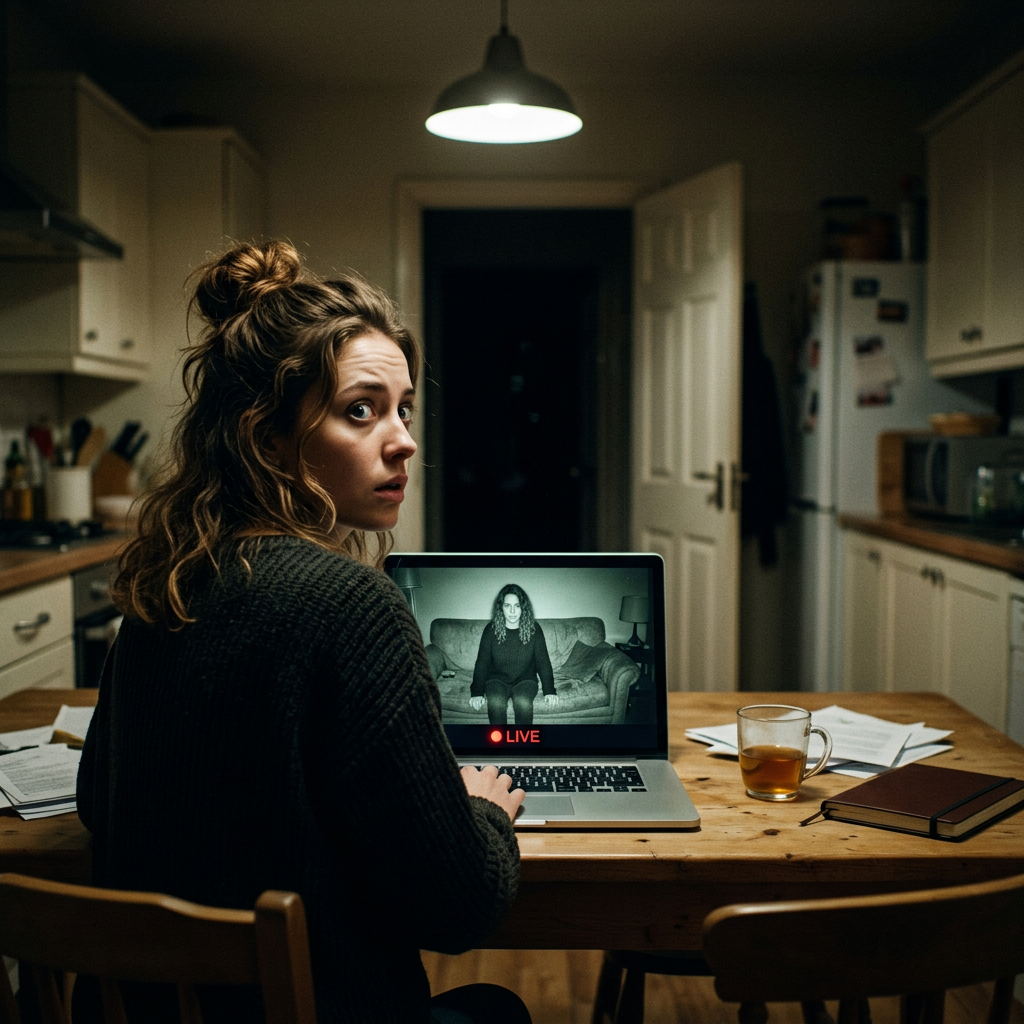
My heart started pounding. I looked up from my screen, glanced around the kitchen, then through the open door into the living room, where every light burned, and the couch sat empty, exactly where it should have been.
Morzsa, who’d been lying at my feet under the blanket, suddenly stood and stared at the kitchen’s open doorway, in the same rigid, hissing posture I’d seen before. I didn’t dare speak, didn’t dare move, just sat there, hand on the keyboard, watching my cat’s eyes track something I couldn’t see, something that might have been moving in the dark strip between kitchen and living room.
I looked back at the screen. The figure in the footage still sat there, motionless, and as I watched, it very slowly began to lift its head.
Along the bottom of the video, where a timestamp should have shown, there was no recorded date at all — only a small red, pulsing circle, and beside it a label I’d never seen in the app before: LIVE. I wasn’t watching an afternoon recording. I was watching what was happening in the living room at that exact moment, while I sat in the kitchen, my back to the open doorway, and on the laptop screen the figure wearing my own hair, my own sweater, now turned fully toward me on the couch, there, where a minute earlier, when I’d looked, nothing and no one had been.
The dragging sound stopped directly behind the spájz door. The silence that followed was denser than anything I’d experienced in that apartment before, and on the laptop screen the figure’s hand, which had still been pointing toward the living room, now slowly began to turn, as if its finger were now singling out me, sitting at the kitchen table, from exactly the angle no camera should have been able to see.
The spájz door, which I hadn’t shut all the way, very slowly swung a few centimeters wider.
Morzsa leapt off the couch — the real couch, behind me — and bolted into the bedroom through the gap under the door, away, far from where he’d been, and the sound of his flight — claws scrabbling on the parquet, quick, desperate footsteps — led exactly in the direction the figure’s finger on the screen had been pointing for a while now, as if the path my cat fled along were precisely what it had wanted to show me all along.
I didn’t know what to do: stand up to face whatever was behind the spájz door, or stay seated, back to the door, eyes fixed on the laptop screen, where the figure now slowly, crawlingly, began rising off the couch, its head still bowed, its long, dark hair hanging across its face — exactly the hair I’d found on my pillow, and on the spájz shelf.
I thought of the sixty-three marks scored into the inside of the spájz door, and how the sequence broke off suddenly, irregularly, as if whoever had been counting the days simply couldn’t continue any longer, or no longer needed to, because something had changed before they could reach the sixty-fourth.
The kitchen light, the only one burning above me, flickered once, then steadied again, but in that brief, trembling moment while the light wavered, I felt something come very close to me, close enough that if I reached my hand back now, without turning around, I might touch something that had no business being there.
I tried to count how many steps it would take to cross from the living room to the kitchen, how many seconds I had before whatever I was watching on the screen actually crossed the few meters separating the two rooms, but the thought fell apart in me before I could finish it, because from beyond the kitchen doorway, from where the living room should have been, I heard a quiet, wet shuffling on the floor, coming closer.
On the laptop screen, the figure, now standing fully upright in the living room, started walking toward the kitchen.




Leave a Reply