
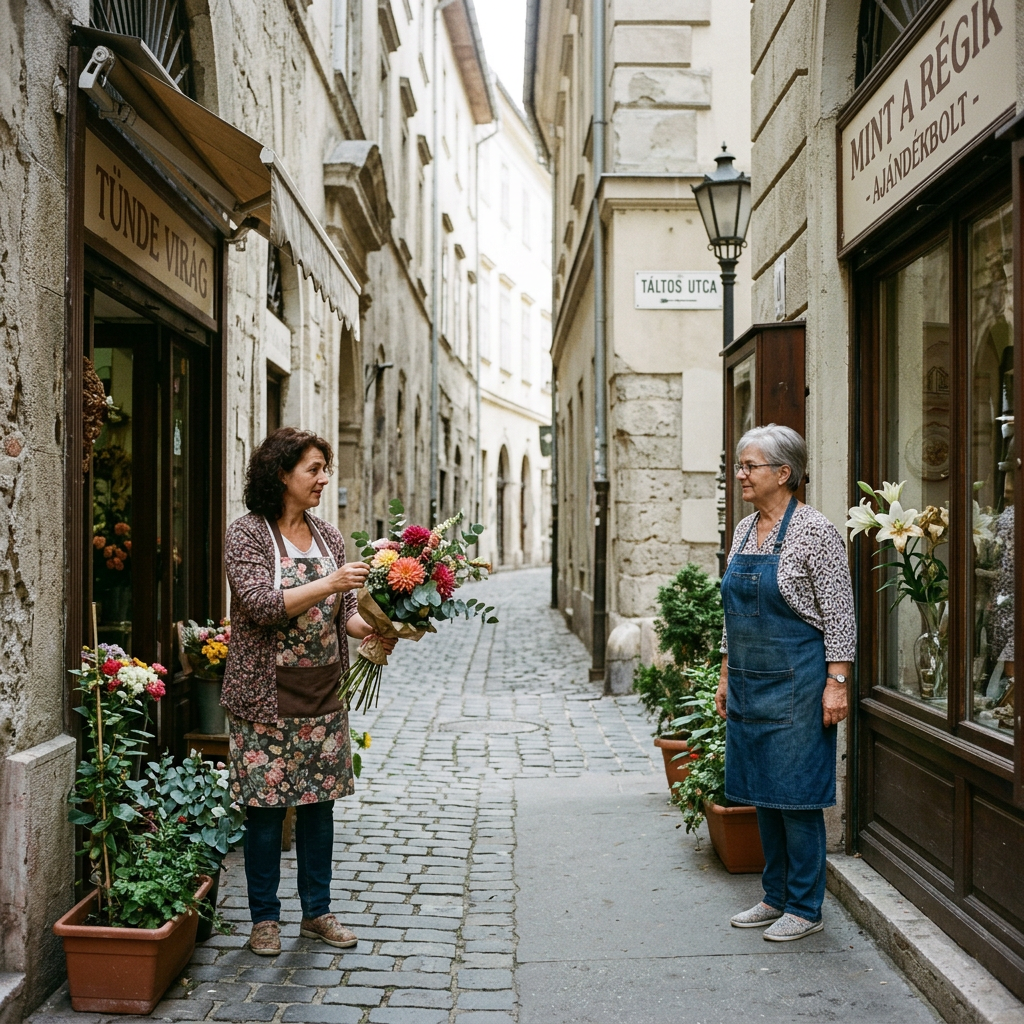
For five years we have opened at exactly the same minute. At half past seven I roll up the grille at Rózsakert, and at half past seven, across the street, Tünde Kardos rolls up the grille at Flóra. We never agreed on this. Neither of us would give the other a single minute’s head start, so both our clocks are set to the same instant, like two guns aimed at each other.
Táltos Street isn’t wide. When I stand in front of my shop and she stands in front of hers, we look at each other the way you’d look across from one balcony to the next. I can see if a bouquet is wrapped badly. She can see if a lily in my window is starting to brown at the edges. Nothing stays hidden. That’s the real punishment of a street like this: the other one always sees.
The morning I actually want to tell you about started with a bucket of water, though that’s not the real story yet — just the overture, worth mentioning because it shows exactly where we stood at the time.
It had rained the night before, and the pavement outside my shop was slick with fallen linden leaves. I went out with a bucket to mop it down before some customer slipped and knocked over a stand of tulips, for which I, not the linden tree, would have been sued. As I poured the water out, Tünde called over from her doorway.
“You’re pouring that on purpose so it runs toward me, Eszter.”
“The pavement slopes that way, Tünde. I can’t command gravity, however much I’d enjoy ordering it to fall on you specifically.”
“There’s a puddle in front of my window now. If anyone slips in there and sues, I’ll be testifying at your trial.”
“I don’t have a trial. But if I did, I’d convict you first, for that hideous arrangement you’ve put in your window. What is that, pampas grass? It looks like an exploded pillow.”
“That’s chrysanthemum, for refined customers, not some roadside carnation like yours.”
At that point we both went back inside and didn’t speak again all morning, except with our eyes, which on Táltos Street was more than enough to constitute a full declaration of war.
We had another ritual, maybe even more childish than the bucket. The radio. Each of us keeps her own playlist in the shop, on the theory that the right music improves a customer’s mood, and we’ve disagreed for years about whose theory is correct. Mine plays old Hungarian chansons, because my mother listened to them when she stood behind this same counter. Tünde’s plays light French pop all day long, and if she leaves her door open — which she always does in summer, because her air conditioning struggles — the two soundtracks bleed together on the sidewalk, and a person can’t tell which shop to walk into, like two radio stations fighting each other at a gas station. One summer we both cranked the volume so high that a police officer finally stopped and said a noise complaint had come in, and neither he nor we could work out which shopfront it had come from, because we both gave him the exact same look of total innocence.
There was a third front, too: online reviews. A one-star review appeared on Rózsakert’s profile, claiming “the flowers rotted within three days and the owner was rude to me,” posted under a name I had never seen among my customers. When I clicked through to the profile, it turned out the same user had given Flóra a glowing five stars a month earlier, dwelling at length on how “elegant and professional” Tünde’s shop was. I couldn’t prove anything, but when I confronted her about it, all she said was, “Maybe the person had a point,” and that sentence burned in me for weeks.
Exactly how it all began, she probably wouldn’t tell it quite the same way I do, but the date is certain. Five years earlier, on a Monday in March, a truck spent hours emptying out a corner unit that used to be a hosiery shop, and a month later a new sign went up: FLÓRA FLOWER SALON.
For eleven years before that I had been the only florist on Táltos Street. The shop had been my mother’s, and before her, her mother’s — a narrow little room whose back wall still dated from when a grocer operated there, and under the floor, people said, there was an old beer cellar nobody had gone down into for decades because the stairs had rotted through. Rózsakert had its own rhythm. Mondays, the funeral home ordered wreaths. Wednesdays, anniversary bouquets came in. Friday afternoons brought the men who had forgotten they were married and were now trying, in a hurry, to fix it.
Then Tünde arrived, with a glass-and-metal shop that was far too shiny, where she kept flowers in a refrigerated display case instead of buckets, as if they were cuts of meat. For the first few months I assumed she wouldn’t last three. She would have, in fact, deserved to fail — but she didn’t, because she was good at what she did, which infuriated me even more than incompetence would have.
She launched her Mikulás promotion before I’d even thought of mine. She started posting wedding bouquets on Instagram that no one on Táltos Street had ever ordered, purely to make her shop famous beyond its own neighborhood. A share of my old customers drifted over to her, because she knew something I didn’t: that modern women like something exotic in a bouquet, protea or some spiky thing she called “style” and I called “garden trash.”
We went to war, and the way it goes in every real war, we both believed we stood on the side of justice.
The first serious battle was Mother’s Day, the year I discovered that someone — who would have had to know my delivery schedule — had told my courier not to bother ringing the bell, just leave everything at the gate, on precisely the day when half my deliveries were going to wedding halls and cemeteries, where a bouquet left at a gate wilts within the hour. The second serious battle came when a client told me someone from Flóra had called her and said that I “inject formaldehyde into cut stems to make the flowers last longer,” which naturally sent the poor woman into a panic and she cancelled her order on the spot.
I never had proof that Tünde did any of this. But who else would have?
She thought exactly the same thing about me, the summer afternoon someone phoned in a huge order for a fake wedding that no one ever showed up to collect, tying up her entire stock for a weekend for nothing. She was certain I’d arranged it.
Maybe we were both right. Maybe neither of us was. We lived on a street where suspicion grew faster than any flower in either window.
I got up at four every weekday, because I had to be at the wholesale flower market on Nagykőrösi Road before the sun had even considered rising. The loading bay was always crowded with refrigerated trucks, Dutch tulips, Kenyan roses, and the traders who worked there all knew Tünde too, since we walked the same rows, just at different hours — she preferred arriving at five, once a small queue had formed, because she claimed the vendors haggle better when they’re tired and worn down. One of my regular suppliers, an older woman named Rozália, who used to sell watermelons before switching to lilies and freesias, once caught the two of us standing in line together — it happened occasionally, when I started early — and asked, “Do you two really hate each other the way people say, or is it just good advertising for the shops?” It took us both a long moment to realize we didn’t actually know the answer.
There was an unspoken rule at the market: if one of us found a good cheap lot of some seasonal flower, we didn’t mention it to the other — we simply bought up as much of it as we could, fast and silent, before the other one noticed. One April dawn Tünde bought out an entire stand of hyacinths right under my nose, flowers I’d already been eyeing for ten minutes while I haggled over the price, and when I called her on it, she just shrugged and said, “There’s no friendship at the market, Eszter. Only order of arrival.”
My mother opened Rózsakert back in the eighties, when buying flowers still meant standing in a long line at a state-run shop, and she decided there ought to be a place where you didn’t have to queue. The shop window glass is still the original, faintly wavy because of how glass was cast back then, and the drawer under the counter still holds the notebook she wrote orders in by hand, because she never trusted a machine with her bookkeeping. I was nineteen when I took the shop over, because she’d fallen ill and could no longer stand all day, and I thought it would only be for a few months, until she recovered. She never recovered. The shop is the only thing left of her, besides one photograph and a ring I never wear, because I’m afraid of losing it.
Tünde never talked much about her own past, but over the years I pieced together what I could, mostly from sentences other people let slip. She spent fifteen years as a marketer at a multinational, good salary and all, until one morning — as she told me herself, once, in a weaker moment — “I looked at my calendar and realized I hadn’t seen a real flower in six months, only a PowerPoint slide where I had to colour the annual-report graphs green to suggest ‘growth.’” She divorced, was left raising her son Marcell alone — he was eight then, and for a long while wrote “my mother works with flowers” under occupation on his school forms, because he couldn’t quite describe the business, only that his room always smelled good when she brought home leftover stems — and she opened Flóra with the settlement money, because at least, she said, “it’s something I do with my own hands.” Marcell is thirteen now, and sits in the back doing homework while his mother works. Once, when I stopped by about a forgotten delivery, he opened the door and said, “My mother says you’re the most annoying person in the district,” which I did my best to take as a compliment.
There was a fourth front too, maybe the bitterest of all, because it had nothing to do with flowers — it was about a parking space. There’s exactly one spot on Táltos Street suited for unloading deliveries, a small recessed curb both shops needed every morning when the trucks arrived from the wholesale market. For months a silent war raged over those few square meters: who got there first, whose van sat there for “just five minutes” that became half an hour, who demonstratively set out a bucket to “reserve” the spot before the delivery had even arrived. Once Tünde put up a sign reading RESERVED — FLÓRA FLOWER SALON, so the next morning I put up one of the exact same size reading THIS IS PUBLIC PROPERTY, NOT YOUR PRIVATE LOT. The district inspectors confiscated both signs one afternoon, and we each got separately fined for “unauthorized occupation of public space” — something neither of us ever told anyone, too embarrassing for either reputation to survive.
The most ridiculous episode, the one I remember best — because it’s the one where I first laughed at my own fury, though I didn’t know yet that I was laughing — happened when a family ordered two wreaths for the same funeral, one from me and one from her, because the person placing the order didn’t want “just one florist handling the whole funeral, let them both make some money.” The two wreaths stood side by side at the grave, ours with a ribbon reading REST IN PEACE, DEAR GRANDFATHER, hers with the same words in her fancier typeface, far glossier than anything that belongs at a funeral. I stood at that grave and caught myself mentally measuring whose wreath was bigger.
Tünde stood a few feet away, doing exactly the same thing. For one moment our eyes met across the open grave, and we both knew we were committing precisely the same disgraceful act at a man’s funeral. We said nothing. We simply turned our heads away, as if the other one didn’t exist.
The dead man’s granddaughter, a woman in a black suit, came up to me afterward and asked why there were two wreaths with identical lettering, since she had only ordered one — the other half of the family, it turned out, hadn’t spoken to her and had ordered a second one without knowing the first existed. “Will one of you refund me?” she asked, and I glanced over at Tünde in confusion, who looked back at me with exactly the same confusion, and in the end we both said, simultaneously, “of course, naturally,” and after the funeral we each quietly refunded the family for one wreath, without telling the other, and it was only weeks later, through an offhand remark from another customer, that it came out that we had both done the same thing on the same day, each of us believing she alone had absorbed the loss.
*
The turning point wasn’t one single event but two letters, on the same day, in early October.
The postman, an older man named Rudolf who has carried the mail on Táltos Street for fifteen years, and who for that reason is a sort of friendly enemy to every shopkeeper on the block, since he’s the one who hands everybody their bills, delivered us both an identical white envelope that morning, the logo of Zoltán Bárdos’s real estate office printed in the corner.
I opened mine in the back of my shop, at the little table by the sink where I also do the books.
The language was polite. The content was not. Mr. Bárdos, who had bought the entire building block four years earlier from a single heir and who had, until then, only raised the rent each year, politely and predictably, now informed me that my lease would expire in December, and that he “regrettably” did not intend to renew it, since the building was slated for “comprehensive renovation and a new purpose.”
I thought at first it was a printing error. Then I read it again.
My hand was shaking as I searched for my phone to call my accountant, János Sárközi, who has done my books for fifteen years, and whose immediate response was, “So does this mean I don’t file the December VAT return, or what?” — as if the tax office were the first thing anyone thinks of on hearing this kind of news. Two months earlier I’d taken out a loan for a new refrigerated display case, because the old compressor had died, and the repayments still had four years to run, on a shop that, apparently, wouldn’t exist come December. I sat down on the floor of the back room, among the brooms and buckets, and for the first time since my mother died and left me this shop, I seriously considered what it would mean for there to be no Rózsakert at all.
I marched over to Flóra — not to share my grief with Tünde, since it hadn’t yet occurred to me that she might have received the same letter, but because I assumed she had done this. I assumed she’d reported me to some authority, filed a complaint against my fire-safety permit, or something along those lines, and that this was the consequence.
I burst through her door so hard the bell went wild, and found her halfway through tying a bridal bouquet, wire and ribbon threaded between her fingers.
“What did you do?” I demanded.
She looked up, and her face wore an expression I’d never seen on it before — not the usual cold, competitive little smile, but something far rawer.
“I was about to come over and ask you the exact same question,” she said, and held out another white envelope that looked precisely like mine.
I sat down in the chair she keeps for customers who are waiting or trying something on, a pink velvet thing that managed to be both too soft and too uncomfortable at once, and read her letter. Word for word identical, except for her name and her lease number.
“So it wasn’t you,” I said.
“Not me, you idiot. I thought you’d reported me over the drainage last month.”
“Why would I report you over the drainage?”
“Because last year you told me my drain stank.”
“That was simply true. Not a complaint.”
We looked at each other, and for a minute we just sat there in that small, stuffy shop, chrysanthemums thick in the air, trying to understand what was actually happening, if it wasn’t happening between us.
*
Over the following days, everyone on Táltos Street received an identical envelope. Jenő, the locksmith on the corner, who’s been there thirty years, whose key-cutting machine is more museum piece than working tool by now, but who can still match any key to any lock without checking the number stamped on it, purely by the shape of the teeth. Jenő’s shop had always functioned as neutral ground on Táltos Street, because he never took my side or Tünde’s in any of our smaller skirmishes — he’d just shake his head whenever one of us stormed in to complain about the other, and always said the same thing: “You two carry on like two dogs fighting over the same bone, when you’ve each got your own bowl.” Margit, who runs the bookshop, a retired librarian who can never bring herself to sell what she’d rather keep, which makes her shop function more like a private library you can occasionally buy something from. And the bakery across the way, run by a married couple, Attila Kiss and his wife Nóra, whose croissants are the only reason Táltos Street fills up with people at all in the mornings.
All of our leases had been terminated.
Zoltán Bárdos, whom none of us had ever met in person, only his lawyer — a slick-haired young man in overly shiny shoes named Péter, who talked the way a brochure reads — wanted to sell the entire block to a development group planning a “boutique hotel” on the site: two stars in reality, though they called it four, twelve rooms, a rooftop bar, and — as we read on a poster somebody had already put up in one of the vacant windows before any of us had even signed an eviction notice — marketed as “the hidden gem of the city centre.”
We all stood on the sidewalk one Tuesday evening, after closing, because Nóra had called everyone together at the bakery, which had the most room and, crucially, coffee, which everyone needed.
“I’ve had this shop for thirty years,” Jenő said, looking at the letter in his hand as though it were someone else’s death certificate.
“We’ve still got eight years left on the loan for the oven,” said Attila, standing beside Nóra, who went silent for the rest of the evening, as if her voice itself had run out.
Tünde and I stood next to each other, not because we’d decided to, but because the bakery was cramped and we both kept gravitating toward whichever spot gave our arms the most room.
“So what do we do now?” Margit asked, in her librarian’s voice, the tone that manages to be both an order and a question at once.
Nobody knew the answer.
“I have four children,” Nóra finally said, when everyone had given up expecting her to speak at all. “Four children, and this bakery is the one thing I never had to doubt. Now I’m going to doubt it.”
“I’m sixty-three years old,” Jenő said. “Who hires a sixty-three-year-old locksmith if I close? Nobody. I’d have to start over, except there’s nothing left to start over with.”
Margit stood behind the counter with her arms crossed, surrounded by books arranged in an order no stranger could ever decode, only she could. “I retired as a librarian, and I opened this shop because I wanted to keep living among books, not to get rich off them. If this gets taken from me now, there’s nothing left to get up for in the morning.”
Tünde and I said nothing in that circle, but it was the first time I looked at her and saw not my rival but a person exactly as frightened as I was, just wearing it differently.
But there, in that warmth, in the smell of pastry still clinging to the shop though the oven had long gone cold, something began to take shape that would later turn out to be an alliance, though nobody called it that yet.
*
The first thing we did was probably also the most useful: we read our leases. Not just our own — each other’s too, since everyone had signed at different times under different terms, and Margit, who’d spent her whole working life with documents, suggested we all sit down and go through every one of them together, spread out on a table like a map.
It turned out that Jenő and I had a clause in our contracts the other three didn’t: a twelve-month notice period, not three, because our leases had been drawn up under a different owner, in an era when landlords were less careful with their wording. That meant Bárdos was, on paper, trying to evict us illegally come December, since our notice period would run until the following October.
“That’s ten months gained,” Margit said, tapping the clause with her finger like a teacher pointing at a blackboard.
“Ten months to do what?” Tünde asked. “So they can just throw us out anyway afterward?”
“Ten months so we’re not doing this alone,” I said, and was startled to hear that sentence come out of my own mouth, aimed, of all people, at Tünde.
We started allying ourselves — though the word felt too grand for what we actually did: we contacted a lawyer whose number Margit got from an old librarian colleague, a woman named Ilona Fekete who specialized in tenancy law, and who, at our first meeting, said, “this is a textbook case,” which simultaneously relieved and enraged every one of us, because if it was textbook, it meant other people had gone through exactly this and nobody had stopped it.
Ilona Fekete’s office was a fifth-floor apartment converted into business premises, with a permanently unreliable lift that could only hold four at a time, so Tünde and I walked up the last flight on foot, and somewhere around the third floor she stopped, caught her breath, and said, “You know what’s funny? Five years ago I opened across from you because I thought this street was big enough for both of us. Turns out it’s not big enough for even one of us, if the landlord decides otherwise.” I didn’t answer, because she was right, and that unsettled me.
Ilona Fekete was a thin woman in her fifties who, instead of framed diplomas, kept a wall of newspaper clippings about her tenant-rights victories, and who stated flatly, right from the start, that we would never win a fight built on crying about our fate — only one built on paper against paper. She requested every single lease and spent an entire afternoon laying them out across her desk in date order, chain-smoking by an open window the whole time, January be damned.
Ilona Fekete advised us to file a joint complaint referencing the discrepancy in notice periods, and to ask the district council to investigate whether the planned redevelopment was even lawful on a street with partial heritage status — since several of the facades on Táltos Street, including mine, date to the 1920s, and if that could be confirmed, the developer would need permits that could easily be stalled, given enough public complaint.
“So now we’re running a petition,” Tünde said one evening, when the two of us were sitting in the back of my shop after closing, having stayed on after everyone else had left, over a bottle of cheap red wine someone had left behind the previous spring as a makeshift apology for a cancelled wreath order.
“We run a petition, we write to the press, and if everything else fails, maybe we march,” I said.
“You’re cooperating with me now.”
“For a while.”
“For a while, until we save the shops, and then we go back to hating each other?”
“That’s exactly what I had in mind, yes.”
She laughed — the first real laugh I’d ever heard out of her, not mocking, not competitive, just laughter — and somehow that frightened me more than any battle we’d fought before.
*
Collecting signatures wasn’t nearly as simple as it looks on a petition sheet. We started going door to door in November, not alone but in pairs, because Ilona Fekete felt two people are always more credible than one, and it somehow worked out that Tünde and I got paired together — maybe because we were the two most recognizable faces on the street, or maybe because Margit privately enjoyed forcing us into each other’s company.
Before the door-to-door campaign began, Ilona Fekete insisted we first visit the district’s heritage officer, a man named Dezső Halmai, who sat in an office lined with old street photographs, including one of Táltos Street from the fifties, where another sign hung in the spot our shop now occupies, too blurry to read. He heard us out while flicking a pencil against the desk, and said only, “The facades do appear in a 2003 survey, but they were never formally protected, just flagged ‘noteworthy,’ which on paper means nothing.” Tünde asked what it would take to get them properly protected, and he sighed, as if he’d answered that question a thousand times. “A full procedure, expert opinions, at least eight months, and no guarantee the committee rules before the developer’s bulldozed the whole thing anyway.” Not a solution — but enough, Ilona said, “to at least give us one official document to cite while we work the other angles,” and that became the backbone of our whole strategy: not one decisive victory, just enough small obstacles to wear Bárdos down.
The neighbors weren’t always kind. An older man who lived above Flóra on the third floor slammed the door in our faces, saying, “I’ve got nothing to do with your shops, you should both get real jobs.” A young couple who worked partly from home signed, but complained the entire time that Flóra started unloading deliveries too early, waking them with truck noise, to which Tünde only said, once we’d shut the door behind us, “See, everyone hates something about each of us. At least now they hate us at the same time.”
A retired Latin teacher who lived above the butcher’s read the entire petition before signing, correcting two typos in red pen, “since if I’m signing it, the grammar should at least be correct.” Another man claimed he never bought flowers, “because what’s the point, they wilt like everything else,” yet signed anyway, “on principle” — developers, he said, had “already bought up the whole district, and enough was enough.”
On the third floor lived a widow, Mrs. Teréz, who for years had bought a single rose from me every Friday, on the theory that “a week is worth nothing without one flower in it.” She not only signed the sheet but burst into tears, saying that if the shops of Táltos Street disappeared, nothing at all would be left in this part of the city that resembled her youth, since everything around her had already been torn down. That was the first time Tünde and I both teared up at the same thing, though afterward we each pretended it was only the cold wind stinging our eyes.
*
Winter arrived slowly, not because of the weather but because of the paperwork. Ilona Fekete prepared a formal complaint that all of us had to sign, and because of it Jenő had to call his son, who was studying law in Debrecen, to double-check everything the lawyer told us, since he “didn’t want to sign anything blindly,” as he put it, which nobody held against him, because we all felt exactly the same way.
The council’s officials moved slowly, the way officials move everywhere, but the petition we’d started circulating on the street, and eventually posted online too — Tünde’s idea, since she understood the internet, a thing I had always resented in her and which now suddenly proved useful — gathered more than twelve hundred signatures within two weeks, because it turned out the residents and regular customers of Táltos Street preferred their actual shops to some future boutique hotel none of them would ever stay a night in.
Meanwhile — and this was the part nobody had planned — we started working inside each other’s shops.
It began because, in mid-January, on a freezing night, one of the water pipes running beneath the block, which Bárdos hadn’t maintained in years, because why maintain something you intend to demolish, froze and then burst, and by morning both my cellar and Tünde’s were flooded, water seeping up under the floorboards, in the exact week we were both preparing our Valentine’s Day orders — the single busiest, most important week of our entire year.
I got there around six, my security alarm having gone off, and found Tünde already there, boots up to her knees, hauling buckets out of her own shop, trying to save the stock before the water reached the roses in the cooler, whose circuit also ran through the floor and was now in danger too.
“Help me, don’t just stand there!” she shouted at me before I’d even had the chance to say hello.
I didn’t ask a single question. I took off my coat and got to work. We worked together for two hours, through mud and icy water, hauling buckets to the street, stacking the priciest bouquets on a raised table Jenő brought over, since the noise had woken him too. Attila showed up with a thermos, always up early for the baking anyway, and Margit arrived by six-thirty with no real reason to be there, except that she hadn’t wanted to lie awake alone once the neighbors told her something was wrong.
Around half past seven, a nervous young man appeared — he’d reserved thirty roses for that exact day, planning to propose that evening, and had no time for anything but this one order. Seeing the wide-open door, the muddy buckets, women in rubber boots, he assumed there’d been a break-in and reached for his phone. Tünde got to him first, calm as if she hadn’t been standing knee-deep in water an hour earlier: “Your bouquet will be ready by eleven, I promise, we just need to save what the water’s threatening first.” He nodded, confused, and left half the deposit in cash, as if the chaos had somehow made the whole thing more trustworthy, not less.
Jenő brought over an extension cord and a pump from the locksmith shop, a device I’d never known he owned — bought after an old flood, “because you never know,” he said, feeding the hose into the water. Attila’s coffee went cold in our hands, because something more urgent kept interrupting, though nobody complained.
By eight that morning most of the water was out, the cooler was running again thanks to an extension cord we’d run over from Attila’s bakery, and most of our Valentine’s orders had survived.
Tünde looked at me then, mud-streaked, hair stuck to her forehead, and said:
“Thank you.”
“Don’t mention it,” I said, and that was the first time in five years those two words had come out of my mouth to her so naturally.
“No, I do mention it,” she said, and added, with a strange, grudging little smile: “Now I owe you a delivery of roses, if my cooler ever dies again, since mine’s full of uglier flowers than yours, and I will never, ever admit that in public.”
“You just did,” I said.
“Only because I’m tired.”
*
Not everything went smoothly between us during this stretch. Late in January, on an evening when we were all worn down from paperwork, Tünde suggested to the group that maybe it would be simpler to accept a settlement, if Bárdos offered one, and everyone could just open a new shop somewhere else with the money.
“Easy for you to say,” I snapped back, louder than I meant to. “You’ve got the capital for that, since you worked at a multinational five years ago. I have nowhere else to go. This isn’t just a shop — it’s my mother’s shop.”
“And you think it’s easy for me to start everything over in another street, with my son, who’s only just gotten used to his school?” Tünde asked, and her voice wasn’t cold this time, just tired. “I’m not trying to give up, Eszter, I’m trying to be realistic. What if we drag this out for months and get evicted anyway, except by then we’re out of both energy and money?”
“At least we’d have tried.”
“Trying doesn’t pay off my refrigerated display case.”
That was the one moment in the whole process when I thought our little alliance might fall apart before it had even properly formed. It was Jenő who stepped in, quietly, the way he always does.
“Nobody’s deciding anything alone. We wait to hear what the lawyer says about the deadlines, and then we vote together. If the majority says push on, we push on. If not, we find another way.”
Tünde and I didn’t look at each other for the rest of the evening, but the next morning, when I rolled up my grille, she was already standing outside her shop, and called across the street, “I don’t want to give anything up. I’m just scared.” That was the first time she admitted her fear to me, and somehow it brought us closer than any shared project had managed before.
*
In February, once the petition passed fifteen hundred signatures, the local paper, the Seventh District Herald, sent a young reporter named Katalin Both, who opened the interview by asking, “Is it true the two of you used to be enemies?” Tünde and I looked at each other, both of us weighing, for a moment, how to answer without lying but also without whitewashing five years of warfare.
“We weren’t enemies,” Tünde finally said. “We were rivals. That’s different.”
“And now?” Katalin Both asked, pen hovering over her notebook.
“Now we’ve got the same rival, just bigger, and he’s called a property developer,” I said, and that was the first sentence I’d ever constructed in public that put me beside Tünde instead of against her.
The article ran under the headline “Small Shops Fight Back Against the Developers,” with a photo of the six of us standing in the middle of Táltos Street, Tünde and I at opposite ends, as if someone had deliberately posed us to highlight the contrast — her elegant coat, my rubber boots, which I hadn’t had time to change out of before the shoot. More than a hundred comments piled up under the article, people sharing their own, similar stories from other districts where developers had tried to push out small shopkeepers. Ilona Fekete said that alone wasn’t enough, but “it never hurts if a judge, should we get that far, has already heard of us somewhere.”
Three days after the article ran, Zoltán Bárdos’s lawyer, Péter, called and invited all of us to a “meeting,” as he called it, though we all knew it was really a negotiation, since the press coverage meant he could no longer afford a public eviction.
The meeting took place in a glass-walled office across the district, in a building so modern the furniture still smelled of glue. Ilona Fekete led us in, and Péter slid a folder across the table, saying Mr. Bárdos “understood our concerns” and was ready to offer an “alternative solution.”
The alternative was that he wouldn’t demolish the whole block at once — only the rear half, currently used for storage — and offered the front-facing shops a new five-year lease, keeping the original rent level rather than raising it, which he tried to present as a great act of generosity, though we all understood he was doing it because he feared the heritage review would slow the entire project down, and that in five years he might get a better price from a different developer anyway.
Before we signed anything, there was a moment in that glass-walled office I couldn’t forget for a long time afterward. Péter, the lawyer, kept using the same brochure-voice he’d opened the meeting with, and at one point said, “Mr. Bárdos was very flexible on this point, I hope you’ll appreciate that,” at which Tünde rose from her chair so abruptly the legs scraped against the floor.
“Flexible?” she said. “In December you tried to throw out six businesses — one of them thirty years in that spot, another with four children to feed — without a single word of warning beforehand. Now that we’ve exposed the discrepancy in the notice periods, and the press has taken an interest, suddenly you’re ‘flexible.’ That isn’t generosity, Péter. That’s defeat, dressed up and handed to us like a gift.”
The room went quiet. Ilona Fekete kept her eyes on her folder, but I caught the faint beginning of a smile at the corner of her mouth.
“So what would you like, then?” Péter asked, and for the first time he sounded like he was actually asking a question, not reading from a script.
“We’d like a guaranteed lease of at least five years, rent that doesn’t rise faster than inflation, and if the property is ever sold, first right of refusal for the current tenants,” Tünde said, as if she’d rehearsed that sentence a hundred times in front of her own mirror before we’d walked in.
Péter left to “consult,” as he put it, and stayed out for twenty minutes while the six of us sat around the gleaming table in silence, nobody saying a word, except for Jenő drumming his fingers on the table until Margit told him to stop.
“This isn’t what we wanted,” Jenő said quietly, once we were outside, all of us standing on the cold street among cigarette smoke and exhaust fumes.
“It’s not what we wanted, but it’s what we can get,” Tünde said, and when I looked at her I saw a strange, cold calculation on her face — the kind I recognized as a businesswoman’s calculation, not an enemy’s anymore, but an ally’s.
“Five years,” I said. “That’s enough time to prepare, in case we have to leave after all.”
“Five years is also enough time to think of something else,” Margit said. “By then we might all look rather different.”
We signed, all of us, within a week, after Ilona Fekete reviewed the papers and fought for two small additions on our behalf: an option clause granting current tenants first right of purchase if the developer tried to sell within the next five years, and a clause fixing that rent could not rise faster than inflation during that same period.
*
I won’t claim that everything between us changed overnight once we signed. It would be a lie. In March, a week after everyone signed the new lease, Tünde put up a new sign in her window that read “The freshest imported flowers here, not just local stock” — clearly aimed at me, since I always proudly advertised that most of my flowers come from Hungarian growers. I went over and asked why she was starting this up again, now that we’d fought together for our shops, and all she said was, “Being allies against the landlord doesn’t mean we have to be friends in the market. The war has two fronts, Eszter, and we’ve only made peace on one of them.”
Strangely, that reassured me, because it meant I didn’t have to pretend we’d suddenly fallen in love with each other, and that felt far more honest than any sudden friendship would have.
*
In June, the district council held its traditional Táltos Street flower weekend, an event that’s been running for years but had gone almost unnoticed the previous two, since the development news had kept everyone’s attention on their own survival rather than decoration. This year Margit suggested we do something bigger, “to show we’re still here,” and, unexpectedly, Tünde and I were given the job of jointly decorating the old wrought-iron gate at the entrance to the street — the one Jenő’s father had forged back in the fifties.
We spent two days on a scaffold together, weaving branches and ribbon through the ironwork, arguing the entire time about which colour should dominate — she wanted lilac-blue, because it was “more modern,” I wanted pink and white, because it was “more classic” — and in the end a composition emerged that contained both colours, because neither of us would give an inch, and that turned out to be the only possible solution. When people stopped that weekend to photograph the gate, and one elderly woman asked, “who made this beautiful thing,” we both answered “we did” at exactly the same moment, and looked at each other, because it felt strange to use that word in a sentence with no other subject but the two of us, working together.
That evening, once we’d taken the scaffold down, our hands covered in small cuts from the wire, Tünde sat down on the steps outside her own shop and said, more to herself than to me, “Funny, isn’t it, that this is what saved us both. Not a great success, not a good year. A shared enemy.” I didn’t answer, because she was right, and because I knew that adding anything just then would ruin that rare minute when we weren’t competing about anything at all.
*
Five years didn’t solve everything, and it didn’t need to. Táltos Street is still narrow, the linden leaves still fall every autumn, and the pavement still gets slick. Tünde and I are still rivals, because we can’t be anything else — two flower shops facing each other on the same street simply cannot afford not to compete, or one of us would close, and then we’d both be worse off than if there’d been any competition at all.
But now we share a delivery van, which we take turns using, which Jenő fixed when the engine finally gave out, and which everyone chips in to fuel, tracked in a shared notebook of who used it and when. We have a group chat on our phones, named “Táltos Street Survivors,” though Attila thinks that’s too dramatic and that “Táltos Street Tenants’ Association” would be more fitting — nobody’s ever changed the name, because everyone secretly enjoys having somewhere to say dramatic things once in a while.
The group isn’t only about work anymore. When Jenő’s son passed his final law exams in Debrecen, he posted it there first, and within half an hour seventeen congratulatory messages had piled up — more than you’d expect, Margit said, “from a tenants’ advocacy group.” When Attila’s oven broke right before Christmas, Tünde called a contact at another bakery and borrowed an industrial oven for the night — a contact I’d never known she had, since before all this we only ever talked about how to poach each other’s.
Last week, a wedding client came to me wanting a large floral arrangement for a church, but her budget wasn’t enough to cover all the flowers through me alone, since certain varieties she wanted could only be sourced cheaply through Tünde’s contact in the Netherlands. I sent her over, and Tünde took the order, then split the fee with me afterward, “since she was your client,” as she put it — something no one had ever forced her to do.
In September, when Marcell started eighth grade and Tünde had a major wedding order to fill on the exact same day she needed to take him to a doctor’s appointment, she called me first — not her own seasonal hire, but me — and said, “I know this is a strange thing to ask, but I need to trust someone, and you’re the only one who knows my orders well enough not to ruin them.” I delivered the bouquets to the church in her place, and when the wedding planner asked, “Are you from Flóra, or the other place,” I didn’t know for a second how to answer, because the question no longer felt like it needed a sharp dividing line.
Yesterday morning, when I rolled up my grille at half past seven, she rolled up hers at exactly the same moment, as always, and called out:
“There’s a carnation browning at the edge of your window again.”
“There’s that exploded pillow of a chrysanthemum in yours again.”
“That was an award-winning arrangement at a flower show.”
“What show, Tünde, some hobbyist forum?”
“An international show you’ve never heard of, because you only know carnations.”
“At least my carnations don’t look like a car crash.”
“At least my drain doesn’t stink.”
“That happened exactly once, three years ago, and it was a lie even then.”
“We’ll see what the next plumber you call says.”
“If it breaks again, you’ll be the first person I call, don’t worry.”
“I’m counting on it.”
She laughed, and went into her shop, and I went into mine.
Last month I was back at the wholesale market, and Rozália, the lily woman, asked me again — for maybe the tenth time now — “Do you two still hate each other, the way people say?” I told her the story of the wrought-iron gate, of the lilac-blue and pink ribbons neither of us would give up on, and Rozália laughed hard, then said, “So now you only hate each other over colour, not altogether,” and that was probably the most accurate description anyone has ever given of what we’ve become to each other over the past year.
The day went on like any other day, two shop windows facing each other, two women fighting the same fight, just no longer against each other.





Leave a Reply