
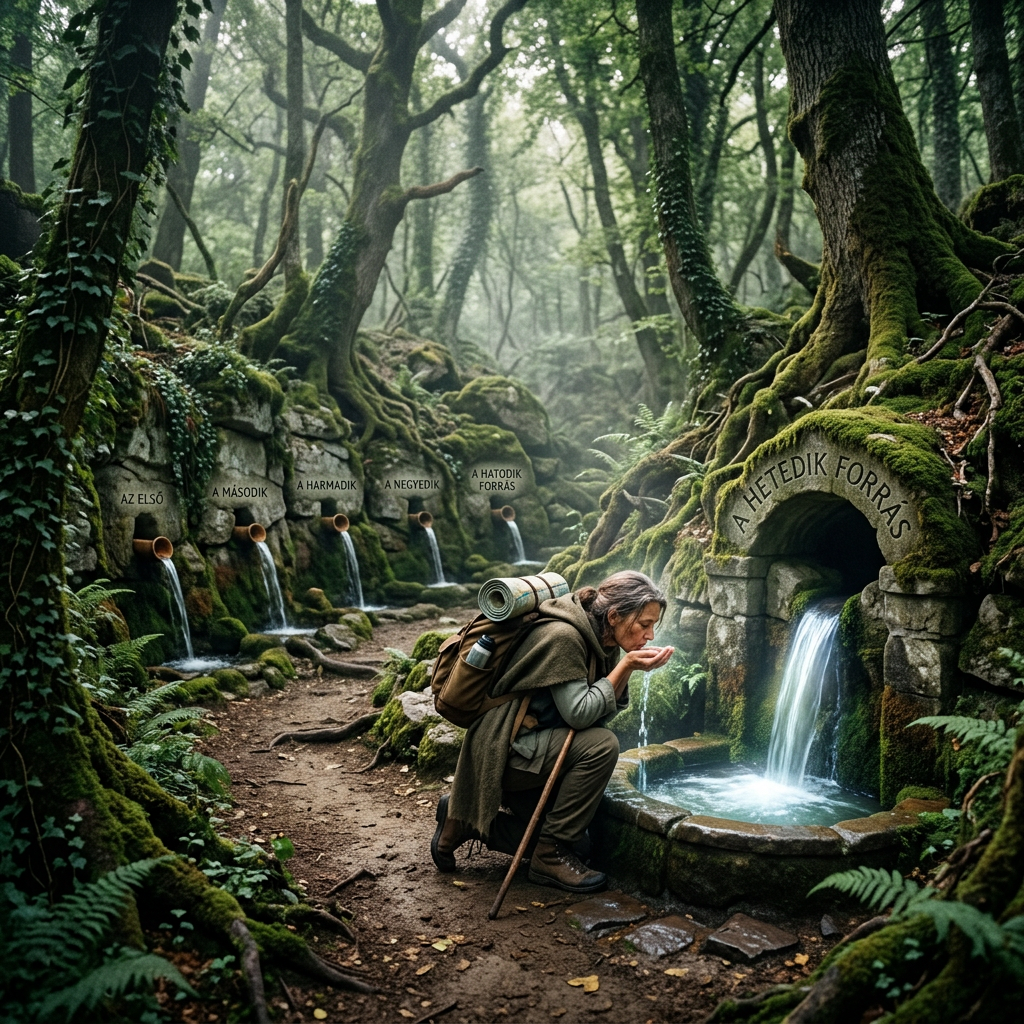
Deep in the old forest the villagers avoided, believing that whoever entered alone didn’t always find their way back out, seven springs are said to rise one after another, and only the last, the seventh, grants the traveler what they truly long for. The first six only quench thirst; the seventh, they say, gives something more, though no one could say exactly what, because few ever made it that far, and those who did didn’t always come back to tell — and those who did come back often carried something changed in them they weren’t eager to talk about.
The forest wore a different face depending on the season, and most who tried their luck went in during spring or autumn, when the ground was kindest. In winter the snow fell so deep that even the boldest gave up the road, and the villagers said the seventh spring itself froze over then — not from the cold, they claimed, but because the forest wanted its rest same as anyone. In summer the forest’s shaded heart would have offered cool refuge to anyone brave enough to step in, though few ever did, since the stories of what waited for those who went too far outweighed any temptation the heat could offer.
The oldest villagers still remembered a young man named Gábor, who’d gone into the forest a generation earlier because he loved a girl who didn’t love him back, believing the spring’s water might change her heart. Gábor never returned, and though some claimed to have spotted him years later at a distant market, older than he had any right to be, others insisted the forest had simply kept him — not because his wish was too large, but because no water on earth can change a heart that isn’t your own. The village used his story to teach its children that the seventh spring was no wishing well where any desire could be tossed in and granted — it gave a person back to themselves, but only if what they asked for truly belonged to their own soul, not someone else’s.
At the forest’s edge, where the last trees began to thicken, villagers kept an old habit of leaving a crust of bread or a strip of ribbon on a certain jutting stone before going on their way, whether toward the fields or the road to the next village that skirted the tree line. Few truly believed it protected them from anything, since most never set foot past the tree line anyway, but the habit had rooted itself so deeply into village life that no one asked why anymore — they simply did it, the way a person crosses themselves before a church without thinking it through each time. Some of the old women said the bread quieted the forest’s hunger, so it wouldn’t need to reach for a person’s instead, and though no one took that literally, the thought behind it — that the forest had its own needs, worth respecting — had settled into everyone, even those who never stepped past the tree line. The widow herself, as a child, had once left a crust of bread on that very stone, only in play, copying her mother, never imagining that as a grown woman she would one day cross the line those crusts only marked, but never truly guarded.
A widow who had lost her son to a war no one could ever quite confirm had happened — or if the village had simply imagined it, since the news always arrived vague and contradictory, one message saying her son was alive, another that he’d fallen, then another contradicting that one too — set off into the forest to find the seventh spring.
The widow’s name was Veronika, and the village knew her as the woman who’d raised her son, Mihály, alone, since her husband had died in an accident felling timber, back when Mihály barely knew his letters — the tree he’d cut had fallen the wrong way and pinned him before anyone could reach him. From that day Veronika worked their small plot alone, and in the evenings sat alone by the fire with Mihály, never once letting herself weep in front of him, believing a child needed a strong mother, not a broken woman, even as something in her broke a little further every night in private. Mihály grew into a quiet, hardworking boy who learned early how to help around the house, and who never complained that other children had fathers and he didn’t — except that sometimes, at the village festivals, when fathers stood beside their sons, Veronika would catch a shadow cross his face for an instant before it settled back into its usual quiet smile.
The night before Mihály had to leave, Veronika didn’t sleep at all, only repacked his bag again and again, as if arranging everything inside it perfectly might somehow protect him on the road. She tucked in a warm scarf his grandmother had knitted, a small pouch of dried fruit, and a wooden spoon he’d eaten his porridge with as a small boy and never wanted to part with, even once he’d grown too old for such attachments. Mihály stood in the doorway with the pack in his hand and told his mother not to worry, that he always found his way back, just as he always had as a boy, even when he and the other children wandered too far at the edge of the forest, and all Veronika could answer was that she knew that, but that knowing was never quite enough for a mother — she needed to see it too.
When his time came, Mihály was conscripted like so many other young men of the village, and Veronika stood at the roadside as he left, and didn’t cry even then, only watched him long after he vanished around the bend, and kept watching that bend a long while after, as if watching alone might call him back. For the first half year letters came regularly, short notes where Mihály described what he ate, what the weather was like, how much he missed sitting by the fire at home, and Veronika read each one a hundred times over, until the edges wore thin under her fingers. Then the letters grew rarer, then vague, then contradictory, and Veronika slowly learned that uncertainty was a particular kind of pain a person never grows used to, because it starts fresh every morning the moment she wakes, not even knowing for an instant what she’s woken into — good news, bad news, or the same nothing as the day before.
Since her husband’s death Veronika had spun thread and sold it at market, and she kept at the work through the two years of the war too, because the steady turn of the spindle gave her days some rhythm when everything else felt uncertain. Her neighbors often came to sit with her, though a few, in their constant asking whether she’d heard anything, only made things heavier, treating every plain “not yet” as bad news in itself. Once, a courier reached the village with word that everyone conscripted from a nearby village was being sent home, because the war — which no one could ever confirm was truly happening — had supposedly ended. The village breathed easier for an afternoon, and Veronika swept the house and baked the sweet bread Mihály had always loved, but by the next day the news turned out false, a misunderstood rumor, and the bread sat on the table for days, because no one could bring themselves to eat it or throw it away.
On the last Sunday of every month the village held a candlelight prayer outside the church for everyone gone to war, and on those evenings Veronika stood among the other mothers and wives who shared the same lack of certainty. Some had already received the sure word that a son or husband had fallen, and though their grief was plain, Veronika sometimes felt, strangely, a kind of envy — that she wasn’t even allowed the certainty of grief, only this in-between state belonging to neither hope nor mourning. At one such evening, a woman whose son had come home alive told her, meaning to be kind, that at least she still had hope, and Veronika only nodded, though inwardly she thought hope, stretched too long without an answer, becomes every bit as heavy a weight as knowing someone is never coming home.
It was those evening prayers that finally gave her the idea of going into the forest, because at one of them old Katalin’s daughter, who’d since married into a neighboring village, told her what she’d heard from her own mother about the forest and the seventh spring — though Katalin herself had never spoken of it openly to anyone, only whispered it once to her daughter while sick and half dreaming, when she no longer had the strength to hold it back. From that evening Veronika could think of nothing else, and though she turned the idea over in her mind for weeks, she finally rose one dawn, packed her bag, and set out before anyone could try to talk her out of it.
In time the village learned not to ask Veronika too much, not out of unkindness, but because no one knew what to say that wouldn’t cause more harm than good, and she grew more and more alone with her uncertainty, though she never let the bread go stale that neighbors sometimes left on her doorstep without a word, knowing that people, in their own way, wanted to be near her even without speaking.
Her neighbors tried to talk her out of it, telling her the forest didn’t let everyone back out, that old Katalin had gone in once too, and was found three days later at the edge of the village, confused, as if she remembered nothing of what she’d seen inside. Katalin herself never spoke of the forest after that, and if asked, said only that it was better not to know beforehand what waited inside, since what she’d seen couldn’t be explained in any way that would make sense to someone else. Some said she hadn’t found her way back for three days because she’d stopped at the first spring and sunk so deep into memory she forgot to go on, and the forest, losing patience, simply turned her back along her own footprints until she gave up and let herself be led out. Others said her confusion came from nothing stranger than days of eating too little — though few believed that, not after seeing the hollow look Katalin wore once she returned.
Her closest friend, a woman named Erzsi, a widow herself, though her own grief was older and more settled than Veronika’s, came by one evening and begged her to reconsider. “What if you come back like Katalin?” she asked. “Or what if you don’t come back at all? Who’ll be left to mourn you, if Mihály’s already gone, and there’s no one left to do it?”
“If I don’t go,” Veronika answered, “every morning I’ll come back to exactly this: the table, the empty chair, the question that never gets answered. At least this way, whatever I’m carrying inside me has somewhere to go, whether it leads to something good or something terrible.”
Erzsi had no answer for that, and though she let her friend go at dawn the next day with tears in her eyes, she slipped a small sack of dried apples into Veronika’s pack while they said goodbye, saying that if she herself couldn’t go along, at least this could. Veronika didn’t notice the sack until she reached the forest’s edge, and though she could have turned back to thank her, she went on instead, knowing Erzsi would understand the thanks better left unspoken in an emptied bag than said aloud between them.
But the widow had nothing left to fear losing, because she felt even the worst outcome would be better than the uncertainty that settled over her every evening.
The village priest, too, stood before her before she left, and told her the forest was no house of God, and that anyone seeking answers there was venturing somewhere no one could guarantee their safety — but Veronika only answered that she’d been living for months already in a place where no one could guarantee anything, and that uncertainty at home was just as dangerous, only slower to kill.
The forest’s mouth, where the trees first closed in thick enough to swallow the path from under her feet, was nothing like what Veronika expected: not threatening, but watchful, as if the trees themselves knew that whoever came this far could no longer be turned back by a kind word. The canopy closed so tightly overhead that sunlight reached the ground only in narrow, shifting patches, which seemed to flicker and vanish on the moss as though the forest itself were breathing. The silence here, too, was unlike the silence at home — it lacked nothing, wasn’t empty, but full of small sounds a person only noticed by standing still long enough: a branch cracking somewhere distant, the brush of a bird’s wing, her own heartbeat, which she’d never heard so clearly at home. On a few tree trunks she found old, faded strips of ribbon tied there by earlier travelers, for some reason — a marker, perhaps, or a vow — and Veronika couldn’t tell which of them had reached the seventh spring and which had only made it this far, because the ribbons told no story, only showed that she wasn’t the first to set out on this road, and wouldn’t be the last.
The forest floor changed from day to day: in the first days she walked soft paths carpeted in pine needles, but by the third the land began to climb, and she had to scramble up stony ground that made her slip more than once, scraping her palm on a jutting root. At one point she had to wade waist-deep across a fast stream that belonged to none of the seven springs, only an obstacle in her way, and waited shivering on the far bank for the sun to dry her. She’d brought little food, trusting she’d find water enough at the springs, but hunger needed other answers: she gathered berries she recognized from childhood, and once a hazel grove generous enough to last two days. She spent her nights by small fires, and every morning, before moving on, put them out with care, so no stray spark would harm the forest that she felt, more and more, was beginning to consider her its own.
She walked for six days, and every day she found a spring, drank from it, and walked on, because her thirst was never really about water. She found the first in a small, rocky hollow, where the water lay so clear she saw her own face in it before she disturbed the surface with her drinking. The spring was cold, ice-cold, as if it came from deep within the earth, and when she drank from it, every cold winter morning she’d sent her son off to school came rushing back, moments when she hadn’t held him tight enough, because she was in a hurry, because she’d believed there would always be another chance.
As she knelt by the spring, something caught her attention: at the water’s edge lay a small bird, motionless, its wing twisted strangely, as if the night’s frost had caught it before it could find shelter. Veronika studied it a long while, remembering how Mihály, as a small boy, always buried the dead creatures he found under a little stone, saying a few words of his own invention each time, because he believed anything that had lived deserved a farewell, even a creature he’d never truly known. Veronika did the same now, laying the bird beneath a small stone, and though she found no words of her own, she whispered only, “rest now, little one,” something she’d once heard from Mihály on a similar occasion, and the gesture itself comforted her enough that when she rose and walked on, her steps felt lighter than they had the day before.
Around midday she came upon a strange clearing where great flat stones stood in a ring, like the remains of some ancient structure, though no one in the village had ever spoken of a building deep in the forest. Deep, circular markings covered the stones, long worn soft by rain and wind, and Veronika stood a while at the center, trying to guess what hand had shaped them, and why here. She found no answer, but there was something steadying in knowing that others had once stood on this very spot, and that her own story was only one among many this forest had listened to across the centuries.
The second spring was sweet, almost honeyed, and her memories turned sweet with it too: she remembered her son’s laughter as a child, the first time he learned to ride a bicycle, falling a dozen times before he got it right, always getting back up laughing, never crying, even when his knee was bleeding.
Bees hummed around the second spring that day, since the nearby trees were in bloom, and the scent lay so thick over the clearing it seemed to press on her from every side. One bee landed on her hand as she drank and stung her, and Veronika hissed at the sudden pain, but looking down at the small red mark left on her skin, she laughed out loud — for the first time since she’d set out, and perhaps the first time in months even at home — because she remembered Mihály laughing the very same way once, stung by a bee while learning to ride, and rather than crying out in fright, he’d only said the bee must have mistaken him for a flower, he was so happy that day. The laugh sounded strange in the quiet forest, and for a moment she startled at the sound of her own voice, but she let it ring out anyway, realizing how long it had been since she’d heard herself laugh, and that this forest, if only for a moment, had given it back to her.
That night, camped near the second spring, Veronika heard a voice that sounded so much like Mihály’s that she sat up at once beneath her blanket and called his name into the darkness. The voice answered again, farther off, and Veronika leapt up and went toward it, her heart in her throat, thinking that perhaps the forest truly meant to give her back what she’d really come for — not a memory, not a feeling, but her son himself. She chased the sound through the trees for a quarter of an hour, deeper and deeper into the dark, until at last she spotted an owl on a low branch, calling out again just as she reached it, and up close its voice sounded nothing at all like Mihály’s — only from a distance, warped by the echo, had it ever seemed to.
Veronika sank down against a tree trunk and wept for a long while, not over the loss she already knew, but over what this moment had shown her about herself — how ready she was to believe anything, simply because she wanted it true so badly, and that frightened her, because she realized that if she wasn’t careful, the forest, or her own hope, could easily lead her astray. When she’d calmed herself at last, she returned to her small fire and resolved that from then on she’d meet every sound, every light, every sign with more caution — not because she didn’t want to believe in them, but because she’d learned that hope, left unchecked, could mislead a person every bit as badly as doubt.
The third spring was bitter, so bitter the widow nearly spat out the first sip, and with it came the months she’d spent waiting for a letter that never arrived, stopping every mail carrier on the street in case they had something they’d forgotten to deliver, and the months when even hope itself had started to feel like something eating her from the inside. This one bubbled up from a crack in a boulder, ringed by stone darker than the first two springs, and dark little leaves drifted on its surface that she couldn’t name, though their scent seemed strangely familiar, something like the old healing herbs her grandmother used to brew when someone in the house caught a chill.
She’d barely risen from the third spring when the sky suddenly darkened, and a sharp, brief storm broke with such force that Veronika had to take shelter inside a hollow tree until the worst of it passed. A branch tore loose above her head during the storm and fell close enough to scrape her arm, and crouched there against the wet bark, she suddenly understood something of what it must have felt like for Mihály out there, where danger wasn’t a falling branch but something far larger, something she, his mother, could never truly picture, however hard she tried every night. When the storm passed and she stepped out from the hollow tree, the air smelled strangely clean, and the scent of wet earth rose so strongly around her that she grew briefly dizzy — and that dizziness, oddly, felt more like relief than burden, as if the storm had carried off some piece of the tension she’d been carrying in her stomach for six days.
While Veronika walked between the third and fourth springs, back in the village the neighbors watched the days pass with growing unease, because after the third day everyone already understood that if the widow didn’t return within a week, someone would have to go after her, whatever warnings she herself had been given. The village judge called together the oldest men to decide what to do, and some argued they should organize a search at once, while others pointed out that Veronika herself had asked not to be followed, and that such a request deserved respect, however much the worry gnawed at them. In the end they agreed to give her the full seven days, just as they had for old Katalin, and would go after her only if she hadn’t returned by the evening of the seventh — but until then, everyone who could lit a candle in their window each evening, so that if Veronika found herself wandering at the forest’s edge on her way back, she’d see which way to turn to find her way home. Erzsi sat out on her doorstep every evening to watch the road toward the forest, even on the coldest nights, when neighbors called her inside to warm herself, because she said she didn’t want Veronika to feel alone on that road for even a moment, even though she herself couldn’t go with her.
The fourth spring was salty, like tears, and that was when the widow first let herself cry during the journey, openly, the way she never dared to at home, where someone always had to be strong, where someone always had to comfort the neighbors who came out of sympathy but whose presence made the grief heavier rather than lighter.
The crying lasted longer than Veronika expected, and when it finally quieted, she noticed her own voice — her loud, open crying — echoing strangely among the trees in a way it never had at home, in that cramped house where every sound was swallowed by the walls at once. Here the echo repeated the last fragments of her crying several times, as if the forest itself were grieving alongside her, and Veronika found herself struck by the sudden thought that perhaps she wasn’t crying alone, that perhaps every tree that had ever drunk in some traveler’s tears through the spring’s water was now letting out, with her, whatever it too had been holding in. She didn’t know where the thought came from, and didn’t question it for long, only let the echo fade, and when true silence finally settled, it was a different kind of silence than the one she’d stepped into — not empty, but emptied, like a vessel someone had finally poured out so it could be filled again.
Before the fourth day was done, Veronika came unexpectedly upon another person in the forest, a thin, graying man sitting at the foot of a tree, his boots and clothes showing days of travel, just like her own. The man introduced himself as Illés, from the valley over, who’d set out to find his daughter, from whom he’d heard nothing in months, since she’d married into a distant city and all correspondence had stopped; he no longer knew where to look for her, only that the seventh spring was said to give everyone what they needed, and what he meant to ask for was simply to learn, at last, what had become of her. They walked together a while, and Veronika found herself surprised at the relief of sharing the silence with someone else, rather than only ever listening to the forest’s silence alone.
As they neared the fifth spring, the man admitted he was afraid of what he might find at the seventh, because if the spring showed him his daughter was lost, he didn’t know how he’d go on carrying that knowledge. Veronika, who until that point had been consumed mostly by her own fears, turned her attention outward for the first time, and told Illés that perhaps the spring didn’t give the knowledge people feared, but the strength to bear it, whatever it turned out to be. The next morning, though, when they woke, Illés was gone — he’d left a message scratched into a stone, saying he was turning back, because he’d realized he didn’t need knowledge, only to go home and search for his answer there, through letters and messages, not in a spring’s water. Veronika stood a long while by that stone, wondering whether she too would choose the same when her own time came, but her feet, strangely, didn’t turn back — only onward, toward the next spring.
The fifth spring was lukewarm, almost body-temperature, and it comforted her somehow, like an embrace, bringing back what it felt like when her son, still a small child, used to crawl into bed beside her during stormy nights and tell her that as long as he was there, nothing bad could happen to them. She found this one in a sheltered little cove, where the trees bent together overhead like a roof, and the air felt warmer here than anywhere else in the forest that day.
The spring’s warmth lulled her so deeply that Veronika, exhausted from the long walking, fell asleep without noticing on the mossy bank, and sank into a sleep deeper than any she’d known in years. In her dream she saw Mihály, not as a soldier but as a child, in the very bed where they’d once curled up together on stormy nights, and he was laughing, and said something to her she heard clearly in the dream — but when she woke, only a thin evening light still filtered through the leaves, and the hours she’d slept through had taken the words with them, however hard she tried to call them back. For a moment panic seized her at having lost the most important part of the dream, but then she settled, remembering that the words had never been the point — only that her son had laughed, and that she, Veronika, had been there with him again for a moment, in that bed where nothing bad could happen to them.
That evening, before setting out toward the sixth spring, Veronika drew from her pocket the one small thing she’d carried of Mihály’s belongings: a worn wooden button, torn long ago from his coat as a boy, which she’d never sewn back on, keeping it instead in a drawer, because Mihály said it brought luck if she kept it safe. Turning the button’s smooth surface between her fingers, she was suddenly seized by doubt: what if the whole journey was pointless, if the seventh spring didn’t exist at all, or if it did and gave nothing she’d consider worth the exhaustion of these days, the hunger, the scrapes, the loneliness. For a moment she seriously considered turning back, as Illés had, and going home before the sixth spring — said to be tasteless and frightening — could reach her.
But clutching the button in her palm, she remembered that Mihály had never once turned back from anything, not even when the other children were afraid to go on at the forest’s edge, and that if she gave up now, she’d betray not only herself but the part of her that she’d learned from her son — the kind of courage that isn’t born from the absence of fear, but from moving forward in spite of it. She put the button back in her pocket and walked on, and though her feet ached, and her stomach growled, and her heart was still full of doubt, her steps no longer trembled quite as badly as they had minutes before.
The sixth spring had no taste at all, nothing, as if it were only water and nothing more, and that frightened her most of all, because it reminded her of those weeks when she could no longer cry or hope, just sat at the kitchen table staring at nothing, and that emptiness had been the hardest part of the whole grief. She found this one lying in a gray, barren clearing where nothing flowered along the bank, and even the water looked faintly gray, though it felt just as clear as the rest when she cupped it in her hand.
After the tasteless water, even the path grew uncertain, as if the forest itself were mirroring what she’d felt at the spring: the trees thickened, the light vanished entirely, and for a while Veronika found no sign at all, no ribbon, no trodden trail, only tree after tree, each the same as the last. It was then that she truly thought of Katalin for the first time, and what was said of her — that perhaps the forest hadn’t led her the wrong way at all, but had simply shown her what it feels like to lose your own inner compass, and that Katalin had come back confused because she’d carried that feeling home with her, not some vision. Veronika stopped, and rather than rushing on, guessing at every turn, she sat on a mossy stone and closed her eyes, trying to recall why she’d set out in the first place, and when Mihály’s face rose clearly before her again, a faint, barely visible path unfolded at her feet in the gloom, as though it had always been there, only waiting for her attention to finally turn the right way.
Walking that path, she noticed for the first time that the forest’s creatures no longer fled from her the way they had in the first days. A deer standing beside the trail didn’t startle when she passed, only turned its head toward her and studied her a long while, as if it recognized something in her, and a squirrel perched on a branch overhead flicked its tail but didn’t run, only watched as she walked slowly beneath it. At first Veronika thought it was only her exhaustion making the forest seem gentler, but as it kept happening, she began to believe that perhaps the forest, too, sensed she was no longer the same woman who’d stepped among these trees six days before — that something in her had grown quiet enough for the animals to notice, the way they always know when a person poses no threat, only another creature searching for something they, too, understand in their own way.
On the seventh day she reached a clearing where the spring ran so quietly she could barely hear it over her own footsteps, and the trees around the clearing seemed to bow inward with something like reverence, as if they knew few ever reached this place, and that those who did owed it the same respect. The clearing itself formed a perfect circle, and at its center, where the spring rose, the water neither rippled nor bubbled, only was, like a still mirror in which Veronika, before kneeling, saw her own silhouette drawn in the light between the trees — and for a moment she stopped, feeling that if she stepped into the clearing now, something would change for good, whatever she chose to ask the spring.
She knelt down, and before she could drink, a voice rose from the water — not threatening, just tired, as if it had been waiting a long time for someone to finally make it there, someone who hadn’t given up across six days and six springs, however hard and wearying each day had been in its own particular way. The voice didn’t sound human, but it didn’t sound wholly foreign either — more like the voice of some very old relative one had never met in person, yet recognized at once by the family likeness in it. Every story Veronika had ever heard as a child about the seventh spring rose in her mind, and none of them had truly prepared her for the fact that the spring wasn’t some magical being sitting in judgment over her, but a patient presence that had been there all along, in every spring before this one, only speaking in a different voice each time — in the cold, in the sweetness, in the bitterness, in the salt, in the warmth, and in the empty tastelessness alike, as though the whole journey hadn’t been six separate trials but one long conversation she only now, on the seventh day, recognized for what it was.
“What do you ask for?” the spring said.
“I want my son back,” Veronika said at once, because for six days that single sentence was the only one that had taken shape inside her, and now that she could finally say it, it tore out of her like a breath held too long.
The spring didn’t answer for a while, and the water’s surface stayed still, as though weighing the request. “That I cannot give,” it said at last. “Not because I wouldn’t, but because I don’t choose among lives when I give. I give what you need in order to live with what you can no longer change.”
“Then tell me whether he’s alive,” Veronika asked, because if she couldn’t have her son back, she wanted at least to be free of the uncertainty, of relieving that same moment every morning when she woke not knowing what she’d woken into.
“That I cannot give either,” the spring answered, “because it isn’t mine to know what happened out there, in the world where your son went. What you’re asking for is certainty, and certainty isn’t something to drink from a spring — it comes from wherever your son went, or not at all.”
Veronika wanted to give up then, to leave the spring weeping, feeling that even after six days of walking she would get nothing for which she’d set out. She thought of her son again, the empty chair at her table, the silence that settled over her every evening, and how she’d already started to forget exactly what his laugh sounded like, how the memory had blurred over the years, and that was what hurt most — not losing him, but watching the memory of him wear away too. But when she looked into the water, meaning to turn away, it wasn’t her son’s face looking back — it was her own, older than she remembered, deeper lines around her eyes than she’d noticed on herself before, but still alive, still here, still moving, when the surface of the water rippled.
“I ask not to forget what it felt like to live, before I lost him,” she finally said, realizing after six days of walking, six springs of water, that no water could give her son back, no matter how much she wished it could, but who she had been before — someone who could laugh, who could hope, who could live without every thought circling back to loss — might still be within reach, if she was willing to learn it again.
“That’s a good request,” the spring said, and something in its voice eased now, like a long-taut string finally loosening. “Many come here asking to get back what they lost, and when they learn that isn’t possible, they turn away empty-handed, unable to shape another request. You found the question behind the question, and that’s rarer than you’d think.”
“Will it be easy?” Veronika asked, because she knew that speaking the request aloud didn’t mean the way home would be easy too.
“No,” the spring answered. “But it will be possible. And for now, that’s enough.”
The spring’s water shimmered then, as if the sun had broken suddenly through the canopy, though the sky stayed overcast, and the widow drank from it like someone finally quenching a thirst she’d carried for years, like she’d only just noticed how dry she’d grown inside, how long she’d forgotten what it felt like to be whole. The taste itself she could never describe to anyone afterward, because it resembled nothing from the six springs before it — not cold, not sweet, not bitter, not salty, not warm, not tasteless, but all of them at once, folded into each other, the way a whole life’s seasons might compress into a single moment. Warmth spread through her limbs, from her stomach to her fingertips, and though nothing visibly changed around her, the clearing’s trees, her own body, the ground she knelt on, all of it seemed a shade sharper, more real than it had moments before, as though she’d been looking at the world through a thin veil all along, and it had finally lifted — after six days and seven springs, each of which had peeled away some small piece of what had been holding that veil in place.
The walk home felt shorter than the walk in, though she followed the same path back, only now she didn’t stop at the springs, just nodded to each one as she passed, the way one nods to old acquaintances who need no introduction anymore. When she stepped out of the forest’s mouth, where she’d once seen the faded ribbons tied to the tree trunks, evening was already falling, and far off, from the village, she saw small points of light catching in the windows one after another, as if every window in the village had lit a candle for her to find her way home. Veronika understood then, once she was told later of the judge’s decision, that they’d expected her home by the evening of the seventh day, and that everyone who could had set a candle in their window — and that sight, all those small lights in the darkening village, moved her more than she could find words for.
When she returned to the village, seven days after she’d left, she hadn’t found someone to replace her son, and she learned nothing certain about his fate — the question of the war remained as unclear as before. But she had found herself again, the self her grief had buried, and her neighbors said she walked differently than when she’d left, that something had shifted in her posture, in her eyes, though they couldn’t say exactly what.
The first person to truly understand what had changed was old Katalin herself, who stopped Veronika on the road one afternoon and looked into her eyes a long while before saying only, “you were there too, where I was,” and Veronika nodded, knowing Katalin wasn’t speaking of the springs themselves, but of the feeling they’d both touched inside, however different the paths that led them there. From that day the two women sat together more often, and though neither ever described to the other exactly what she’d seen, asked, or received, each somehow knew the other understood, and that knowledge was enough that neither needed to put it into words.
The priest, who had once warned her away from the forest, stopped her after the first Sunday mass she attended on her return, and admitted he’d worried for her every day she was gone. Veronika thanked him for his prayers, and added that the forest hadn’t harmed her — only shown her something about herself she’d never have seen within her own four walls. He thought about this a long time, and in his next sermon, without naming her, spoke of how an answer to prayer doesn’t always arrive from the direction we expect, and that God’s paths sometimes lead through places we’d never choose, yet come to look back on with gratitude.
Veronika returned to her spinning, and though her neighbors asked, carefully at first, what she’d found in the forest, she never answered in detail, only said she’d found what she needed, and that brief answer seemed to settle everyone, because her voice carried a peace no one had heard in her for months. The sweet bread she’d baked for Mihály on that spring day of false news, she baked many times again afterward — no longer to wait for anyone, but to share with the neighbor children, to whom she loved telling stories of his childhood mischief, and her voice never broke telling them, only grew warmer.
Three years after her return, a wounded soldier passed through the village, and on learning that Veronika’s son had served in the same army, said he’d once heard of a man named Mihály, though he couldn’t be sure it was the same one, since the story he’d heard was too vague to confirm anything by it. By morning the soldier had moved on, and Veronika was left with the same uncertainty, though it no longer struck her as a fresh wound — more like an old acquaintance she’d learned to live alongside. She didn’t chase after him, because she realized she’d only be chasing another uncertain word, not an answer, and she’d had enough of those for one lifetime.
Nothing certain was ever learned of the war, and Mihály’s fate remained unclear in the village’s memory, but Veronika lived from then on as though the uncertainty no longer held her — not because she’d accepted she’d never learn the truth, but because her life couldn’t stop for a question that might never be answered. In the evenings, sitting by the fire, she no longer looked at the empty chair, but into the flames themselves, exactly as she’d learned to look at the springs in the forest, and that gaze no longer spoke of absence, but of what remained.
A year later Veronika ran into Illés by chance at the market, and he told her that after turning back he’d found his daughter alive and well in a nearby city — only her letters had gone astray — and that he’d never regretted it, since the answer he needed had waited not in a spring’s water but in a postmaster’s office. It left Veronika thinking that everyone finds what they need by a different road, and that her own, six springs and a forest long, hadn’t been right because everyone ought to walk it the same way, but because it was the road her own soul had needed.
When the old men brought up Gábor’s story again on some winter evening, they now set Veronika’s story beside it, as its counterpoint: Gábor had lost himself in the forest — whether in truth or only in the village’s memory — because he’d wanted to change another person’s heart, while Veronika had found her own way back out because she’d asked only for what she herself had lost. The two stories were told side by side to the children now, not to frighten them away from the forest, but to teach them the difference between a request that’s about someone else, and one that’s truly about ourselves.
The wooden button Veronika had carried on her journey, she later strung on a ribbon and wore around her neck from then on, not as a memorial to her loss, but as a sign that she’d walked a road few could have told her, before she set out, where it would lead.
The villagers still tell it this way, passed down generation to generation: the seventh spring doesn’t give you what you ask for, it gives you what you actually need — and the two are rarely the same, no matter how certain we feel, before setting out on the road, that we know exactly what we’re longing for.



Leave a Reply