
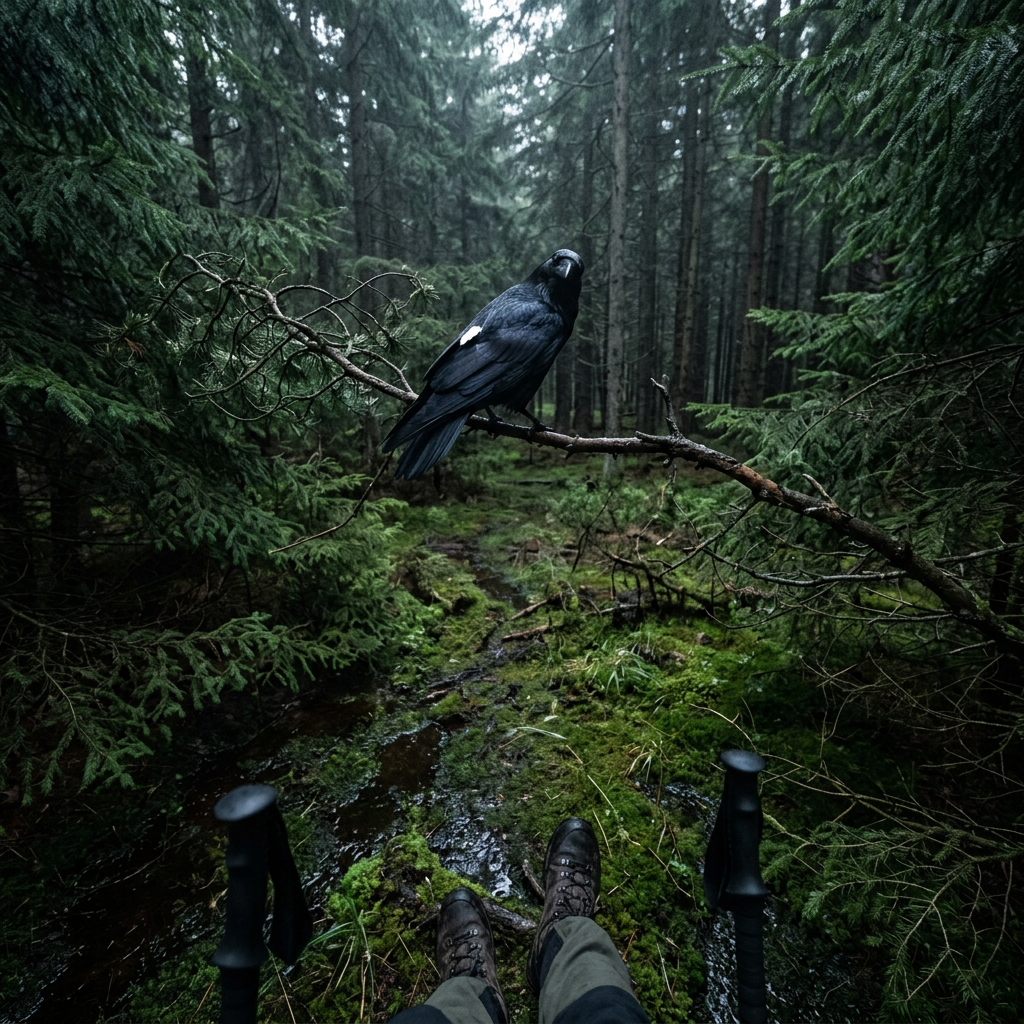
I set out from the Szalajka Valley car park on a Saturday morning, around eight, when the fog was still curling around the trunks of the trees and the air was cold enough that my breath hung in small clouds in front of me. My plan was simple: hike up to Jávorkút, then on to the Istállós-kő cave, where I’d pitch my tent for one night, continue the next day to Három-kő, and from there down to Lillafüred, where I’d already arranged to have my car waiting with a friend. I’d taken four days off work, and I wanted to do it alone, because I felt like the last few months — the breakup with Marci, the pile-up of deadlines at the agency, a constant tension I couldn’t name, only feel — had worn away whatever ability I had to sit quietly with another person. I wanted to be alone, but not in the empty apartment — among the trees, where a person’s solitude at least means something.
Marci and I had planned this hike together three years ago, back when things were still good, when we thought we’d eventually do the whole Bükk ridge route between Szilvásvárad and Lillafüred, laughing about how one day we’d show the forest to our kids. The plan kept getting postponed — work, money, and then the slow cooling that finally hardened into a breakup on a cold evening in March, when we realized we hadn’t wanted the same thing for months. Now, setting off alone from the same car park where the two of us had once stood bent over a map together, I felt a strange satisfaction, as if I were taking something back that had been taken from me, though I wasn’t sure from whom.
I’d repacked my bag three times the night before, because I never fully trusted my own memory when heading out alone on something like this. I checked the first-aid kit, the spare socks, the gas canister for the little stove, sealed the paper map in a waterproof pouch even though the sky was clear and nothing suggested rain over the next few days. When we said goodbye, my father told me to call my mother every day, or at least send a message if there was no signal to call, because he knew she wouldn’t sleep well until she’d heard from me.
My pack weighed about fourteen kilos, loaded with the tent, sleeping bag, the small gas stove, enough food for three days, and a paper map, because I didn’t want to rely on phone signal in that region. The Bükk plateau is a moody place: riddled with sinkholes and dolines, sudden deepening hollows the limestone has gnawed out over centuries, and the forest in places is so dense that even at noon only a dusky light filters down through the canopy.
I followed the blue trail markers toward Jávorkút, a well-known route that in summer sees a dozen hikers a day, but on that early-autumn day I didn’t meet a single person past the upper stretch of the Szalajka Valley. The sound of the stream slowly fell away behind me, and in its place came the silence of the beech forest, which isn’t really silence at all, but a dense, living noise, full of birdsong, the creak of branches, the crunch of my own footsteps in the dry leaf litter.
At Jávorkút, by the spring, I rested, filled my water bottle, and exchanged a few words with an older man who came out of a small wooden hut where he worked for the forestry service. I asked him about the trail toward Istállós-kő, and what the area around the cave was like for camping. He nodded, told me to follow the markers, said there was a designated fire ring on the clearing in front of the cave that campers usually used — but then, as I was walking away, he called after me.
“If you hear anything in the trees at night, don’t go to it,” he said, and there was something in his voice I couldn’t place at the time, a caution that didn’t match the usual warning a forester gives about bears or wild boar. I asked what he meant. “Just voices,” he said, and turned away, as if he didn’t want to say more, or as if he’d already said too much. I didn’t press him. I assumed it was just some local superstition the old-timers told each other at the pub to scare off littering tourists.
*
Around midday, at a high point where the trees thinned a little and opened onto a view of the Bükk’s rolling, forested back, I finally got a signal on my phone. I called my mother, because I’d promised to check in every day while I was alone in the woods, and she, though she never said it outright, always worried when I went hiking by myself.
She picked up on the second ring, and her voice was its usual self — light, a little distracted, because she was out in the garden, and I could hear the mower in the background, which my father had started, and she was complaining that he’d started too early even though she’d asked him to wait until afternoon. I told her where I was, that I was making good time, that I’d camp near Istállós-kő that evening.
“Are you sure it’s a good idea, going alone?” she asked, and in her voice I heard that familiar, mild worry she’d carried for me ever since the time I got lost as a little girl in a shopping mall, and they searched for hours before finding me curled up behind a clothing rack, where I’d hidden because I thought if I stayed quiet enough, she’d eventually find me. “If anything happens, call, any time, it doesn’t matter what hour.” I promised her I would. “Be careful, Verácska,” she said finally, using the name she’d called me since childhood whenever she was worried about something, and then added, half-laughing: “And don’t listen to anything the forest tells you out there. Only to me.” I laughed at that too, at the time, assuming she was only joking, in her usual, slightly superstitious way of closing a goodbye before I set off somewhere far.
We said our goodbyes, and I hung up, her voice still ringing in my ear, warm and familiar, the same voice I’d heard my entire life.
I mention this call in such detail because later, when everything began, it was the only proof I had of where my mother was and what she was doing that afternoon. Eger, the garden, the mower, my father. Nothing else.
Barely half an hour later a man came the other way on the trail, a large, old-style backpack on his shoulders, his beard unkempt, deep purple hollows around his eyes. We greeted each other, and I asked where he’d come from. “Istállós-kő,” he said, not quite looking at me. I asked what the camping was like up there. He went quiet, then said: “Go on if you like, but stay close to the fire, and don’t answer if someone calls your name.” Before I could ask anything else, he set off with fast, deliberate steps, as if trying to put distance between himself and wherever he’d come from. He never looked back. Eventually I continued on, telling myself I’d just met a tired, slightly odd hiker who’d had a bad night up there.
*
The stretch toward Istállós-kő grew steeper, the markers faded in places on the bark, as if painted long ago, and the terrain turned rockier, forcing me to cross between large limestone blocks the water had carved into strange shapes over the centuries. The sun was already sinking when I reached the clearing in front of the cave, where there really was a stone-ringed fire pit, surrounded by ash and charred logs, proof that many had camped here before me.
I pitched my tent on a flat patch, not too close to the cave mouth, because the cold air flowing out of the cave chilled me even in daylight if I stood near it too long. I lit a fire, ate a packet of instant porridge heated on the gas stove, and watched the light slowly gray out above the forest, the gaps between the trees deepening into black, as if the darkness weren’t descending from above but rising up from near the ground.
The first hours of the night were quiet, only the crackle of the fire and, now and then, a bird’s cry somewhere far off. I crawled into the tent around nine, wrapped in my sleeping bag, my headlamp hung from the tent’s ceiling for a faint light, writing a few lines in my journal — a habit I keep up on every trip, recording small details of the day before I forget them.
That’s when I heard it for the first time.
“Vera!”
The voice came from far off, to the left of the camp, from the dark trees where the terrain sloped down toward a small stream valley marked on the map as the Feketesár Ravine. The voice was familiar — so familiar that my body reacted before my mind had caught up with what I was hearing: I sat up in my sleeping bag, my heart suddenly pounding faster, and for one moment I thought someone had followed me into the woods.
Because it was my mother’s voice.
Not a similar voice, not some distant echo my imagination had shaped into hers — her actual, specific voice, that particular, slightly rolled R she’d never managed to fix since childhood, and that special lilt she always used when saying my name after dark, calling me in from the garden.
I crawled out of the tent, turned on my headlamp, and looked into the trees, but I saw nothing, only a row of dark trunks that leapt suddenly into view in the lamp’s beam before the blackness swallowed them a few meters out. I stood there in the cold night air, my breathing faster than it should have been, and listened.
Nothing. Only the wind rustling the leaves, and far away, somewhere, an owl calling.
As a child, if I ever stayed out in the garden too long after dark, my mother would come to the back door and call me in that same exact way — lightly at first, then, if I didn’t answer right away, more and more impatiently. I’d learned to read her voice, the small signs buried in it that told me exactly how much time I had left before she got genuinely angry. This voice now carried the same signs, the same rising impatience, and that was the most frightening part: not that it was foreign, but that it wasn’t foreign at all.
I went back into the tent and tried to convince myself that exhaustion and the silence of a nighttime forest had conspired to shape themselves into the most familiar voice I knew, because the mind, when tired and alone, loves to find patterns in nothing, especially patterns that signal safety or danger. I tried to fall back asleep.
Half an hour later I heard it again.
“Vera, come here!”
Closer this time, though still from deep in the trees, from the direction of the ravine. There was a small tremor in the voice now, exactly like the one my mother’s carried when she was genuinely anxious about something — not the usual mild worry, but a deeper fear, the kind that surfaces when something is truly serious.
I sat at the tent’s entrance, sleeping bag over my legs, sweeping my headlamp across the trees, but I saw no movement, only the usual forest shadows my own light conjured and shifted whenever I turned my head.
I checked my phone. No signal, as expected, deep in the valley, under the trees. I couldn’t call anyone to confirm my mother was safe at home in Eger, far from here. But I remembered the afternoon call, the sound of the mower, the garden smell I thought I could sense in her voice, if that was even possible — and I knew, rationally knew, that it couldn’t be her voice, because she couldn’t be out there, deep in the woods, at night, alone.
But the body doesn’t operate on rationality in situations like this. My body was already half out of the sleeping bag before my mind stopped it.
*
I didn’t leave the camp that night. I zipped myself into the tent completely and tried to sleep, though every small noise woke me — a snapping branch, some animal passing nearby, my own heartbeat, which seemed too loud in the silence. Toward dawn I finally managed a little sleep, and when I woke the sun was already high, the birds were loud, and everything seemed so normal that I was ready to believe the night’s voices had been nothing but tricks of my tired mind.
Before I broke camp, I walked the perimeter of the site, something urging me to check for any trace of whoever — or whatever — had called my name in the night. On the dewy ground toward the ravine I found footprints. Not animal tracks — too long, too straight, like a human sole, but the toes were pressed too deep, as if whoever left them leaned forward onto the balls of their feet with every step, the way a predator moves, not a person. The tracks broke off abruptly at the edge of the camp, as if whoever left them had simply lifted into the air.
I photographed them, though I knew I’d probably never show anyone, and stood there a long time trying to convince myself a deer had left them, though some part of me knew no animal leaves a print like that.
I broke camp, ate breakfast, and set off toward Három-kő, on a route that for a while followed the same blue markers as the day before, then branched onto a narrower path. The sun shone brightly through the canopy, the dew slowly dried off the grass, and the forest now seemed friendlier than it had at night — though I knew that was only a trick of the light, that it was the same trees, the same shadows, only lit differently.
Around noon I rested at a clearing, and that’s where I found the first thing that unsettled me.
In the grass, beside a fallen trunk, lay a child’s shoe. Small, maybe for a four- or five-year-old, pink, the toe scuffed, the sole cracked, as if it had lain out exposed to the weather for months, maybe years. I picked it up and turned it over in my hand. Inside, a small name tag: Anikó. I had no idea who that was, or why she’d left her shoe on such a hidden clearing, far from any official trail, because this clearing wasn’t even marked on my map.
I put the shoe back where I found it, because I didn’t know what else to do with it, and something told me it was better not to take it. I continued on, but the image of the shoe stayed with me — the small pink shape in the green grass, the scuffed toe, the name on the tag.
An hour later I stumbled on something else: a small pile of stones, not arranged naturally, but as if someone had deliberately stacked them into a mound, about twenty meters from a path, among the trees. On top of the pile lay a dried bouquet of flowers, long withered, the stems brittle and brown. I didn’t know why, but the pile struck me as a grave, though nothing indicated it actually was one.
Not far past the stone mound, half-trodden into the earth under a rotting stump, I found a folded, water-stained sheet of paper that looked torn from a notebook. The writing had blurred, the ink running from the damp, but I could still make out a few sentences. “…called on the third night, this time in my father’s voice, laughed exactly like he used to, but my father has been dead two years, and that’s when I understood that what’s calling isn’t a lie, I just don’t know what it…” The next lines were completely illegible, the paper crumbling along the fold, but at the bottom, in different ink, as if added hastily afterward, it read: “If you’re reading this and you hear the voice, don’t let anyone answer for you. Go south. Don’t stop.”
I stood there a long time with the paper in my hand, my fingers trembling slightly, not from the cold but from the realization that someone who’d walked this same marked trail had lived through the same uncertainty I was starting to feel. I tried to work out who might have written it, and what happened to him afterward. The paper’s edge was tattered, as if it had lain exposed to rain and sun for years. I slid it into my pack’s outer pocket, not knowing why I wanted to keep a stranger’s warning, except that someone who’d walked this forest before me had heard exactly what I hadn’t heard yet, but already suspected I would.
*
Late in the afternoon I reached a small ranger’s hut that wasn’t marked on my map, but stood beside the path, smoke rising from its chimney. An older man sat on a log in front of the hut, smoking a pipe, and looked up as I passed.
I stopped, we greeted each other, and I asked if he knew anything about a clearing a few kilometers back, where I’d found the stone pile and the child’s shoe. His face changed when I said this — not dramatically, just a small tightening around the eyes, the same wariness I’d already seen in the forester at Jávorkút.
“People leave things behind here all the time,” he said, looking back at the fire he kept in a small iron pan in front of the hut. “People act strange in this part of the woods. They set off in one direction, and they don’t always come back from where they left.”
I asked what he meant. He was quiet for a long time, as if weighing how much to tell a stranger hiking alone, then said: “Some say they’ve heard someone call their name. Someone they knew. But the person they heard wasn’t there.” He looked up at me, his eyes dark in the hut’s shadow. “If you hear that at night, don’t follow it. No matter how familiar it sounds.”
I pulled the water-stained page from my pack and showed it to him. As he read it, the hand holding his pipe trembled for a moment. “Where did you get this?” he asked, his voice sharper now than at any point in our conversation. I told him where I’d found it. He nodded slowly, as if confirming something to himself. “There was a young man here, two years ago, maybe three. His friends reported him missing when he didn’t come back as planned. The park service searched for weeks, but all they found was his tent, empty, the zipper pulled shut from the outside — which it couldn’t have been, from the inside.” He didn’t give a name. When I asked what happened to him in the end, he only shook his head and said: “I don’t know. No one does. Still.”
I asked if he knew what caused this. He shook his head. “I don’t know, and I don’t want to know. All I know is that of the ones who didn’t heed the warning, not all of them came back.” He stopped, as if he’d already said too much, then added, almost as an excuse: “But it’s just a tale. The forest is big, and it’s easy to get lost in it, especially at night.”
I asked if anyone could be called for help if someone went missing out here. “The park service comes sometimes, if it’s reported. But it’s hard to get up here fast, and by the time they do…” He didn’t finish the sentence, turned back to the fire, and I understood the conversation was over. I thanked him and moved on, his words settling over me with growing weight.
*
The final stretch toward Három-kő was harder than I expected, the markers barely visible in places, as if painted long ago, and the terrain turned rockier, forcing me between large limestone blocks the water had worn into strange shapes over the centuries. In the early afternoon, on a longer, straight stretch where the wind blew harder through the canopy, I thought for a moment I heard my name in the rustle of leaves — just a fragment, a syllable that dissolved right back into the wind, and when I stopped, straining to listen, nothing followed, only the usual forest noise. I shook my head and told myself fatigue was starting to take over my senses, that this wasn’t yet what the ranger had meant, only a daytime trick born of sunlight and wind.
The sun was already low when I realized I wouldn’t make it down to Lillafüred that evening, and that I needed to find somewhere safe to stop for the night.
I found a small clearing, not far from the marked trail, where a lightning-struck beech stood, its bark blackened, its trunk split lengthwise like a fork. I pitched my tent beside it, because it was the only flat ground nearby, and tried not to think about what the ranger had said.
While hammering in the tent stakes, I noticed something among the tree’s roots that stopped the mallet in my hand: a small pink child’s shoe, exactly like the one I’d found on the clearing hours earlier, several kilometers from here. The same scuffed toe, the same cracked sole. I knelt down and turned it over — the same name tag inside, Anikó, in the same handwriting. Either two identical shoes existed in this forest, or the same shoe had somehow arrived here ahead of me, without anyone carrying it. I put it back where I found it and tried not to think about it further, though the hand driving in the stakes was no longer as steady as before.
While I built the fire, I remembered Marci once saying he worried about me going on a trip like this alone, with no one to warn me if something went wrong. At the time it annoyed me, that worry. Now, sitting in the shadow of the lightning-struck beech, the firelight drawing small, trembling circles on the dark trunks, I thought for the first time that maybe he hadn’t been wrong, only worried for the wrong reason.
The second night began quieter than the first. I ate the last of my porridge and wrote up the day in my journal — the shoe, the stone pile, the ranger’s words — trying to record it all plainly enough to see for myself how irrational it sounded, how perhaps it was only my own exhaustion and this unfamiliar place that had built a tension in me that I was now projecting onto my surroundings.
Around eleven I heard it again.
“Verácska, why won’t you answer?”
Closer this time than the night before, and more wounded in tone, more hurt — exactly the way my mother’s voice changed when she believed I was deliberately ignoring her. I crawled out of the tent, aiming my headlamp into the trees, and now — for the first time — I saw something. A shape, far off, among the trunks, a dark outline that moved, though I couldn’t tell if it was human, animal, or just a branch stirred by the wind.
“Vera, please, come, I’m lost!” the voice went on, using exactly the phrase my mother would use if she were truly in trouble, with the same desperate edge I’d heard from her only once, truly, when I got lost as a little girl in a shopping mall and she searched for hours before they found me.
My leg moved before I could decide whether I wanted it to. I took one step toward the trees, then stopped, because something — maybe the ranger’s words, maybe some deeper, instinctive fear — held me back. I stood there, inside the small circle of my headlamp’s light, and called back into the darkness: “Who are you?”
The voice went silent. The silence that followed was worse than the call itself.
*
I didn’t sleep again that night. In the morning, as soon as it was light enough, I broke camp with shaking hands and set off back, not toward Három-kő, but down, toward Lillafüred, because I’d decided I didn’t want to spend another night in this forest. I abandoned the original plan; I just wanted to get home.
But the markers I followed began behaving strangely a few hours later. The blue stripe I kept looking for on the bark suddenly vanished at a fork where, according to my map, I should have gone straight. I went back, looked for the marker left and right, but found only a faint, almost washed-out trace of paint on a tree, which might have been the remains of an old marker, or might have been something else entirely.
I followed that direction, because I had no better idea, and after an hour of walking I realized the terrain looked familiar. A lightning-struck beech stood in front of me, its bark blackened, its trunk split like a fork.
My first thought was that there must be a second, similar tree somewhere nearby, since lightning often strikes the tallest trees in a given spot, and a forest like this could easily have more than one. But as I stepped closer, I recognized the exact shape of the split, a small V-shaped notch at the base of the crack that I’d noticed the night before while pitching my tent, wondering whether it was really safe to sleep so close to a tree that had already been struck once. At the base of the trunk, there was even the small pile of ash from my fire, which I’d scattered that morning before leaving — in exactly the same place, in exactly the same shape, as if the time I’d supposedly spent walking for four hours hadn’t actually passed at all, or as if the whole four hours had only been a loop that brought me back to my starting point without my noticing it at any single moment.
It was the same tree I’d camped beside the night before. But according to my map, I’d walked at least four kilometers in the opposite direction, downhill, not in a circle.
*
That’s when I truly began to be afraid.
Not because I’d heard voices — I’d already survived that by blaming exhaustion and imagination — but because the spatial reality I was moving through had begun collapsing around me. The forest, which I’d previously treated as a familiar kind of danger — I might get lost, I might get hurt, but at least the trees, the stones, the directions would remain constant — had become a place where even the most basic rules no longer seemed to apply.
I tried to call my mother. A single bar of signal appeared on my screen, then vanished, then reappeared, as if the signal itself were uncertain whether it existed in that place. The call didn’t go through. I tried to send a text, a short message saying I was lost, that I needed help, but the send icon on the screen spun endlessly, never indicating success or failure.
While I watched the screen, the spinning icon suddenly stopped, and a small checkmark appeared beside it, showing the message had gone through. A few seconds later, a reply came back: a single word. “I know.” It hadn’t come from my mother’s number — no name appeared on the screen, only an unfamiliar, long string of digits I didn’t recognize from any network. I tried to write back, to ask who it was, but the signal dropped completely, and the message never sent.
I sat down on a rock, tried to calm myself, and went back over the map again. The Istállós-kő cave, where I’d started, lay northeast of my current position, if the map could be believed. The lightning-struck beech where I’d camped the second night stood somewhere on the stretch between Három-kő and Istállós-kő. If I was now standing by the same tree, then after four hours of walking I’d gotten nowhere — or worse: I’d gone backward, without ever noticing I’d turned around.
The sun had already passed its peak and begun sinking, and the light in the forest had changed — not the usual golden afternoon light, but something colder, bluer, a shade that hadn’t characterized the day before, as if clouds were somehow filtering it differently, though I saw no clouds through the canopy above.
*
I decided to follow the sun — the actual sun in the sky, not the compass — and head due south, no matter what, until I reached some familiar point, a crossroads, a marked trail, anything that led back to the civilized world.
After two hours of walking, the terrain changed: pines began appearing instead of beech, darker, denser growth, and the ground beneath me began to give, as if marshy, though the Bükk plateau has no true bogs, only a few mossy patches in the higher-lying dolines. I stepped carefully, avoiding the darkest, wettest patches, my heart beating faster, because I knew this terrain didn’t fit any map I’d known of this region before.
Three times on the way I spotted the same raven, glossy-feathered, a white patch on its left wing, perched in exactly the same posture on the same branch each time, head tilted as if watching. Any forest holds countless ravens, and there’d be nothing strange in seeing one twice — but the bird never moved, never called, only watched as I passed beneath it, as if it weren’t a living animal at all but a marker placed there to confirm I was heading the right way.
Around four, when the light slanted sideways through the trees, I heard the voice again.
“Vera, where are you? I’m hurt!”
Very close now, maybe only thirty meters away, from behind a thick stand of brush. The voice trembled, sobbed, and in every breath, every syllable, there was my mother — the specific, singular way I’d heard her cry when my grandfather died, that same particular, throat-deep sound no one else could ever reproduce so precisely.
I stopped, and against every rational thought I had, my body turned toward the brush. “Mom?” I called, and my own voice sounded strangely foreign in my ears, too small for the vast, silent forest.
“I’m here, Verácska, hurry, my leg hurts!” The voice now came from so close that I was certain if I pushed through the brush, I’d find my mother there, sitting on the ground, a broken ankle, and everything that had happened until now — the phone call, the mower, Eger — would turn out to have been a dream, a misunderstanding, and I’d finally find her and lead us both home.
I stepped toward the brush. The branches scratched my arm, tearing the skin in one place, but I barely felt the pain, because all my attention was fixed on the voice, which, as I got closer, shifted in some small, barely audible way — a fraction-of-a-second slip in emphasis, as if whoever was speaking hadn’t breathed between the words the way a real person would.
I stopped at the edge of the brush. On the other side was a small clearing, and in the middle of it — nothing. Empty grass, a few stones, a rotting log. No one.
The grass, though, was flattened in a circular patch at the center, as if someone had sat or lain there for a long time, and at the edge of the flattened circle lay a small pile of white bones, too small to belong to anything large, more like a bird’s or a squirrel’s, but arranged too neatly to be the work of a natural predator — in a row, side by side, like little slats in a fence.
“Mom?” I asked again, quieter now, my voice shaking.
No answer came right away. Then, very close, maybe directly behind me, though I knew no one could be standing there, since I myself had stood there only a minute before, I heard: “Why won’t you come?”
*
I spun around. No one was behind me, only the trees, the brush I’d pushed through, and the slowly darkening forest. But the voice now wasn’t coming from among the trees — it spoke directly beside my ear, so close I would have felt breath on my skin, if it had breath, if it had a body for air to move through.
I started running. I didn’t think about which way, I just ran, across the clearing, into another stand of trees, my pack jolting on my back, leaf litter and mossy stones slick underfoot. The voice followed, keeping the same distance no matter how fast I ran — never falling behind, never closing in, just there, behind me, beside me, sometimes ahead, as if it weren’t coming from one direction at all, but from the air itself.
I crossed a small stream, the water ice-cold, and one of my boots went completely under when I misjudged a stone and half-slid into the current. On the other bank, scrambling up the steep edge, I stopped for a moment to catch my breath, and that’s when I heard the voice wasn’t calling alone anymore. Somewhere off to my left, another voice rose, a man’s voice, calling a different name — not mine — with the same begging, urgent tone the voice calling me had used. The two voices tangled together for a moment, as if pouring out from the same source in two directions, then the man’s voice faded, and only mine remained, closer than it had ever been.
That was what truly terrified me — not that it was calling me, but that it was calling someone else too, somewhere, another lost name, and I realized I wasn’t the only one being summoned in this forest tonight, and that whoever — whatever — was doing this wasn’t speaking to me personally, but repeating a pattern it had already played out who knows how many times before, with other names, other voices, other lost people.
“Vera! Vera, where are you going?!” it shouted, and now there was a new note in it I hadn’t heard yet: an anger, a bitterness my mother had never shown me so openly, except once, years ago, when she thought I was deliberately avoiding her calls during a hard stretch, and finally shouted, asking why I wouldn’t let her help.
I stopped for a moment, breath ragged, and looked back. Among the trees, maybe fifty meters off, I saw the shape again — but much closer now than before, and I saw that its movement wasn’t human: too smooth, too seamlessly it glided between the trunks, as if it weren’t stepping at all but flowing, like a liquid following the path of least resistance.
I didn’t look any longer. I turned and started running again, no longer thinking of anything except putting as much distance as I could between myself and what I’d seen.
*
The light drained fast, the sun sinking below the canopy, the darkness thickening by the minute. I tripped once on a jutting stone and went down hard on my knees, hands sinking into wet earth, but I scrambled up and kept moving, now more a fast stagger than a run, my legs trembling with exhaustion and fear.
The ground began to slope downward, and among the trees a line of rock suddenly took shape ahead of me, limestone blocks with sharp, irregular edges, as if some giant hand had torn them apart long ago. A narrow path wound between the rocks, and I followed it, because I had no better choice, though the slope grew steeper and the stones slid under my feet on the wet moss.
The air grew colder, and at one point a smell drifted toward me that I couldn’t place — not wet earth, not rotting leaves, but something sweeter, closer to the scent of laundry fresh and warm, exactly the way my mother’s kitchen used to smell after washing, when she took the freshly ironed sheets off the drying rack. That was the strangest part of the whole night: it wasn’t the frightening details that scared me most, but the fact that even in the middle of the terror, something kept reminding me of home, as if the forest knew precisely which scent, which sound, would reach me fastest.
The voice, which had gone quiet for a while, spoke again, now deeper, more serious, as if tired of pleading and switching instead to a commanding tone: “Stop, Vera. It’s dangerous that way.”
I stopped, because the content of the sentence was logical on its own, and for a moment I wondered whether it was telling the truth, whether the direction I was heading really was dangerous. But then I remembered this was the same voice that had just been calling angrily, that had begged me for help, and I realized that whatever it said, I couldn’t trust the content — I could only be sure it didn’t want me to reach a certain point, or that it wanted exactly the opposite, that it didn’t want me going that way because that way lay the way out.
I continued along the path between the rocks, more carefully now, hand gripping the cold, wet stone, when the ground beneath my feet suddenly disappeared.
*
I didn’t fall far — maybe two meters down a steep, rocky scree slope before I stopped against a protruding root that, luckily, held my weight. My ankle twisted in the slide, a sharp pain shooting down my leg, and when I looked up, I saw I was standing at the edge of a narrow, dark hollow — a sinkhole, a doline sunk into the limestone, its rim crumbling, its depth unknown in the dark.
If I’d slid two meters farther, I would have gone straight in.
I looked up at the rim I’d slid from, and against the darkening sky I saw a shape standing there, motionless, at the edge of the rocks, exactly where I’d set off from a moment before. I couldn’t make out a face in the fading light, only a silhouette, a human shape too tall, too lanky to actually resemble my mother up close — but the voice, when it spoke, was exactly the one that had haunted me all day.
“Verácska, why are you running from me? I only want to help.”
My ankle throbbed, my hands bled from the roots I’d grabbed, and the rim of the doline crumbled beneath me, every movement sending small stones tumbling into the depths without a sound, as if the depth were too great for the sound to carry back.
I tried to shout for help, as loud as I could, though I knew no one was likely to hear, this far from any marked trail. My shout died among the trees, and only my own echo returned seconds later, distorted, foreign.
The shape stood motionless at the edge, watching. It didn’t come closer, didn’t retreat, just stayed there, patient, like someone who knows there’s nowhere for me to go, that the darkness and my injured ankle and the gaping hollow behind me were already enough that it didn’t need to hurry.
I began shifting slowly sideways along the scree slope, trying to find a safer path upward, away from the edge of the doline, but with every movement the rock and wet earth slid under my hands and feet, and my ankle screamed with sharp pain at every bit of weight I put on it, warning me it wouldn’t hold much longer.
One strap of my pack snagged on a jutting root, and for several seconds I couldn’t move, my face pressed against wet stone that gave off a cold, sour smell, like centuries of decomposed leaves at the bottom below. When I finally freed myself, a stone shifted under me, and my legs swung out over nothing above the dark hollow before my hand found the root again and stopped the fall.
The shape at the rim still stood there, and now, as my eyes adjusted somewhat to the dark, its head seemed tilted slightly to one side, attentive, the way a person might watch an insect trying to climb out of a glass.
*
“Vera.” The voice now came from very close, not from the rim where the shape stood, but from below, from the depths of the doline, the dark hollow gaping beneath me.
I froze. My hand gripping the root, my body half on the slope, half hanging in the air, and the voice now rising from the depths was exactly like the one I’d heard above on the rocks — as if it existed in two places at once, or as if it weren’t tied to a location at all, only spoke from wherever it would land best, wherever it would reach me most effectively.
“Come down to me, Verácska. It’s dark down here, and I’m cold.”
I looked down into the blackness beneath my feet, from which no light filtered back, and for a moment — just a moment — some part of me, a deeply childlike, instinctive part that still believed that if your mother calls, you have to go, wanted to let go of the root and slide down into the dark where the voice was coming from.
I jerked my head away, turning my ear from the depths, and with everything I had I began pulling myself up along the root, my hands shaking, my nails tearing on the wet stone, my ankle screaming with every movement, but I moved upward, inch by inch, while the voice below continued, no longer pleading now but impatient: “Vera, don’t go. Vera, look at me.”
I didn’t look down. I didn’t let my gaze return to the dark hollow, because something in me was certain that if I looked down and actually saw what the voice claimed to be, I wouldn’t know what to do afterward — neither believe it, nor refuse it, nor move.
*
I managed to haul myself to the top of the scree slope, back to where the rock rim had been, but when I looked up, the shape I’d seen standing there earlier was gone. Full darkness had fallen, the trees only dark patches against a slightly lighter band of sky, and my headlamp — which I switched on now with trembling hands — threw a weak, yellowish circle just around me, beyond which everything was black.
My ankle couldn’t properly bear my weight, every step sending a wave of pain up my leg, and I knew I couldn’t go far that night, that I’d have to stop somewhere, though every cell in me screamed to keep moving, not to stay in one place where the voice could easily find me.
I sat down on a rock, back against a tree trunk, keeping my headlamp’s light close around me like a small, fragile shelter in the blackness. I checked my phone screen — a single bar of signal appeared again, trembling, then vanished, and in the second before it died completely, the same reply arrived as before: one word, “I know,” from the same unfamiliar string of digits. I didn’t try to answer this time.
Among the trees, somewhere in the dark, growing quieter but still perfectly audible, the voice spoke again, no longer pleading, no longer angry, only patiently waiting, as if it knew that eventually, if it waited long enough, I’d have no choice but to stand up and walk toward it.
I fumbled in my pack’s pocket for the water-stained page I’d shown the ranger outside his hut, as if the stranger’s handwriting might somehow help, as if it held an answer I hadn’t yet noticed. In the dark I couldn’t read it, only felt its outline under my fingers, the paper crumbling along the fold, and I remembered the last line: go south, don’t stop. But my ankle wouldn’t let me go far, and in the dark I couldn’t tell which way was south, because the stars I’d once known how to read now stood strangely in the sky, as if the whole night sky had slipped slightly out of the place I’d memorized.
“Verácska.” A pause. “I know you can hear me.”
In the darkness, among the trees, something moved, and came closer. Not running, not even walking — more the way water moves down a gentle slope, evenly, silently, following the smallest fold in the terrain. At the edge of my headlamp’s circle, right at the farthest reach of my vision, I caught a faint shift among the trees, a darker shadow against the dark background, which paused for a moment, as if it knew I was watching, then resumed its approach.
I didn’t stand. I couldn’t have, even if I’d wanted to, because my ankle answered every movement with white-hot pain, and my body, which had spent the whole day fleeing, suddenly gave in to exhaustion, as if it had decided on my behalf that there was no more running left in me.
The voice no longer said my name. Quietly, very close now, it asked: “Why do you keep so far from me, Verácska? You always just want to leave.”
I tried to stand, to get my back against a tree trunk, but when I put weight on my ankle it gave way, and I dropped back onto the rock, the pain so sharp I gasped — and that sound betrayed exactly where I was.
From below, from the darkness, the voice now spoke from very close, perhaps only a few steps away, and in its tone there was something I’d never heard from my mother — an impatient, hungry edge, beneath which something else entirely, something far older and far more patient, seemed to be trying to imitate the warmth I’d heard earlier. “Come, Verácska,” it said. “Don’t leave me alone again.”
I didn’t know which direction the camp was in, which direction the ranger’s hut was, which direction held the life where my mother really stood in the garden with the mower, safe, far from here. All I knew was that the voice kept getting closer, and that my hands, which I was using to brace myself against the stones, shook so hard I could no longer tell if it was the cold, or something else.




Leave a Reply