

They say that in two neighboring villages, on either side of the border between Hegyköz and Rétalja, there once lived two singers more famous than any others in the whole region, and more furious with each other than any two men had ever been. One was called Benedek, a son of Hegyköz, who drew his fiddle bow in such a way that even the wearinest feet leapt up to dance. The other was called Kálmán, a son of Rétalja, whose voice sounded like water drawn from a deep well: cold, clear, and coming from so far down that a listener felt it in his own bones.
Hegyköz lay on the hillside, where the soil was stony but the air was sharp, and its people, they say, loved music that set the blood racing for that very reason. Rétalja spread out lower down, among the soft-grassed meadows by the river, and its people, they say, loved songs that rolled along slowly and solemnly, the way the water itself did.
Both men claimed to be the region’s greatest singer, and both stood ready to prove it at any moment, if need be by leaping at the other’s throat — though in truth they cut at each other with their tongues far more often than their fists, since both took pride in calling themselves “artists,” not “peasant lads who settle things with knuckles.”
If a stranger had asked in either village why these two hated each other so, the answer was never the same twice. Some said the rivalry sprang from an old land dispute between the two villages; others claimed it went back to a half-forgotten love triangle their grandparents had gotten themselves tangled in. The truth, as so often, was simpler than any legend: two gifted, proud men simply could not bear that someone else might be better than they were at the one thing they’d built their whole sense of themselves around.
Benedek’s days ran thus: each morning he checked himself in a cracked mirror to make sure he looked dashing enough with the fiddle at his neck, then practiced all day, and every evening told anyone who would listen — and a few who wouldn’t — which village, which wedding, had given him the loudest applause. Kálmán’s days ran thus: each morning he read an old ballad “to keep his mind fresh for great poetry,” then spent the day working his voice by the riverbank, believing the nearness of water improved his tone, and every evening told anyone who would listen how many whole wedding tents he’d once reduced to tears with a single ballad of his own.
The feud, they say, traces back to when the two were still young men, invited — without either knowing the other had been asked — to the same wedding. The groom’s family wanted Benedek for the dance music; the bride’s family wanted Kálmán for the farewell songs. By the time evening came, both stood side by side under the wedding tent, and no one could decide whom to let play first.
Benedek, already famous for his quick fingers, suggested he begin, “since good spirits are easier to keep going once the celebration starts that way.” Kálmán answered that “a wedding is worth nothing without a kind word, and my voice carries what a fiddle can never say.” The groom’s father tried to mediate, suggesting they might perhaps take turns, but both shot back at once that turn-taking would be beneath their talent. In the end both began playing at the very same moment, defiantly, not even looking at each other, and the two kinds of music collided under the tent like two roosters in a farmyard, until no one could tell whether to weep or dance, the two melodies pulling so hard against each other that the whole wedding dissolved into chaos. The old folk who were there still describe that evening, years later, as “the wedding where two singers tried to win over the bride, the guests, and each other all at once, and ended up winning none of it.”
The groom was named Mihály, the bride Kati, and the wedding is remembered in both villages to this day not for the happy couple — who, by the way, apparently lived happily ever after, and never again hired more than a single citera player for any family celebration — but for the two singers. Mihály, who ended up paying them both, though only half what either would have charged alone, still tells people he was the only person in the whole story who came out of it well.
Ever since, neither Benedek nor Kálmán could forgive the other for “ruining” that evening — though in truth both were equally to blame, a fact neither was ever willing to admit.
*
The feud between the two villages repeated itself every single year, for every summer, in the month of Szent Iván, the great hill-fair was held, drawing people from every village around to trade, to celebrate, and — increasingly — to see which of the two singers would win that year.
Simon, the fair’s organizer, who had now run the event for fifteen years, began every single day of it with the same weary sigh:
“God grant that this year, at least, they don’t burn down each other’s tents.”
That line had grown so famous in the region that the local innkeeper painted it onto a sign he hung over his door every Szent Iván’s day, and people stopped every year to read it and laugh before heading toward the market square to see what new mischief the singers had cooked up this time.
Simon himself came from an old line of singers, though he himself had never learned to truly sing or play an instrument, a fact he mentioned with a touch of sadness now and then — but it was exactly what led him to become the one who organized and judged these contests, since at least this way he stayed close to the thing he loved best, even if he could never perform it himself. Over the years the rivalry had taken on ever stranger shapes. One year, one of Benedek’s fiddle strings “happened” to snap just before he was due to perform, and though nothing was ever proven, everyone suspected one of Kálmán’s cousins, who had taken a suspiciously friendly interest in the fiddle that very morning. Another year, Kálmán’s voice went “mysteriously” hoarse the morning of a contest, and he swore someone had mixed hot pepper into his evening tea, though no proof was ever found for that either. There was the year someone set up Benedek’s tent so that the noon sun shone straight into his eyes while he played, and he swore Kálmán had bribed the tent-raisers with a bottle of brandy to arrange it. Another year, someone mixed up the sheets of ballad verses Kálmán carried — purely for safety’s sake, he always insisted, since he claimed he never actually needed them — with a cookbook’s recipes, so that Kálmán spent the whole day muttering that “no one has ever heard of a ballad that calls for two eggs and a pinch of salt after the third verse.” Both singers swore their innocence in every incident, while both their apprentices knew perfectly well what had really happened, and never told their masters, for fear that exposing the truth would only launch a fresh campaign of revenge.
Perhaps the greatest scandal of all came the year Benedek, hearing that Kálmán had been invited to perform alone at a christening in Rétalja, simply wandered into the celebration “by accident,” fiddle tucked under his arm, and begged the hosts so persistently to let him play even a single song out of courtesy that they finally gave in. Kálmán grew so furious he did not speak a single word to him for the rest of the christening, and on the walk home spent a full mile loudly listing to Zsuzsa everything he thought of Benedek, while Zsuzsa only nodded along, privately wondering whether Samu was doing exactly the same thing with his own master on the road back the other way.
This year, however, Simon decided he’d had enough of the half-truths, the suspicion, the endless tug-of-war around the tents, and announced that he meant to settle, once and for all, who was the greater singer in the region. He proclaimed a grand, public contest, with judges, with rules, and with a prize both villages agreed was worthy of the struggle: the winner would carry the title “Voice of the Valley” for a full year, and would be the one to sing at the local lord’s name-day celebration — an honor greater than which nothing existed in those parts. The lord himself had never heard either Benedek or Kálmán perform in person, but had heard so much gossip about them from every neighboring settlement that he waited eagerly to see which of them he would finally get to invite to his own court, and is said to have sent Simon a separate message asking that “whoever wins, I do hope he won’t try to compete with the other one at my own celebration.”
*
The news spread quickly, and both Hegyköz and Rétalja fell into a fever. Benedek, on hearing it, immediately gathered the young men of his village and announced that this time he would show Kálmán, “once and for all,” who the true singer really was. The young men cheered, though a few privately thought he’d said much the same thing with the same enthusiasm some ten years back, and the phrase “once and for all” had begun to wear a little thin from overuse.
At the news, both villages instantly split into two camps — not officially, of course, since Hegyköz and Rétalja traded, married, and celebrated with each other all the time regardless, but the moment the contest came up, everyone suddenly remembered exactly which side their heart belonged to. The old women at the well argued for weeks in advance over who would be proven right, and a few old, half-forgotten slights the two villages hadn’t dredged up in decades resurfaced now, caught up in the fever of the contest.
Kálmán, hearing the same news, grew just as furious, though he expressed it his own way — not shouting, but sighing long and with great dignity, which made it perfectly clear to everyone just how outraged he was. This sighing technique had become so famous in Rétalja that the children sometimes imitated it among themselves whenever something annoyed them, saying “now I’m sighing the Kálmán way,” and everyone knew exactly what they meant.
“That blustering fool from Hegyköz thinks a few quick finger-tricks can match a real song,” Kálmán told the neighbors gathered outside his house. “But a dance fades the moment the music stops. A good ballad, though, stays with a person their whole life. I know this. He doesn’t.”
An old farmer from Rétalja listening to this speech only nodded along, though privately he thought he’d rather hear Benedek’s dance tune one more time than sit through another long, sorrowful ballad from Kálmán — a thought he would never have dared say aloud in the village.
Both men practiced for weeks, both composed new songs that — though neither ever admitted it outright — were largely devoted to mocking the other. Benedek wrote a little tune about “a Rétalja toad who believes his croaking counts as singing.” Kálmán composed a ballad about “a Hegyköz magpie who mistakes his own shiny feathers for the finest music in the world.”
The night before the fair, both singers, though hours apart, did exactly the same thing: paced back and forth in their houses, tested their voices, adjusted their instruments, and talked loudly to themselves about how certain they were of victory, while trembling inside with doubt. Benedek restrung his fiddle three times because he felt its tone “wasn’t bright enough,” though Samu swore nothing had ever been wrong with the original strings. Kálmán sang through his planned final ballad seven times, until his voice grew so hoarse from practice that Zsuzsa had to wake him with hot tea and honey the next morning, lest his own nerves ruin what years of rivalry had never managed to.
*
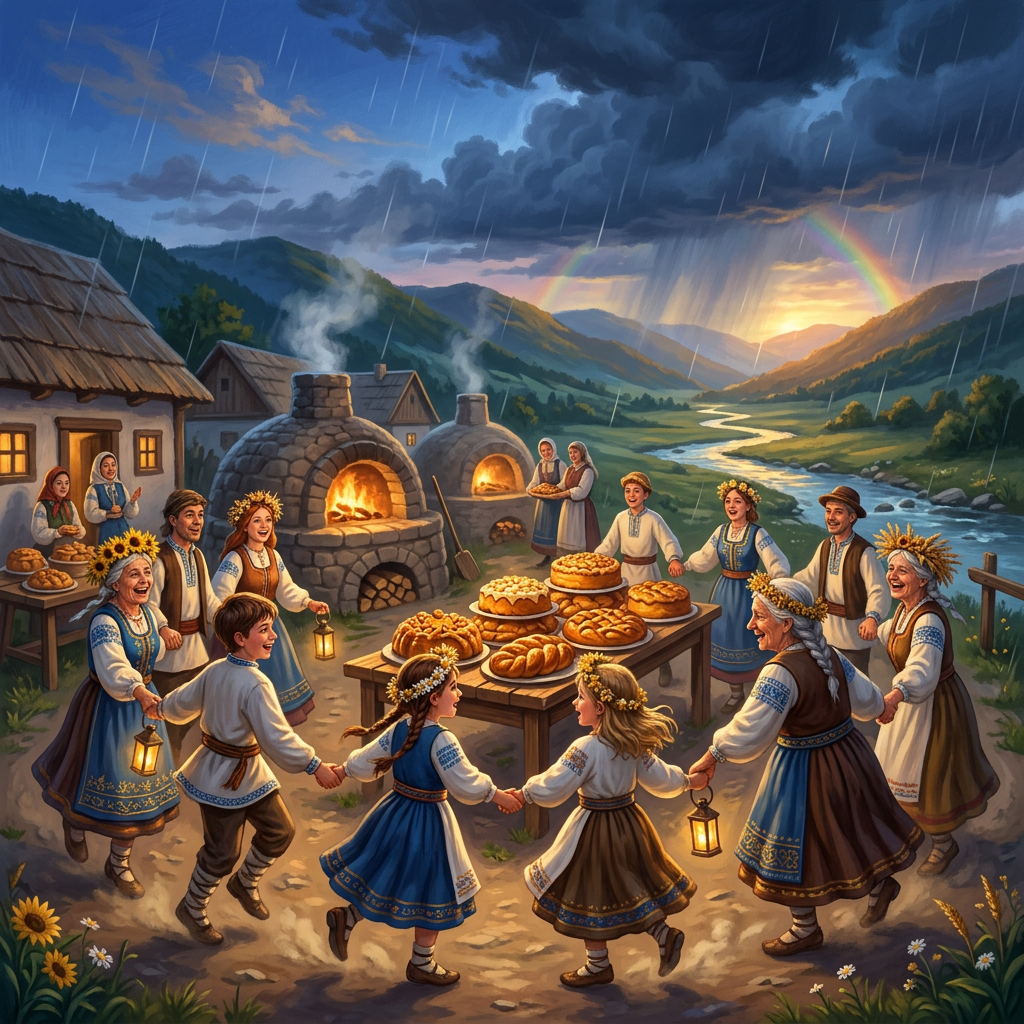
On the day of the fair, both villages pitched their tents at opposite ends of the market square, facing each other like two hostile camps, and although the space between them filled with stall-keepers, bakers, livestock traders, and craftsmen hawking their wares, everyone sensed that the true center of the day would be the two singers.
The air was thick with the smell of roasting sausage, fresh warm cake, the ring of blacksmiths’ anvils, and the whinnying of horses brought along for sale or to pull carts. Children ran among the stalls begging for gingerbread, and a few young men had already started placing bets that morning on which verse Benedek would supposedly break down crying over his own fiddle — though he never actually cried, only playfully pretended to come close.
Benedek’s small apprentice, Samu, who followed his master everywhere to learn from him, nervously tuned the fiddle deep in the tent and asked:
“Master, what happens if we don’t win after all?”
“We’ll win, Samu,” Benedek answered with confidence, though his hand trembled slightly as he tightened the strings. “Because we are the true music, and truth always wins. Or at least, almost always.”
In the other tent, Kálmán’s assistant Zsuzsa — who secretly adored Benedek’s dance tunes, though she would never have dared admit it in her own village — tried to calm her master, who paced back and forth anxiously.
“Master, people love the Hegyköz songs too,” she ventured carefully.
“People love whatever moves their feet, not what moves their soul,” Kálmán snapped. “But today I’ll teach them the difference.”
Samu and Zsuzsa, who had followed their masters to this same fair for years, and who — though they never spoke of it openly — had quietly grown into good friends whenever the singers weren’t watching, ran into each other now in the narrow gap between the two tents, water buckets in hand.
“My master practiced all night again,” Zsuzsa whispered. “Barely slept, tested his voice before he even had breakfast.”
“Mine too,” said Samu. “I think if you asked either of them right now what season it was, they’d both answer ‘contest season.’”
Both smiled, and for a moment forgot that, by the color of their ribbons, they were supposed to belong to opposing camps.
*
Before the contest began, Simon called both Benedek and Kálmán over to his crate and said, quietly but firmly:
“Listen to me, both of you. This year there will be no snapped strings, no sudden hoarseness, no ‘accidents’ of any kind, because I will personally watch over both your tents all day long. If anything suspicious happens, I’ll disqualify you both, and the title of Voice of the Valley will simply go to some singer from a third village — perhaps less talented, but at least honest.”
Both men protested indignantly that they would never cheat, but neither met the other’s eye while saying it, from which Simon drew exactly the conclusion he’d expected to.
Simon climbed onto a crate in the middle of the market square and announced the contest’s rules. There would be three trials: first, the liveliest, most spirited tune, one that would set even the weariest foot dancing. Second, the deepest, most moving song, one that would bring tears to even the driest eye. Third, a song meant to make the crowd laugh — for, as Simon remarked, “a true singer must be able to tune his listener to any feeling, not just one.” The judges — three respected old women from neighboring villages, accepted by both sides since neither had any tie to Hegyköz or Rétalja — would decide the winner of each trial, and announce the final victor at the end.
The three judges were brought in every year from a nearby third village, Középhomok. Vén Borbála, the eldest, was famous for a glare so sharp it could silence even the most stubborn farmer mid-argument. The other two, sisters named Zsófika and Erzsi, who had never married because, as they put it, “no man’s voice was ever beautiful enough to hold our attention,” had sat through these contests for years now, and judged both singers’ weakest moments with perfectly equal sharpness.
*
Before the trials began, each village claimed its own half of the square, and though everyone mingled freely while trading, the moment the contest came up, allegiance became visible at once. Hegyköz folk tied red ribbons round their arms in Benedek’s honor, Rétalja folk blue ones for Kálmán, and the two colors swam through the crowd like two rivers that hadn’t yet decided where they’d merge. There were, of course, a few — mostly families who’d intermarried between the villages — who wore both ribbons at once, one on each arm, and when asked which man they were rooting for, only answered proudly: “Both, and we won’t apologize to anyone for it.”
For the first trial, Benedek went first, the lots having fallen his way. He climbed onto the little platform raised in the square’s center, bowed — a touch too deeply, in Kálmán’s opinion — and launched into a csárdás so lively that the fairground burst into motion at once. Feet stamped, skirts whirled, even the old folk nodded along to the rhythm; a blacksmith’s apprentice swept a young girl up and spun her twice before both tumbled to the ground laughing; a stout butcher, who’d been hawking his wares until then, set down his knife and began dancing with surprising grace, to the astonishment of everyone around him. By the time the tune ended, half of Hegyköz and a fair number of Rétalja folk were dancing in the square too, flushed and laughing, and the red ribbons looked triumphantly at the blue.
Kálmán, listening from deep in his tent, watched through clenched teeth as even some of his own villagers were swept into the dance, but when his turn came, he stepped onto the platform calmly and — as if out of sheer defiance — struck up a lively tune of his own, though his voice didn’t carry it as lightly as Benedek’s fiddle had; it moved more like a river trying to flow faster than its own nature allowed. The crowd smiled, some even danced, but not the way they had for Benedek’s tune — more out of courtesy than real abandon.
The three judges put their heads together for a moment, Vén Borbála exchanging a few words with Zsófika and Erzsi, and then all three nodded. The judges awarded the first trial to Benedek unanimously. A triumphant shout rose from Benedek’s tent, which Samu confirmed with a quick, proud stamp of his own foot, while Kálmán only muttered to himself that “this means nothing yet — the next trial is the real measure.”
*
For the second trial, Kálmán went first. He climbed onto the platform, closed his eyes for a moment, and then began a song about a father bidding farewell to his son before the boy marched off to war, never knowing if he would return.
“My son, when you go, do not look back at me,
Do not watch my tears through the old gate’s door,
Carry my name to battle, carry my heart too,
And bring it home again, if God so wills it true.”
His voice rolled deep and slow, like a river in no hurry to reach anywhere, and every word settled on the listeners’ hearts like a heavy stone. An old woman at the edge of the crowd, who had lost a son of her own long ago, burst into open sobs, and the women beside her wrapped their arms around her while fighting their own tears. By the time the song ended, there was not a dry eye left on the square — even Simon wiped at his own, and a stifled sniffle came from Benedek’s tent too, which he fiercely denied afterward, insisting “it was only fair-dust in my eye.” Samu, standing right beside him, who had seen perfectly well that there was no dust in the air at that moment, only nodded wisely and said nothing, knowing when silence served his master’s pride better than the truth.
When Benedek’s turn came, he tried a similarly moving song about a fisherman who loses his boat in a storm, but his voice wasn’t built to descend to such depths, and though the song was lovely, it never touched the crowd the way Kálmán’s had. A few people even remarked, half to themselves, that “Benedek speaks to the feet, not the heart.”
The judges gave the victory to Kálmán this time, and now it was his tent from which the triumphant shout rose, while Benedek angrily plucked at his fiddle strings as if trying to vent his anger on them. Samu tried to console him, saying, “Master, we already won the dance trial — this just evens things out,” but Benedek only growled back, “Evens things out? This is a loss, Samu, just dressed up nicely.”
*
The third trial, the comic song, took an altogether different turn. Benedek performed a song about a vain magpie so in love with his own glittering feathers that he finally flies into a river, believing his own reflection to be another, even more beautiful magpie — and at the end of every verse he added, “and even as he fell, the magpie still thought he looked rather fine” — and the crowd, recognizing exactly whom the song was really about, roared with laughter, many turning toward Kálmán’s tent, where he tried, in vain, to keep a dignified face.
Kálmán answered with a ballad about a toad who believes his croaking is the finest music in the world, giving so many concerts in the reeds by the pond that the other animals beg him to stop, but he only croaks prouder still, until a stork swallows him, mistaking him for just one more noise worth silencing. The crowd now laughed looking toward Benedek’s tent, and Benedek, though he tried to stand with dignity, clutching his fiddle as though he feared he might hurl it, was plainly seething inside.
This trial ended in a tie — the judges could not agree, for both songs had made the crowd laugh equally hard, just in different ways, and each camp cheered loudest for its own singer. Vén Borbála said Benedek’s song was “cleverer, since it aimed more delicately.” Zsófika said Kálmán’s song was “deeper, since a little truth hid behind the laughter.” And Erzsi, unwilling to choose, remarked only that “they can both make people laugh, they just play the fool differently.”
*
So the contest stood: one win each, one tie. The mood in the square climbed to a fever pitch — the red ribbons and the blue stood eyeing each other like two armies readying for a final battle, and a few young men were already arguing over what should happen if the deciding trial ended in a tie too, whether some even grander contest would be needed to finally settle the question once and for all. Simon announced that one last, decisive trial was needed — each singer could perform any piece of his own choosing, whatever he felt best displayed his talent, and the judges would declare the final winner based on that alone.
Both singers withdrew to their tents to prepare for the final trial, and the fairground waited eagerly for what would come next, while the sky — which few people noticed, so absorbed were they all in the contest — slowly but surely began to darken in the west.
The square buzzed with talk of what the two singers might be preparing for the deciding trial. The red ribbons whispered that Benedek had learned an entirely new fiddle technique from a traveling musician who’d once passed through Hegyköz. The blue ribbons claimed Kálmán had found some ancient ballad in an old book, one not even his grandfather’s grandfather had ever heard, that could bring stones themselves to tears. No one knew for certain how much of this was true, but the betting grew fiercer, and Simon twice had to separate men who’d fallen into heated arguments over how much they’d wagered on the outcome. An old shepherd, who came to the fair every year purely for the contest, claimed he’d already seen the future in a dream, in which “both singers win and lose at once” — which everyone dismissed at the time as the confused dream of an old man, but which many recalled, shaking their heads, years later, wondering if he’d dreamed the truth after all.
Samu, Benedek’s apprentice, who’d stepped out for water, looked up at the sky and remarked:
“Master, it looks to me like a storm’s coming.”
“Once we’re done,” Benedek answered, too absorbed in tuning his fiddle to pay the sky any mind.
“But master, the clouds are quite black in the west, and the birds have already come down from the trees,” Samu tried again, for he’d watched weather signs since childhood, taught by his grandfather.
“Samu, if you’re so afraid of a little rain, go sit in the tent,” Benedek snapped, though a trace of nervousness crept into his voice that he tried to hide. “I need to think about the final trial now, not the clouds.”
A nearly identical scene played out in the other tent, where Zsuzsa warned Kálmán, and he too answered only that “the storm can wait until I’ve finished the greatest ballad in the valley.”
*
The deciding trial had just begun when the first thunder rolled across the hills, and the crowd on the square looked up with some unease, though no one wanted to leave their spot, for the excitement of the contest outweighed any fear of the storm — at least as long as the storm remained only a distant rumble.
Benedek went first, launching into a piece he called “the greatest work of all time,” a long, intricate fiddle solo full of rapid finger-work so complex that the crowd admired it more than they enjoyed it. Halfway through, however, a strong gust of wind swept across the square, flapping the edges of the tents, and people began scrambling after their wares even as they tried to keep watching the singer.
Kálmán, when his turn came, began an even longer, even more intricate ballad, seven verses long, about an ancient war between Hegyköz and Rétalja, and the crowd, though the wind already tugged hard at the tent corners, tried to listen on, for no one wanted to miss the end of the deciding trial. But he had barely reached the end of the third verse when the rain broke too, first only a few drops, then pouring, and the thunder was no longer distant rumbling but a close, sharp crack that made everyone jump, and a few stall-keepers scrambled to save their goods from the sudden streams of water.
*
And then the horses tethered at the edge of the market square — brought along by traders to pull their carts — spooked at the thunder and began all at once to strain against their ropes, whinnying, rearing, until a few of their lines snapped, and a small knot of horses broke loose, panicked, charging straight toward the middle of the square, where most of the people stood.
In the chaos, a four-year-old girl, little Marcsi, the Hegyköz blacksmith’s daughter, whom her mother had brought to the great fair for the very first time that day, believing her old enough now to see the famous singing contest, lost her mother’s hand when everyone began backing away from the horses, and found herself directly in the path of the terrified animals. She was too small, too frightened to run — she only stood there screaming, caught between the carts and the charging horses, a half-eaten piece of gingerbread still clutched in one small hand, bought for her by her mother barely an hour before.
Marcsi’s mother screamed her daughter’s name in despair, but was too far away to reach her in time — a toppled fruit cart blocked her way, apples rolling everywhere, and the harder she tried to get past it, the more she tangled in her own skirt. Simon tried to keep order, waving his arms to push people back, but the chaos was too great, and his voice was lost in the noise of the storm and the whinnying horses. An old street vendor standing closest to Marcsi tried to reach for her, but the horses were already too close, and he too was forced to retreat, lest he end up under their hooves himself.
Benedek, standing on the platform, fiddle still in hand, saw what was happening and cried out at once, trying to direct the crowd with his voice, then in desperation struck up a sharp, high run on the fiddle too, hoping at least to draw attention that way — but the fiddle’s voice, however bright and quick it was for dancing, wasn’t strong enough to cut through the noise of the storm and the panicked horses.
Kálmán, standing on the other side of the platform, tried to calm the horses with his own deep, powerful voice, singing, then shouting, then singing again, but his voice, however moving it was in his ballads, wasn’t sharp enough, piercing enough, to make the horses take any notice in the chaos, and all he achieved was to leave his own throat hoarse from the effort.
*
Simon ran in circles, trying to clear bystanders from the path, trying to call the strongest men nearby for help, but no one dared go near the maddened horses, which now seemed utterly beyond control, wheeling, screaming, hooves churning the dust into mud. Then Simon, desperately searching for any solution at all, suddenly seized the stand beside the platform that held the fair’s great, ornate twin-horn — the paired horn blown only at the fair’s opening and closing each year, said to never give out its true note from a single horn alone, only when both were blown together, in harmony, since they had been made, the story went, for a pair, not for one.
“Take them!” Simon shouted, shoving one horn into each singer’s hands. “This is the only thing loud enough to cut through this noise, but one man can’t blow them both at once, and blown alone, separately, each one gives out nothing but a weak, whistling little note!”
Benedek and Kálmán looked at each other, one long, taut moment that held within it every year of their rivalry, every “accidentally” snapped string, every “mysteriously” hoarse voice, every mocking song about toads and magpies. Benedek’s eyes said: “If you ruin this, I’ll never forgive you.” Kálmán’s eyes answered: “If you ruin it, neither will I.” But both men’s eyes carried something else too, something no one else in the chaos could have noticed: the fear that there might simply not be enough time.
But the horses were drawing closer, and Marcsi’s scream was growing sharper.
“Now!” Kálmán shouted, raising his horn to his lips.
“Now!” Benedek shouted, raising his too.
And they blew together.
*
The sound that rose from the two horns resembled nothing either of them had ever produced before, alone. It was not as sharp as Benedek’s fiddle, nor as deep as Kálmán’s voice — it was something else entirely, a third sound that held both their strengths within it, yet surpassed them too, a piercing, and yet rich, resonance that swept across the whole square, drowning out even the thunder. It was as if two separate rivers had run alongside each other for years, never meeting, and had now suddenly merged into one great current, stronger than either had ever been alone.
The horses, startled by the sound, stopped for a moment, ears pricked, confused — for the sound was at once familiar, like an old call their kind had been trained for generations to answer at the fair’s opening and closing, and at once new, carrying such force that it could not be ignored.
Benedek and Kálmán, seeing the horses halt, blew into the horns again, now looking at each other, seeking each other’s rhythm — Benedek matching his usual quick reflexes to Kálmán’s slower, deeper breath, and Kálmán, to his own surprise, following Benedek’s tempo more easily than he would ever have thought himself capable of. The sound, the second time, grew even stronger, even more composed, and the horses, as if finally understanding what was being asked of them, slowly turned and began plodding back toward their tethers, leaving behind the path where Marcsi stood.
The moment the horses turned, Marcsi’s mother rushed forward and swept her daughter up, both of them crying now, but with tears of relief, not fear. “I didn’t hear you, my darling, but that sound, that great sound, I would have heard from the end of the world,” she told her, holding her tight. Marcsi, still trembling, could only manage: “The two men… the two men’s trumpet saved me.” The village children repeated that sentence to each other for years afterward, whenever they told the story of the two singers.
*
The storm, as if satisfied with having caused this one dramatic moment, began to ease, the rain grew gentler, and the crowd on the square, which moments before had scattered in terror, slowly gathered back around the platform. Stall-keepers began gathering their scattered wares, a farmer righted his overturned fruit cart, and people, still a little pale but already smiling, helped each other set things right after the chaos. Then, as if everyone arrived at the same thought at once, the crowd began to cheer — not for Benedek, not for Kálmán separately, but for both of them together.
Simon, still somewhat pale from the fright, climbed back onto his crate and shouted:
“You saw it! You saw what they did! Alone, neither of them could have stopped those horses, but together…”
His voice trailed off, for he didn’t quite know how to finish the sentence without sounding too grand, but the crowd understood what he meant to say, and cheered on regardless.
Benedek and Kálmán, still holding the horns in their hands, looked at each other, and now not with anger, nor with triumph, but with something else entirely, something one might call confusion, for both felt that something had happened they didn’t quite understand, yet couldn’t deny either.
“That…” Benedek began, and didn’t quite know how to continue.
“That was different,” Kálmán finished for him.
“It was better,” Benedek added quietly, as if afraid that saying it too loudly would make the whole moment dissolve.
“Better than either of us alone,” Kálmán admitted — perhaps the first time in his entire life he had openly conceded that anything connected to Benedek might be better than what he could create by himself.
*
The three judges put their heads together for a while, and then the eldest, called Vén Borbála, stood and announced:
“We cannot close this contest the way we originally planned. Benedek and Kálmán each won one trial, one ended in a tie, and the deciding trial was interrupted by the storm. But we saw something today more important than any trial: that when it truly mattered, these two men could create together something neither of them could ever have made alone. The judges therefore rule that there is no single winner this year. The title, Voice of the Valley, belongs this time to both of them — together.”
The crowd cheered, though a few from Hegyköz and a few from Rétalja grumbled loudly, for they had wanted to see their own village’s singer crowned sole victor. A red-ribboned old man shouted that “this is a cheat, Benedek could have stopped those horses alone,” to which a blue-ribboned woman shot back that “nonsense, without Kálmán’s voice Benedek’s fiddle would only have spooked them worse.” But most of those who had seen what happened with the horses, and especially those who had seen the look on Marcsi’s mother’s face when she got her daughter back, agreed: this was the right decision, and the argument between the two camps died quickly, since no one wanted to seem as though their own pride mattered more to them than a small child’s rescue.
*
That evening, after the fairground slowly emptied and the people drifted home, Benedek and Kálmán still stood in the middle of the square, by the light of the dying fires, the horns still in their hands, for neither had thought to return them to Simon.
“I can’t believe we had to work together to make something truly good happen,” Benedek said, half grumbling, half laughing.
“I can’t believe your fiddle was capable of adding anything worthwhile to my voice,” Kálmán shot back, though the old edge was gone from his tone.
“Perhaps we should try it again?” Benedek asked, raising his horn. “Just to see if it wasn’t a fluke.”
Kálmán hesitated a moment, then raised his own horn too.
“Just to see,” he agreed.
And they blew into them again, now not because of a storm, not because of panicked horses, not because of a screaming child, but simply to hear again the sound only the two of them together could make. And the sound was just as rich, just as powerful as before, echoing over the square, all the way to the houses of both villages.
Samu and Zsuzsa, watching from beside the tents, exchanged a glance, and Zsuzsa remarked:
“I think our masters have just understood something we’ve known for years.”
“That it’s easier together than against each other?” Samu asked.
“That you don’t have to wear the same color ribbon to be fond of somebody,” Zsuzsa answered, and though she didn’t look at Samu as she said it, her ears went red to the tips.
Samu smiled and said nothing, but from that day on he always found some excuse to wander toward Zsuzsa’s tent at every fair, and Zsuzsa never once sent him away.
*
Ever since, whenever the hill-fair season comes round, the people of Hegyköz and Rétalja still catch the fever, still keep their own camps, still proudly insist their own singer is the better one — for Benedek and Kálmán, truth be told, never did stop competing. Benedek still claims to this day that his fiddle is the loveliest voice in the valley; Kálmán still claims a good ballad is worth every dance tune ever played; and every year at the fair they still hold the same three trials, the lively one, the moving one, the funny one, and every year there’s a winner in each, and every year the two villages argue with just as much fire over whose singer came out on top.
Simon, who still organizes the fair to this day, though his hair has long since gone white, remarks every year, half complaining, half smiling, that “these two would compete over whose eulogy sounds finer, even at their own funerals.” Benedek and Kálmán have both heard this more than once, and both react with equal offense, though secretly laughing, because they know Simon speaks the truth.
The old mischief hasn’t entirely vanished either — the occasional “accidentally” snapped string, the occasional “mysteriously” hoarse voice still happens now and then, but these days both Samu and Zsuzsa, who understand each other in their own way, keep watch, and if one master goes too far with his tricks, the other’s helper quietly warns him before anything becomes irreparable. So the rivalry has stayed playful, and has never again curdled into real malice, the way it once did.
There is one thing, though, that nobody in either village knows for certain, only suspects: that on the night after the fair, when everyone else has gone home to their own village, Benedek and Kálmán sometimes — not every year, but sometimes — sit down together at a roadside tavern halfway between the two villages, and over a few glasses of wine discuss which songs they ought to perform next year, and which trial deserves more attention to the other man’s strengths. No one has ever seen them publicly admit these meetings have anything to do with friendship — both would insist it’s purely a “strategic discussion” — but the innkeeper who always serves them says he has never seen two men laugh so much during a “strategic discussion.”
The fair itself has only grown larger over the years, its fame spreading far and wide, and nowadays traders and curious visitors come not only from the two villages but from the whole region, having heard of the famous “storm duet,” wanting to hear that too, not only the trials. Samu, who grew old at Benedek’s side, and Zsuzsa, who grew old at Kálmán’s, are themselves married now, and their own children grow up running around the fairground, half Hegyköz, half Rétalja, and no one can really say which village they belong to more — which, to the great annoyance of both villages, the children themselves have so far only ever found funny.
The judges, Vén Borbála and her companions, who return every year to render judgment, still remark that they rarely see a contest where the final victory doesn’t decide who is better, but instead proves that the question itself was wrong from the very start.
But there is one thing they have done together, every year since: at the fair’s close, when the sun goes down, Benedek and Kálmán climb onto the platform, each takes up a horn, and together they blow, and the sound the two of them make together is always just as strong, just as rich, as it was on that stormy day, and the people of both villages, however much each still loves their own singer better the rest of the time, listen to this one moment with equal pride and equal joy, for it is the only sound at the fair that belongs neither to Hegyköz nor to Rétalja, but to both of them at once.
In the village they still say: two good voices stay in competition with each other their whole lives, but in one good moment, they learn that the most beautiful sound is the one given not alone, but together. And when someone asks Benedek or Kálmán which of them is the true winner, both give the same answer, always a little irritably, as though the question itself were an insult: “The horns will tell you, if we ever need them again.”




Leave a Reply