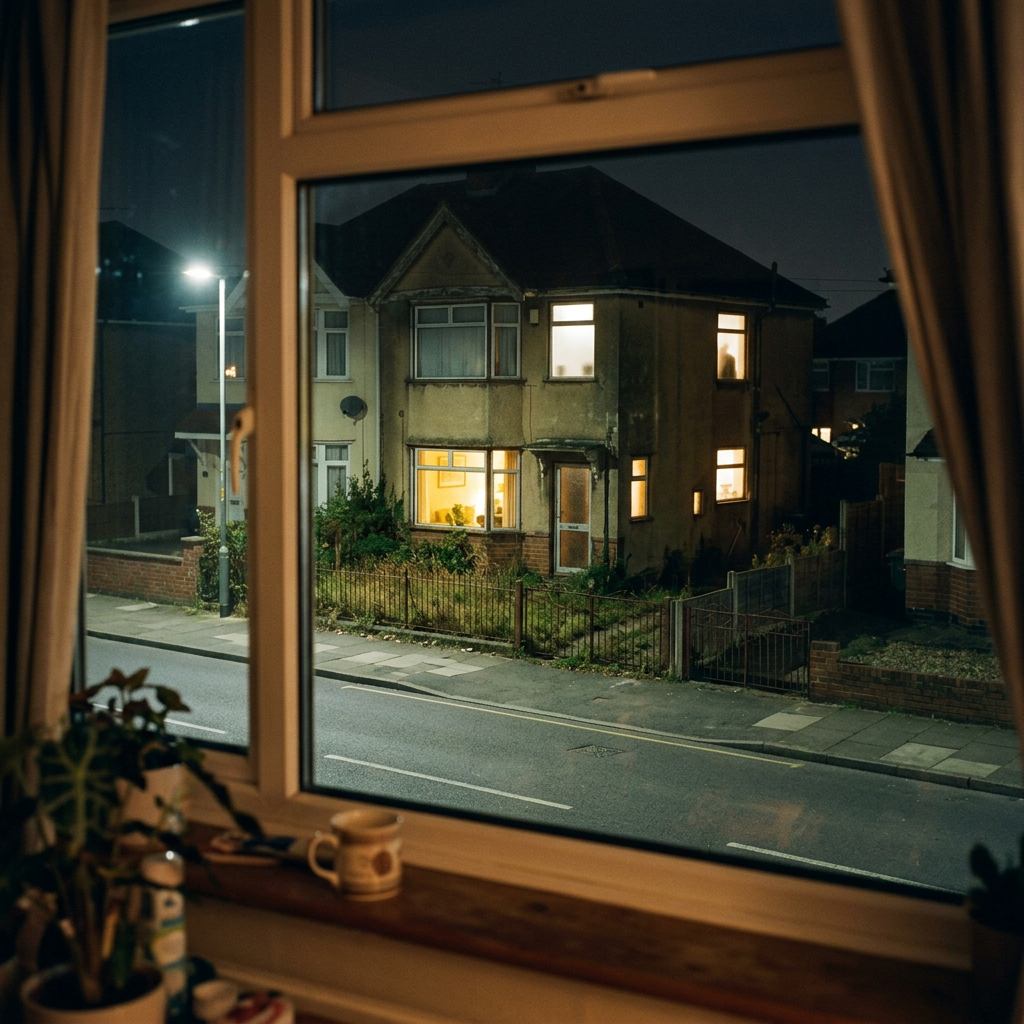
Three months ago, my partner and I moved into this house, on a quiet street of family homes at the edge of the city, where the real estate agent proudly told us nothing ever happens here, that the neighbors are quiet, the gardens tidy, and in the evenings all you hear is the crickets. At the time I believed him, and I was just glad we’d finally escaped the downtown rental where you could hear the neighbors arguing through the walls every night.
The house across from ours, a two-story, old-fashioned building with an unkempt garden and a rusted fence, somehow doesn’t look abandoned at all — because every single evening, the lights come on inside in exactly the same order. First the living room, then five minutes later the kitchen, then ten minutes after that the bathroom, finally the bedroom — always at the exact same minute, as if clockwork ran the whole house, not a person.
The street itself felt strangely out of time from the first days, even before I ever noticed the windows across from us. Twelve lots sat in a row, each aging differently: fresh hedges on one, peeling fence paint on another, a kid’s bicycle tipped against a gate further down, as if someone had set it there for just a second and never come back for it. Our house stood in the middle of the row, directly facing Mr. Bálint’s, and despite everything the agent had promised, what settled over me those first nights wasn’t quiet so much as a kind of held breath, as if the whole street were waiting on something I couldn’t yet name.
I worked from home, translating literary fiction for a handful of small publishers, which meant I was at the window often during the day too, mid-sentence on some stubborn paragraph, or pouring tea in the kitchen, which happened to look straight across at the side of Mr. Bálint’s house and the garden beyond it. My partner, on the other hand, left early for work and came home well after dark, so those first weeks were mostly mine alone — unpacking boxes, hanging curtains, learning to live inside a silence that sounded nothing like the one we’d left behind downtown.
By the second week I’d noticed that nothing in Mr. Bálint’s garden ever moved. It wasn’t only untended — the weeds in one bed had grown taller than a person — it was still in a way that suggested no one had walked through it in years. Two wicker chairs sat around a round table on the terrace, their varnish flaking, their cushions discolored by rain and sun, and on the arm of one chair sat a forgotten mug, its contents turned to a gray, silty paste by years of rain and dust. I watched that mug for months, and it never moved an inch, as if time itself had simply stopped on that terrace, while inside the house, at least by evening, someone kept living out their hours.
Those first weeks I didn’t think much of the windows at all. I assumed I was simply watching an old man’s rigid schedule, the kind of life someone arranges so thoroughly over decades that every motion becomes automatic, gears in a well-kept clock. One evening, standing at the window with my partner, watching the kitchen light flick on, my partner remarked, half-joking, that the lights seemed to run on a metronome. We laughed about it together, and I didn’t think any more of it that day — just a strange, passing comment I forgot before dinner was over.
There was one evening, maybe the third week, when I noticed something else, something I didn’t want to dwell on for a long time afterward. During the five-minute gap between the living room and kitchen, while one room’s light still burned and the other hadn’t come on yet, a shadow crossed in front of the living room window — except it didn’t move in one direction, the way you’d expect from someone alone, but seemed instead like two separate shapes drifting toward each other in the middle of the light, before the shadow vanished before I could be sure of what I’d seen. I told myself it was my eyes playing tricks, that it was just the glare off freshly washed glass, and for a while I managed to believe it.
At first I barely noticed. The first weeks were consumed by the move, arranging furniture, and I barely paid attention to the neighbors at all. Then one night, when sleep wouldn’t come, because my partner’s snoring and the unfamiliar sounds of the new apartment kept me awake, I sat down by the living room window with a cup of tea, and happened to watch the whole sequence start to finish. That’s when it first registered that the lights stayed on for the exact same length of time every evening, down to the minute.
I started tracking it deliberately after that. I wrote the times down in a notebook, like some kind of obsession, though even then I couldn’t quite explain to myself why it mattered so much. Living room: exactly eight p.m. Kitchen: 8:05. Bathroom: 8:15. Bedroom: 8:25. The living room light goes out at eleven at night, the bedroom’s exactly at midnight. For weeks, no matter when I checked — weekday, weekend, holiday, it made no difference — there wasn’t a single second’s deviation.
I asked the mail carrier, who biked down the street every morning, who lived in that house. He said an elderly man, a Mr. Bálint, who’d lived there at least thirty years, but who never had visitors and never took anything out of his mailbox — the carrier left the bills tucked on the door handle with a rubber band instead, because the box had been full for weeks and there was no point cramming anything else in. I asked if he’d ever seen the man up close. He said once, early on, when he still delivered straight to the box — a thin, gray-haired man had opened the door, said a quick hello, then shut it before he could ask anything.
I asked our other neighbor too, a middle-aged woman in the house to the left, who clearly enjoyed a bit of gossip when the chance arose. She told me Mr. Bálint had lived in that house decades ago with his wife and daughter, but sometime in the late nineties, his wife and daughter died in a car accident on their way home from an evening out. Ever since, Mr. Bálint has lived alone, and although people used to see him working in the garden, over the last ten or fifteen years almost no one has seen him leave the house at all.
“Sometimes I wonder if he needs anything from out here at all,” the neighbor said. “Like there’s a whole little world in there that doesn’t need ours.”
That line stuck with me so hard that a few days later I wandered into the little bar at the end of the street, The Old Walnut, where the neighbor said the old-timers still gathered most evenings, men who’d lived in this part of town their whole lives and might remember a version of Mr. Bálint who existed outside his windows. The place was nearly empty — just three old men at a table by the long bar, playing cards among beer glasses and an ashtray — and when I mentioned Mr. Bálint’s name, all three looked up at once, like I’d said something you weren’t supposed to say out loud.
One of them, a deeply lined but sharp-eyed man the others called Old Fekete, studied me a long moment before speaking. He told me Mr. Bálint had been a math teacher at the district school, strict but fair, the kind students feared and later thanked. His wife, Ilona, gave private violin lessons, and their daughter, Eszter, barely twelve when the accident happened, already played piano well enough that her parents planned to enroll her in a music school in the next town.
“Every Thursday you’d hear that piano through their window,” Old Fekete said, his voice softening for a moment. “Then one day you just didn’t hear it anymore, and for a while we told ourselves they’d gone off somewhere, because nobody wanted to believe a whole family’s life could just end, all in one evening.”
I asked what happened to Mr. Bálint after the hospital. Another man, quiet until then, said he’d seen him once, months later, still trying to make it to the shop alone. He barely spoke by then, and when he did, often muttered numbers to himself, like reciting a list no one else could follow. After that people saw him less, until they didn’t see him at all — he kept working the garden a while longer, then even that stopped.
Old Fekete added that neighborhood kids kept passing down a game for years afterward, something they called “counting the windows” — if you watched Mr. Bálint’s house long enough, through the whole stretch while the lights moved from room to room, you were supposed to be able to make out shapes forming in the glass, not shadows exactly, more like someone standing inside the light rather than in front of it. No one could say who’d invented the story, but generations of kids passed it along anyway, always with the same warning never to go near the place after dark.
“We figured it was just kid stuff,” Old Fekete said, and drained his beer like he meant to close the subject there. “But I still haven’t walked past there in the dark in forty years, myself.”
I asked if anyone still living nearby had actually known Eszter, not just heard about her secondhand. Old Fekete thought it over, then said her best friend, a woman named Judit, still lived two streets over, and that she’d remember everything, because the two girls had been inseparable as children — always sleeping over at each other’s houses, always walking to school together.
Judit lived in a small, tidy house full of family photographs, and when I explained why I’d come, her face hardened for a second, as if she’d been waiting years for someone to finally ask. She invited me in for tea, and while the kettle heated, told me she and Eszter had actually planned to see each other that very evening — Eszter was coming back from a music school audition with her parents, and they’d agreed Judit would come hear how it went if they got home in time.
“I waited by the phone all evening,” Judit said, the kettle going still in her hand for a moment. “Then it got so late I just went to bed, figured she was tired, or something was wrong with the line. My mother woke me the next morning with the news, and for days I couldn’t believe that while I was lying in my own bed waiting for a call, they were out there on that icy bridge, and I had no idea.”
I asked if she’d stayed in touch with Mr. Bálint afterward. She said she’d tried — in the first months she went over several times, brought him food, tried to talk to him, but he answered less and less each time, until one day he simply stopped opening the door at all, and Judit, however much it hurt, had to accept that grief had carried Eszter’s father somewhere she couldn’t follow him.
She also told me Eszter loved to draw, and a row of her sketches had hung on the wall beside her bed, which Judit had seen on visits — each one showing the same four rooms, living room, kitchen, bathroom, bedroom, like panels in a comic strip. Eszter had told her once, half-laughing, that this was the family’s “evening road,” walked together every night before bed, and that if she were ever not there, she hoped her parents would keep walking it, because familiar things hold a person together when everything else changes.
That detail sent a cold line down my spine when I heard it, because until then I’d assumed the routine was something grief had built out of nothing, a ritual born from Mr. Bálint’s pain — but if Eszter’s own words were true, then the routine had existed before the accident, had already been part of their life together, and Mr. Bálint hadn’t invented some new rite to honor the dead. He’d simply never stopped doing what they’d always done together, as if continuing it were the only proof left that nothing had truly ended.
Out of curiosity, I also went to the district library to find out more about the accident the neighbor had mentioned. In the local paper’s archive I found a short article from November 1998 that confirmed the story, but added a detail the neighbor either didn’t know or didn’t want to mention: Mr. Bálint himself had been in the car that night, in the back seat, and he was the sole survivor of the accident on the icy bridge.
Next to the article was a grainy black-and-white photograph, apparently submitted by a neighbor since the family had no photo of their own to offer the paper. It showed Mr. Bálint, far younger than I could now picture him, standing at some garden party with Eszter on his arm — she looked about six, laughing so hard at the camera that her whole face had crinkled with it. Ilona stood in the background holding a tray of pastries, half turned, as if she’d just been called over and hadn’t had time to compose herself for the picture, leaving only a natural, unguarded smile the photographer had caught by luck.
Underneath the photo was a short caption naming the neighbor who’d submitted it, and a date: 1996, Eszter’s sixth birthday. In the background of the photo I recognized our own street, and even the terrace where that flaking wicker chair still sits now with its forgotten mug — except back then the paint was fresh, the garden tended, full of flowers, and a long table stood on the terrace surrounded by children and parents, as if the whole street had turned out that afternoon.
I stared at that photo a long time, trying to find something in it that might have hinted at what would happen two years later, but of course there was nothing — just a happy family on a summer afternoon, no different from any other birthday photo on any other street, and that was exactly what made it so hard to sit with: that someone could start from such an ordinary kind of happiness and end up where Mr. Bálint is now, alone in a dark house where the lights come on down to the minute, every single night.
That detail shook me — I’d assumed until then that he’d simply lost them somewhere else, far away, through a phone call bringing the news, but I hadn’t known he’d been there when it happened, that he’d had to live through the moment itself, something no one could ever explain to him how to survive.
Near the bottom of the article was a name, a certain Gábor Rézműves, who’d been on the rescue crew that responded that night. The librarian helped me track down that he was retired now but still lived in the city, and one afternoon, out of nothing more than curiosity, I called a number I’d found in an old fire department newsletter.
He didn’t want to talk about it at first. He said thirty years on the job meant most accidents blurred together in his memory, but that one had stayed separate from the rest, because something about it had felt wrong from the moment they reached the bridge. He said the river under the ice was running unusually loud that night, loud enough that they could barely hear each other shout, and that when they finally pulled Mr. Bálint out of the back seat, the man didn’t cry, didn’t scream, didn’t ask a single question about his wife or his daughter — he just lay on the stretcher, muttering numbers, over and over, in a steady rhythm, like reciting a song.
“Eight, five, ten, twenty-five,” Gábor recalled, his voice going strangely quiet over the phone. “Again and again, same order, the whole way to the hospital. The doctors said it was probably some form of shock, that the mind grabs onto something simple and repeatable when reality’s too big to process all at once. I was young then, didn’t think much of it. But I never forgot those numbers, because it was so strange, hearing someone repeat them that precisely, like he was reading off a code only he understood.”
He said that years later he’d run into Mr. Bálint by chance at the market, and the man had said those same numbers to him instead of a greeting, before walking off, as if that were the only sentence he had left for a stranger. Something in his eyes, Gábor said, made it feel like he wasn’t quite looking back from where a living person should be.
When I hung up the phone, I sat at the kitchen table for a long time, staring at my own notebook: living room eight o’clock, kitchen eight-oh-five, bathroom eight-fifteen, bedroom eight-twenty-five. Eight, five, ten, twenty-five. The numbers didn’t line up exactly with my timings, but they were close enough that I couldn’t call it coincidence — as if the numbers mumbled on a hospital stretcher decades ago had become the rhythm of an entire house, as if Mr. Bálint were still repeating that same single sentence, only now not in words, but in light.
One Saturday morning I drove out to the bridge the article had named, about twenty-five miles from the city, on a narrow stretch of road where the river bends sharply beneath a wooded hillside. The bridge had since been reinforced, fitted with a new railing, and a small metal plaque had been mounted on it bearing no name, only a date and a line noting the bridge had been fully rebuilt in 2003 for safety, with better surfacing and new signage. Nothing suggested that a whole family had been lost here once, nothing a passerby would notice unless they already knew what to look for.
I stood at the middle of the bridge and looked down at the water, which that early in autumn wasn’t frozen yet, just dark and fast, rattling over stones below. I tried to picture that night in 1998 — the cold, the dark, the moment the car lost its grip on the ice — and what it must have been like for Mr. Bálint to wake in a hospital bed and gradually understand he was the only one left of everyone he loved. I couldn’t really picture it, no matter how hard I tried, and maybe that was part of what drew me to him so strongly — my own imagination wasn’t equal to it, and somehow I believed that if I watched those windows long enough, I might get closer to something I would never truly understand.
On the drive back I stopped at a roadside shop, and the woman at the register, recognizing my car from an earlier visit, asked why I’d been out that way. When I mentioned the bridge, she nodded like it was nothing unusual, and said locals still avoid that stretch after dark — not mainly because of the accident, but because several people over the years claimed that if you stopped there at night, you could hear a child laughing somewhere down by the water, where no one could possibly be, since both banks were choked with impassable brush.
I asked the neighbor if she knew this detail. She said she’d heard rumors, but no one had ever confirmed it, because Mr. Bálint never spoke about the accident himself. She added that the evening routine I’d been watching fell at exactly the time the accident happened — around eight, in November. Every year, on the anniversary, the lights in the house apparently stayed on all night, not in the usual order, but scrambled, as if someone were running from room to room in a panic.
That thought wouldn’t leave me alone for days. I started to wonder whether the nightly routine wasn’t simple habit at all, but some kind of reenactment of that last evening — the living room, where they may have sat together for the last time before dinner, the kitchen, the bathroom, the bedroom, as if each room were a stop on an evening he relives every single day, because it’s the only way he can still be with them.
My partner grew less and less patient about how much time I spent at that window. At first it was just teasing, a new hobby I’d apparently picked up, but as the weeks went on and my notebook filled up with timestamps, dates, notes from the bar and the retired firefighter’s words, the teasing gave way to something more serious. One evening, when dinner had gone cold for the second time because I was sitting at the window waiting for the bathroom light, my partner sat down across from me and said they were afraid this was turning into something that couldn’t be undone afterward.
“We don’t know this man,” they said. “Maybe there’s no mystery here at all, just a lonely old man who likes his routines, and the two of us are out here building ourselves some kind of entertainment out of a stranger’s suffering.”
I couldn’t really argue, and didn’t try very hard to, because there was truth in it, but it didn’t stop me from watching. The only thing that changed was that I got more careful about doing it while my partner was home, going over my notes instead during the day when I had the house to myself, as if I should be ashamed of what the watching had become.
Three weeks after that conversation at the bar, my partner left for a week for a work training abroad, and for the first time I really felt what that house was like alone at night, with no other sound in the apartment but my own footsteps, and across the street, right at eight, the living room light. The first two nights nothing unusual happened, just the sequence I already knew by heart, but on the third night, when the bathroom light should have come on at eight-fifteen, a fourth light flared for a few seconds instead — in the narrow upstairs window I’d always taken for an attic, which had never once lit up since I’d started watching the house.
The light lasted only a moment, a faint, yellowish glow that looked more like a candle or a flashlight than the sharp electric light of the other rooms, and by the time I looked back a second time, it had already gone out, as if it had never been there at all. I wrote down the time in my notebook, and the exact spot, and also how unsure I was whether I’d really seen it, or whether it was just my tired eyes and the loneliness of an empty house playing tricks on me.
When my partner came home, I told them about the attic window, and I could see on their face that they didn’t fully believe me, but I could also see they weren’t as eager to argue the point as before — as if they too sensed there was something here that couldn’t simply be chalked up to my curiosity running away with me, even if they didn’t want to say so out loud.
In the middle of autumn the old mail carrier retired, and a young woman took over the route, who at first knew nothing about Mr. Bálint beyond the fact that her predecessor had left her a specific instruction about his mailbox: never try to empty it, just keep leaving the bills on the door handle the way it had always been done. One morning, while I was out watering the garden, she stopped to talk, and mentioned that years earlier the district council had actually sent someone out to inspect every mailbox on the street after a storm, because some of the neighbors worried the overstuffed boxes might hurt the carriers.
During that inspection, it turned out that the bottom layer of mail in Mr. Bálint’s box had decomposed into a damp paper pulp from decades of moisture and dust, but the box never seemed to get any fuller than that — new letters arrived on top every week, but the bottom kept disappearing, without any sign the box had ever been opened from behind or below. The inspector’s report guessed at a crack somewhere in the bottom, but when the carrier told me this, I could hear in her voice that she didn’t quite believe that explanation herself.
“Something about it gives me goosebumps every time I leave a bill there,” she said, and laughed it off a little, as if trying to wave away her own words. “But that’s the job, isn’t it? Not my place to understand it. Just to deliver.”
I asked if she’d ever seen Mr. Bálint in person. She said once, early one morning, just as the sun was coming up, she’d caught movement through the slats of the blinds — a low, stooped shape, moving not toward the front door but deeper into the house, as if searching for something he hadn’t found yet, no matter how many decades he’d already spent looking.
One evening, after weeks of just watching from the window, I decided to walk over, just to knock and see if he needed help, if he was sick, if he was simply lonely and might welcome a little company. My partner tried to talk me out of it, saying that if someone doesn’t want to be disturbed, that should be respected, but something stronger than that logic was pulling at me — maybe my own loneliness since the move, maybe just that I couldn’t stand not knowing any longer.
The lights came on in the living room right as I reached the gate — exactly on schedule, eight p.m., as if my footsteps had triggered the whole sequence, or as if the house had known I was coming. I knocked on the door, twice, firmly. No answer came from outside, but I heard footsteps inside, moving in the exact same rhythm the lights had followed earlier — like someone following a choreography practiced for years, maybe decades, evenly, never missing a beat.
The footsteps stopped on the other side of the door, right behind it, close enough that I could sense someone standing there, maybe half a meter from me, nothing but the wooden door between us. It never opened. I stood there for maybe a minute, listening to the silence on the far side, and for a second I had the feeling I was being watched through the peephole too, even though I never saw any light shift across it, no shadow at all. I spoke up, gave my name, said we’d moved into the house across the street, that I just wanted to say hello, see if he needed anything. No response. The footsteps didn’t move deeper into the house, nor toward the door, just stood there, motionless, for what might have been minutes.
Eventually I went home, unable to decide whether I felt relieved, or disappointed, or some third thing, harder to name, that sat closer to fear than either.
The next night the lights came on again, same order, same minute, as if nothing had happened the evening before. The mailbox is still full. I haven’t knocked again, no matter how much the curiosity gnaws at me, because something tells me that whatever’s behind that door, if it were ever opened, isn’t something easy to unsee. But in the evenings, when the living room light switches on over there, right at eight, I still look out the window and wonder what someone who never stops, year after year, maybe decade after decade, down to the minute, could possibly be doing in there — and whether he’s really alone in there at all, or only believes he isn’t, following the same evening routine every night with someone who stopped being there to follow it with him a long time ago.
About a month after I’d knocked, I tried something else, this time without facing that silence behind the door directly. I wrote a short note explaining who we were, that we’d moved in across the street, and that if he ever needed anything — groceries, a doctor, even just conversation — we’d help, and included my number. I slid it through a gap at the base of the gate instead of the overstuffed mailbox, figuring he’d notice it there if he ever stepped into the garden at all.
The next morning the note was gone. No rain had fallen, no wind had blown, and the grass around the fence wasn’t disturbed the way it would be if an animal had taken it. It had simply vanished, which unsettled me more than if it had sat there untouched, because it meant someone had come out for it without my hearing a sound, without seeing a shadow move behind the windows that night.
No reply ever came. But from that day on I had a feeling that whatever I’d meant to say had somehow reached him anyway.
Around that same time I started looking into the house’s previous owners, curious whether anyone who’d lived in our place before us had watched Mr. Bálint too. The agent who’d sold us the house remembered a name — a middle-aged man, Ferenc Pálinkás, who’d lived here about fifteen years before suddenly selling, with no real explanation, and moving to another city.
I found his number in an old listing archive and called, hoping he might remember something. The moment I mentioned Mr. Bálint’s name, a long silence stretched out on the other end of the line, long enough that I thought the call had dropped.
“Why are you asking me this?” he finally said, and there was something in his voice that wasn’t quite suspicion, more like fear.
I explained that we’d moved into his old house, that I’d been watching the neighbor’s routine, and that I just wanted to understand if there was some explanation he might know. Ferenc didn’t answer for a long time, then said that once, years ago, he too had walked over and knocked, exactly like I had, and that something happened that evening he never wanted to describe in detail, because the less he thought about it, the easier he slept at night. All he’d admit was that the footsteps behind the door hadn’t stopped that evening when he knocked — they’d started moving toward him, all the way to the door, and that he’d heard a voice, very quiet, that might have said a name, but not his own.
“We sold the house two months later,” he said, and wouldn’t tell me anything more, no matter how I tried to lead him further. I thanked him for his time and hung up, but that night I lay awake a long while, turned toward the window, watching the dark house across the street, where no light burned at all, because it was already well past midnight.
In late October my old friend Nóra came to stay with us for a long weekend, since we’d been promising each other for months that she’d finally visit the new place. Nóra is a practical sort, works as a medical assistant, and generally has no patience for anything she can’t measure or verify, so when I started telling her about Mr. Bálint, she mostly just nodded along patiently, the way you’d listen to a coworker describe some odd hobby.
The first evening, though, as we sat on the terrace with a glass of wine right around eight, Nóra stopped mid-sentence and looked toward the house across the street, where the living room light had just come on. She didn’t say anything, just watched the minutes pass, and when the kitchen light flicked on exactly five minutes later, I saw her hand tighten around the stem of her glass a little more than before.
“That can’t be a coincidence,” she said finally, and there was nothing left of her earlier, good-natured doubt in her voice. “Who sets every light in a house that precisely? Does he have it on a timer?”
I explained that he didn’t, that I’d checked as best I could from outside, that I couldn’t see any sensor or control box anywhere near the windows, and that the lights always flared on with a faint little flicker that suggested an ordinary switch, not some programmed system. That only quieted Nóra further, and that night, as we were getting ready for bed, she asked if it was safe to live here, and I didn’t really know how to answer, because the question itself had never occurred to me in such a plain form — only the curiosity that kept pulling me in deeper and deeper.
The next evening, since it was around Halloween and neighborhood kids were going door to door, a small group of teenagers stopped at our gate too, but instead of ringing the bell, they stood staring across the street, whispering. Nóra and I watched from the window and heard a tall, thin boy dare the others to try “counting the windows,” the game Old Fekete had told me about — watch the whole sequence through without looking away, because anyone who sat through all four light changes was supposed to see something in the glass.
Most of the group hung back laughing, but one girl, maybe fourteen, walked up to the fence and watched anyway. At eight the living room light came on; she didn’t move. Five minutes later, the kitchen; she stayed put. When the bathroom light came on ten minutes after that, she stumbled backward so fast she nearly fell, and when her friends ran over, we heard her crying that she’d seen something in the upstairs window wave at her, right before the bathroom light went dark.
The group never came back to our street that night. Nóra went quiet for a long while, then said maybe she shouldn’t stay the full week after all — she felt like this house, however much we loved it, pulled something out of a person who looked at it too long. She left two days later and never brought up Mr. Bálint again, as if we’d silently agreed it was better left alone from a distance.
The week Nóra left, I started dreaming about the house almost every night. The dream was always the same: I stood inside the living room, among furniture I’d never actually seen, only imagined — a worn sofa, a floor lamp casting a yellowish glow, a table with an unfinished drawing on it, four rooms sketched out exactly the way Judit had described. I knew I had to wait for a signal, and when a clock I never saw yet somehow heard ticking reached some certain point, I had to move to the kitchen, then the bathroom, then the bedroom, always the same order, feeling with every step more certain I wasn’t alone — that someone moved exactly one step ahead of me, behind a door or a wall, never close enough to see, close enough to hear.
Once, reaching the bedroom door, I stopped, because from inside I heard a child’s voice repeating a name that wasn’t mine, wasn’t Mr. Bálint’s, a name I could never recall after waking no matter how hard I tried — only that it sounded fond, not threatening, like a child calling another to come play. I always woke before I could open that door, heart pounding as if I’d really been running.
I told my partner about the dreams, and they suggested I rest from the watching a while, that my mind was spending too much energy filling gaps reality refused to give me. I tried, drawing the curtains early for a week, forcing myself toward a book, a film, anything else. But the dreams didn’t stop, and eventually I went back to the window anyway, telling myself that at least awake I could stay in control of something the dreams denied me — when in truth I controlled nothing, had never controlled anything, only watched something repeat itself, entirely indifferent to whether I sat there or not.
On the anniversary of the accident, in November, I tested whether what the neighbor said was true. That evening I sat by the window and waited. At eight, right on schedule, the living room light came on, as always. But five minutes later, when the kitchen should have followed, the upstairs bedroom light flared instead, then went dark, then the bathroom’s, then the living room’s again, completely scrambled, in rapid succession, as if someone were running from room to room in a panic, searching for someone, or fleeing from something.
This went on for maybe ten minutes, then every light went out at once, and the house dropped into total darkness — for the first time since I’d been watching, the bedroom light never came on, not at midnight, not after. The whole house stayed dark all night, and I sat by the window until dawn, unable to move, watching for anything else to happen.
The next evening everything returned to its usual order — living room, kitchen, bathroom, bedroom, at exactly the same minute as always. As if the night before had never happened. I never dared ask anyone if they’d seen it too, because I was afraid the answer would confirm the thing I feared most — that the house isn’t home to someone simply following a dead routine every night, but that once a year, on a single night, he lives through again, in full, the thing that took everything he ever loved.
For the year that followed, I tried to settle back into something like a normal rhythm. My partner suggested we plant a thick hedge along the street side of our garden, hoping it might draw my attention away, and I agreed, partly to prove to myself I could. It grew waist-high within three months and blocked part of the living room view, but from our bedroom upstairs you could still see every window of Mr. Bálint’s house clearly, and I never once managed to pass that window without glancing over.
Work once took me away for two weeks to a translators’ conference, and when I came home, my partner acted strangely whenever I asked about the house across the street. They just said nothing had changed, that the lights still came on every evening the same as always, but their eyes slid away from mine when they said it, and days later, over dinner, on the second glass of wine, they admitted that one evening, alone in the living room, thinking of nothing in particular, they’d glanced up through the window, and exactly as the bathroom light went dark and the bedroom’s should have followed, they’d seen a face in the bedroom window — very briefly, maybe a second — before the light came on behind it and the face vanished into the glow, as if the light itself had swallowed it.
My partner hadn’t wanted to tell me sooner, afraid that saying it out loud would somehow make it more real, and that I’d sink even further into the thing they’d been trying to pull me out of. I asked if they were sure of what they’d seen, and they admitted they weren’t — it could have been their own reflection in the glass, or a branch moved by the wind at just the wrong moment — but I could hear in their voice that they didn’t quite believe that explanation either, any more than the new carrier had believed hers about the mailbox.
From that evening on, my partner stopped arguing whenever I sat at the window, and sometimes, rarely, joined me there, though we never talked much in those minutes — just watched together as the living room came on, then the kitchen, then the bathroom, then the bedroom, as if standing some shared watch over something we couldn’t name and weren’t sure we should even try to.
On the second anniversary, a year after I’d first watched the night the lights fell into chaos, I decided to be at the window again, this time with my partner beside me. We started watching earlier, by half past seven, not wanting to risk missing anything. At eight, exactly as always, the living room light came on. We waited, holding our breath, for whatever would come five minutes later.
This time it wasn’t the usual sequence, and it wasn’t last year’s chaos either. The kitchen light came on right on schedule, the bathroom’s too, exactly as always, but when the bedroom should have followed, at eight twenty-five, instead that narrow upstairs window lit up — the one I’d once taken for an attic, the one my partner swore they’d seen a face in. This light didn’t go out after ten minutes, didn’t flicker, didn’t fall into chaos — it simply burned, steady, and after a while every other room’s light came on at once too, all four together, and stayed that way the whole night, while the two of us sat at the window until dawn, unable to move, not speaking, just watching a house that for the first time since we’d lived there looked, somehow, truly lived in — all four lights together, as if an entire family were awake over there, just for one night.
Toward dawn, as the sky began to gray, a shape appeared for a moment in that narrow upstairs window — not Mr. Bálint’s stooped silhouette, the one the carrier had described, but something slighter, shorter, moving with the height and posture of a child, standing there only as long as it takes to count to ten before the light, and the shape with it, went out together, and the house dropped back into its usual darkness, as if nothing had happened at all.
A few days later, still hunting for some rational explanation, I called the power company, hoping at least to confirm the household was still actively drawing electricity. The representative, after a long search through the system, said only that privacy rules kept her from sharing details, but that the bill came in on time every month without a single lapse as far back as their records went — which, oddly, stretched all the way back to 1998, the very month of the accident. She added that the payment ran through an automatic transfer set up decades ago, the kind of arrangement that sometimes just never gets canceled, even once the life behind it has changed entirely. That answer didn’t reassure me; if anything, it left me with the feeling that even if Mr. Bálint had, in some form, stopped existing the way we understand existing, the house around him — its bills, its routine — would simply keep going, as if habit alone were enough to keep something alive.
We never talked about what we saw, not that night, not the next day, not since. All I know is that from that dawn on, every evening when the living room light comes on across the street, right at eight, we both glance toward the window, just for a moment, before going back to whatever we were doing, and neither of us ever asks the other whether they’re hoping, or dreading more, to see that shape in the narrow window again.
Sometimes, when work keeps me up late and the house has gone quiet, I stand at the bedroom window and look at the dark roofline across the way, the chimney that never smokes, the gutter that’s held the same dead leaves for years. I think of Judit, still two streets over, who always asks, whenever we meet at the shop, whether I’m “still watching that house,” half question, half warning. I think of Nóra too, who rarely asks about the neighbor now, and changes the subject quickly when she does.
The mailbox is still exactly as full as it was three years ago, and the wicker chair on the terrace still sits in the same spot, its forgotten mug worn further by the rain but never quite dissolved. There’s a strange comfort in knowing that at least this doesn’t change, even though everything else I’ve learned has only left me understanding less about what happens in there every evening at eight, when the living room light comes on and a whole finished life starts over from the beginning.
Every so often it occurs to me that we should sell the house, move somewhere with no window to count every night. But whenever we talk about it, we end up in the same place: wherever we went, we’d carry the habit with us, and it’s probably too late to unlearn it now. So we stay, and in the evenings, when the light comes on over there, we still find ourselves at the window for a moment, together or separately, because somehow it’s become our own evening road too, without either of us ever saying when it started.





Leave a Reply